
Skill Development Toys for Kids: Simple Toys That Make Play More Useful
Children learn many things while they play.
They learn how things fit together. They learn to hold and move objects. They learn colours, shapes, numbers, and words. They also learn to try again when something does not work the first time.
This is why many parents look for skill development toys for kids.
A good toy does not need to be expensive or complicated. A simple puzzle, building set, peg board, matching game, or tracing board can give a child something to do, think about, and practise.
The main thing is to choose a toy that suits the child's age and interests.
What Are Skill Development Toys?
Skill development toys are toys that give children a chance to practise different skills while playing.
For example:
-
A puzzle gives children a chance to match pieces.
-
Building toys let children make and arrange things.
-
Sorting toys let children group objects.
-
Tracing boards let children practise lines, shapes, letters, or numbers.
-
Flash cards can help children learn and talk about new words and pictures.
-
Memory games give children a chance to remember and find matching items.
The toy does not have to feel like school.
In fact, children often enjoy learning more when they can touch, move, try, and play instead of only sitting and listening.
Why Are Skill Development Toys Useful?
Young children learn by doing things.
When a child picks up a puzzle piece and tries to find where it belongs, they are looking closely and making a choice.
When a child builds a tower, they are deciding where to place each piece.
When a child sorts objects by colour, they are comparing the objects.
These simple activities give children opportunities to practise different skills.
However, every child is different. A toy can give a child an opportunity to practise a skill, but it does not guarantee a particular result.
The most important thing is that the child enjoys playing and gets enough time to explore.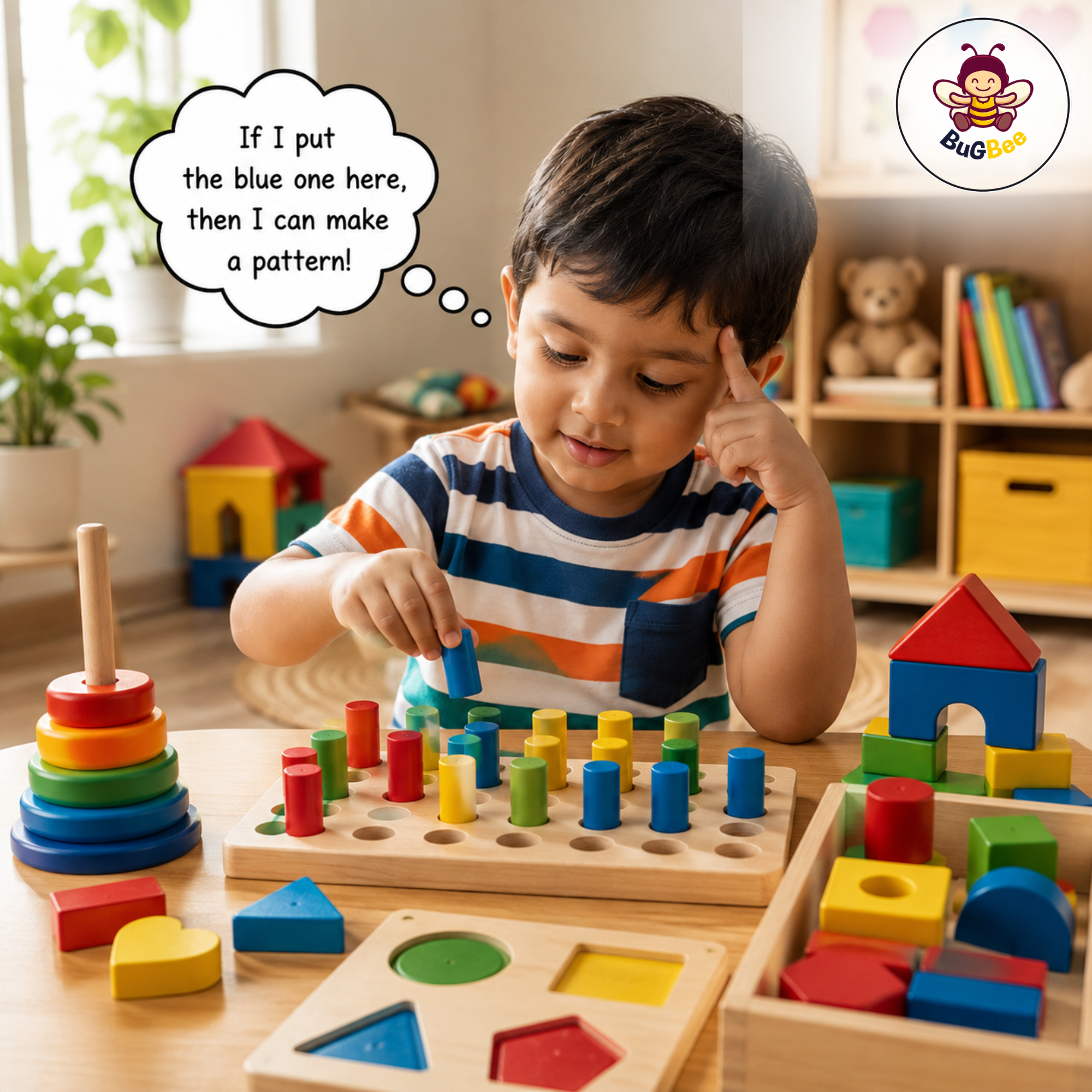
Different Skills Children Can Practise With Toys
There are many types of skill development toys. Choosing the right one depends on what your child enjoys and what is suitable for their age.
1. Fine Motor Skills
Fine motor skills involve the small movements children make with their hands and fingers.
Toys such as:
-
Peg boards
-
Threading toys
-
Stacking toys
-
Simple puzzles
-
Building blocks
-
Activity boards
can give children opportunities to pick up, place, move, and arrange objects.
These activities can be especially interesting for younger children because they can see what happens when they move each piece.
2. Thinking and Problem-Solving
Some toys ask children to work out what to do next.
Puzzles are a simple example.
The child looks at the pieces and tries to find where each one belongs.
Other options include:
-
Matching games
-
Shape sorters
-
Pattern games
-
Simple brain games
-
Construction toys
-
Maze activities
The activity should be suitable for the child's age. If it is too hard, the child may lose interest.
3. Language and Vocabulary
Children learn new words through everyday conversations.
Toys can help parents start these conversations.
Picture flash cards, animal puzzles, fruit puzzles, books, and pretend-play toys can give parents things to talk about with their children.
For example, while playing with an animal puzzle, you can ask:
"What animal is this?"
"What sound does it make?"
"Where does it live?"
"What colour is it?"
There is no need to ask all the questions at once. Keep it simple and let the child answer in their own way.
4. Hand-Eye Coordination
Hand-eye coordination means using what the eyes see to guide the hands.
Many simple toys involve this.
A child placing a peg into a board, putting a puzzle piece into the right place, or stacking blocks is using their eyes and hands together.
Parents can choose toys that allow children to repeat these actions without making the activity too difficult.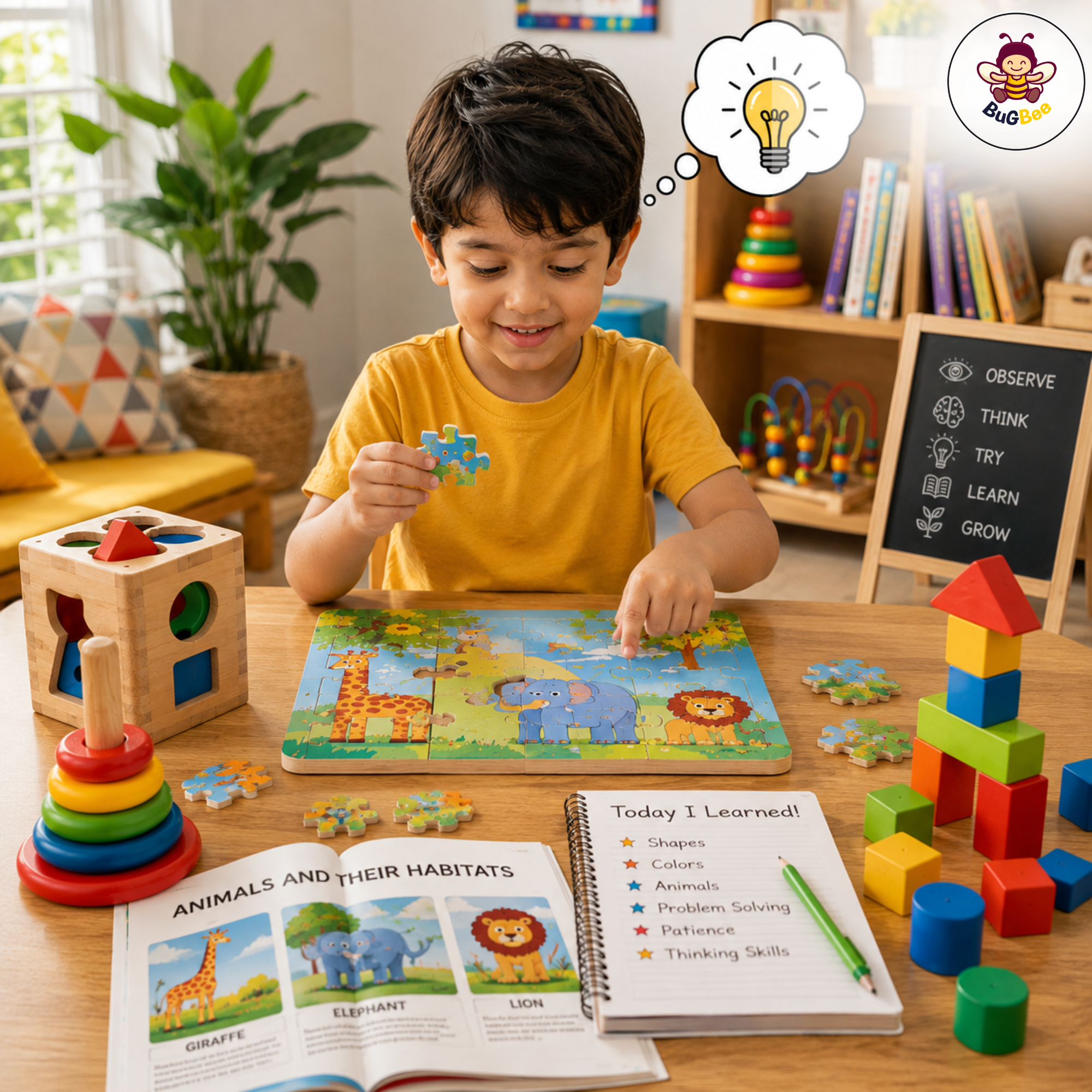
5. Memory
Memory games can be a fun choice for older toddlers and preschool children.
A simple matching game can ask children to remember where a picture or object is.
Start with a small number of cards. As the child becomes comfortable with the game, you can add more.
The aim is to have fun, not to see how quickly the child can finish.
6. Creativity
Not every toy needs to have one correct answer.
Building blocks, drawing materials, pretend-play toys, and open-ended activity sets can give children space to make their own things.
One child may build a house.
Another may build a car.
Someone else may simply stack the pieces.
There is no need to correct every little thing a child makes.
Letting them decide what to create is part of play.
Skill Development Toys for Babies
Babies need toys that are simple and safe for their age.
They may enjoy toys that allow them to look, touch, hold, move, and explore.
Parents can consider:
-
Soft toys
-
Easy-to-hold toys
-
Simple activity toys
-
Safe sensory toys
-
Age-suitable stacking toys
Always check the recommended age and safety instructions before giving a toy to a baby.
Toys with small parts should not be given to children who are too young to use them safely.
Skill Development Toys for Toddlers
Toddlers are usually curious about everything around them.
They like putting things in, taking them out, stacking them, matching them, and doing the same activity many times.
Some good choices for this age can include:
-
Large-piece puzzles
-
Peg boards
-
Stacking toys
-
Shape matching toys
-
Sorting activities
-
Simple building toys
-
Activity boards
Do not worry if your child plays with the same toy again and again.
Children often enjoy repeating activities because they are still learning how the toy works.
Skill Development Toys for 3–4-Year-Old Kids
Children around three to four years can start trying activities that involve more steps.
Parents can look at:
-
Wooden puzzles
-
Flash cards
-
Tracing boards
-
Counting toys
-
Alphabet activities
-
Matching games
-
Memory games
-
Building toys
At this age, you can also make simple games from toys that your child already has.
For example, give your child a few coloured blocks and ask them to put all the red blocks together.
Then ask them to count them.
A simple toy can become two different activities.
Skill Development Toys for 4–6-Year-Old Kids
Children between four and six can enjoy toys that ask them to think, remember, build, match, and solve.
Some options include:
-
More challenging puzzles
-
Building sets
-
Brain games
-
Number games
-
Alphabet games
-
Tracing activities
-
Memory games
-
Maps
-
Creative activity sets
At this age, it is also useful to let children choose what they want to play with.
If a child loves puzzles, give them different puzzles.
If they enjoy building, give them building toys.
If they like drawing and making things, choose creative activities.
A toy is more likely to be used when it matches the child's interest.
Wooden Toys for Skill Development
Wooden toys are a common choice for parents who want simple, hands-on toys.
Wooden puzzles and peg boards, for example, allow children to pick up pieces and place them in different positions.
Many wooden toys do not need batteries or a screen. The child has to interact with the toy to make something happen.
But parents should not choose a toy only because it is made of wood.
Age, size, design, safety, and how the child will use the toy are also important.
Montessori Toys and Skill Development
Many parents also look for Montessori-style toys for young children.
These toys often involve simple hands-on activities such as sorting, matching, stacking, placing, and tracing.
The activity should still be right for the child's age.
A toy should not be bought simply because the word "Montessori" is written on the box.
Think about what the child can actually do with it.
Can they pick it up?
Can they understand the activity?
Can they try it without too much help?
Will they enjoy doing it again?
These questions are more useful when choosing a toy.
How to Choose the Right Skill Development Toy
Buying a toy becomes easier when you know what to look for.
Choose by age
Always check the age recommendation.
A toy made for an older child may be too difficult for a toddler.
A very simple toy may not hold the interest of an older child.
Think about the child's interests
Does your child like animals?
Do they enjoy vehicles?
Do they like numbers?
Do they like drawing?
Do they enjoy building?
Their interests can help you choose something they will actually use.
Choose something the child can do
A toy should give the child something to try.
Look for toys that involve:
-
Matching
-
Building
-
Sorting
-
Counting
-
Drawing
-
Moving
-
Finding
-
Solving
-
Creating
Do not buy too many toys
Children do not need a large number of toys to learn.
A few toys with different types of activities can be enough.
For example, you could have:
-
One puzzle
-
One building toy
-
One matching game
-
One creative activity
-
One toy for counting or sorting
You can also rotate toys instead of keeping everything out at the same time.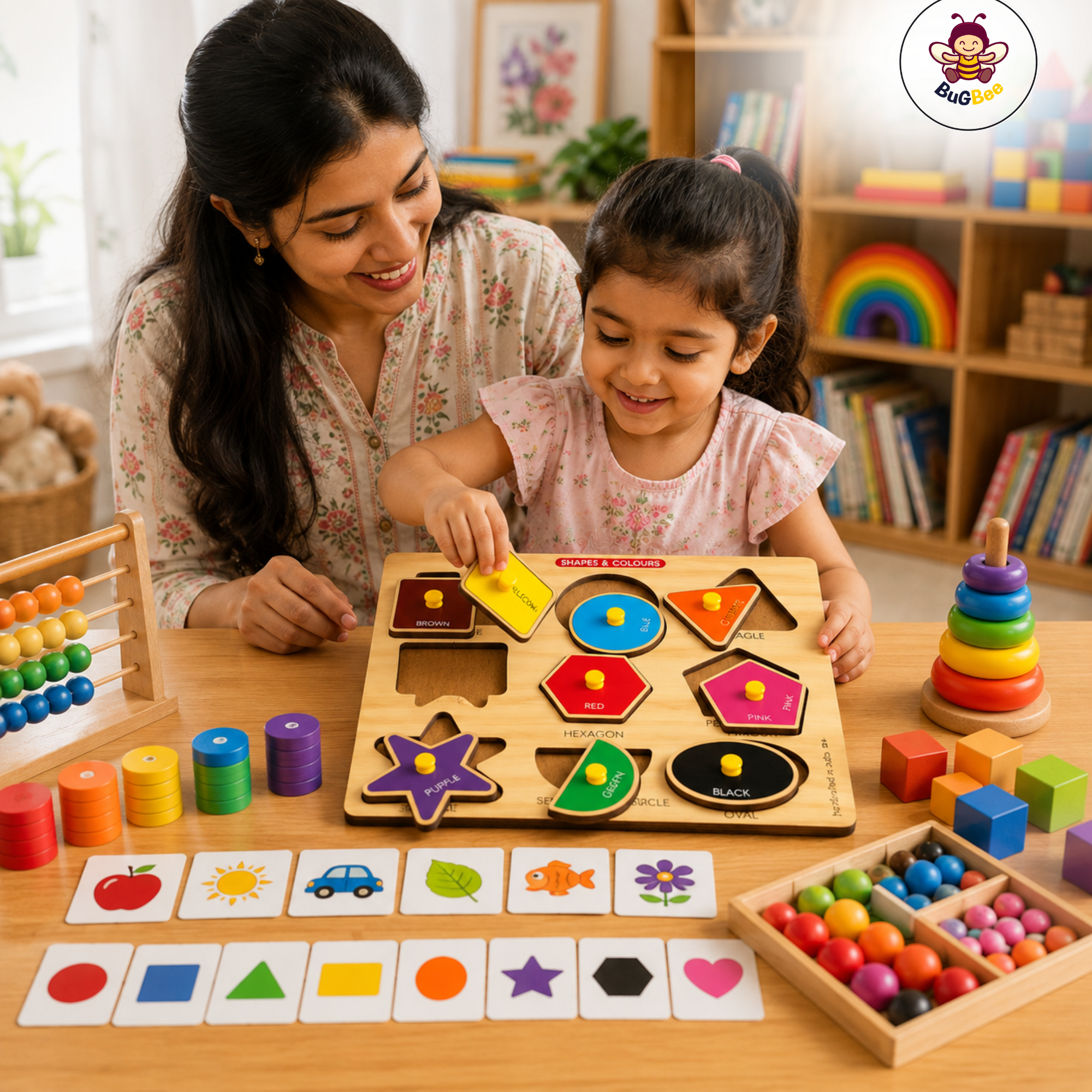
Parents Can Be Part of the Play
A toy does not have to keep a child busy while the parent does something else.
Sometimes playing together makes the activity more fun.
Sit with your child.
Ask questions.
Let them show you what they are doing.
If they are solving a puzzle, ask them which piece they want to try next.
If they are building a tower, ask how many blocks they used.
If they are using flash cards, talk about the pictures.
You do not need to turn playtime into a lesson.
Just talk, play, and let the child explore.
Where to Find Skill Development Toys in Bangalore?
Parents looking for skill development toys in Bangalore have many choices, but visiting a physical toy store can make the buying process easier.
You can see the toy before buying it and check the size, pieces, and type of activity.
At BuGBee Toys, parents can explore different educational and activity-based toys for babies, toddlers, preschoolers, and young children.
The store offers categories such as:
-
Wooden puzzles
-
Montessori toys
-
Flash cards
-
Tracing boards
-
Peg boards
-
Baby toys
-
Activity toys
-
Brain games
-
Maps
-
Educational games
This makes it easier to look at different types of toys in one place and choose according to your child's age and interests.
Visit BuGBee Toys in Bangalore
If you are looking for skill development toys for kids in Bangalore, you can visit BuGBee Toys at:
Door No. 39/9, Partition 3
4th Main Road, Cholurupalya
Magadi Road
Bengaluru, Karnataka – 560023
Visiting the store can be helpful if you are not sure which type of toy to choose.
You can look at different puzzles, activity toys, tracing boards, flash cards, and other learning toys and choose something that suits your child's age.
You can also explore the BuGBee Toys collection online before visiting the store.
A Toy Does Not Have to Be Fancy
Parents often see toys with many lights, sounds, buttons, and features.
But a simple toy can also keep a child interested.
A wooden puzzle can give a child something to solve.
Blocks can become a house.
A peg board can become a colour game.
Flash cards can become a guessing game.
A tracing board can become a short drawing activity.
What matters is what the child can do with the toy.
Final Thoughts
Skill development toys can make everyday play more interesting.
They give children opportunities to build, match, sort, count, trace, remember, and solve simple problems.
But there is no single toy that is right for every child.
Start with the child's age and interests. Choose something they can use without too much difficulty. Give them time to try it on their own, and join them when they want you to.
If you are in Bangalore and looking for skill development toys for kids, visit BuGBee Toys at 205/A, 55th Cross Rd, opposite to ABC Park, 4th Block, Rajajinagar, Bengaluru, Karnataka 560010 and explore the different options available.
A simple toy can be enough to start a good play session.
Let children play, try, make mistakes, and try again.