


TOY COMPARISON · SHAPE SORTERS & PUZZLES
Shape Sorter vs Puzzle: Which Should You Buy First for Your Toddler?
Standing in a toy aisle, or scrolling through a toy website late at night, it is easy to feel stuck between a shape sorter and a puzzle. Both are labelled "educational." Both promise to build fine motor skills. Both cost roughly the same, and both come in similar-looking wooden boxes with bright shapes on the front. But the two toys are not interchangeable, and buying the wrong one first often means a toy that gets used twice, sits in a cupboard, and leaves you wondering whether your child simply "isn't interested" in learning toys.
This guide compares the two directly — by age, by the exact skill each one builds, by how much frustration each one creates, and by what happens after the first week of play — so you can make a decision based on your child's current stage rather than the packaging.
The short answer
For most toddlers between 12 and 18 months, a shape sorter is the better first purchase. It teaches shape recognition and hand control without needing one single "correct" fit, so a young toddler can succeed through trial and error across several holes rather than facing one narrow target. A puzzle is usually a better second step, introduced once your child can already match a shape to an opening and has the patience to try a piece more than once without giving up.
If your child is closer to 2 years old and already knows basic shapes — from books, blocks, or everyday conversation — you can often skip the sorter stage and start directly with a simple 2 to 4 piece knob puzzle. Neither toy is "better" in general terms. They are better suited to different points along the same developmental path, and the right choice depends on where your specific child is right now, not on the age printed on the box.
What each toy actually teaches
Shape sorter
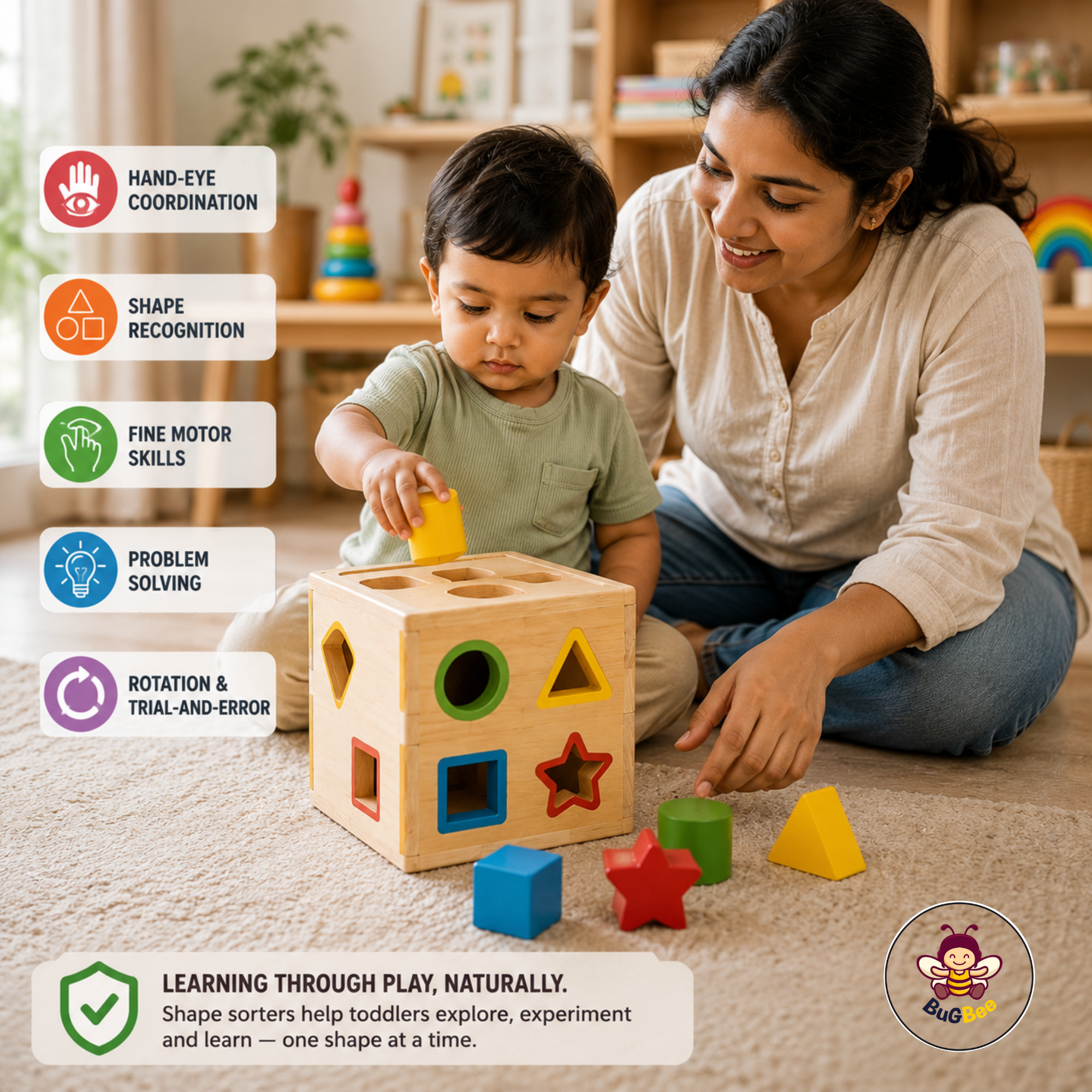
A shape sorter asks a child to recognise a shape, turn it in the air until it lines up correctly, and post it through a matching opening. Because most sorters have several holes and only one of them has to be found for each shape, a child can keep trying different holes without a single "wrong" answer bringing the game to a stop. This built-in forgiveness is exactly what makes it a good first toy: a 13-month-old does not yet have the patience or the fine motor precision for a task with only one acceptable outcome, but they can happily spend ten minutes rotating a star shape until it drops through the right gap.
Puzzle
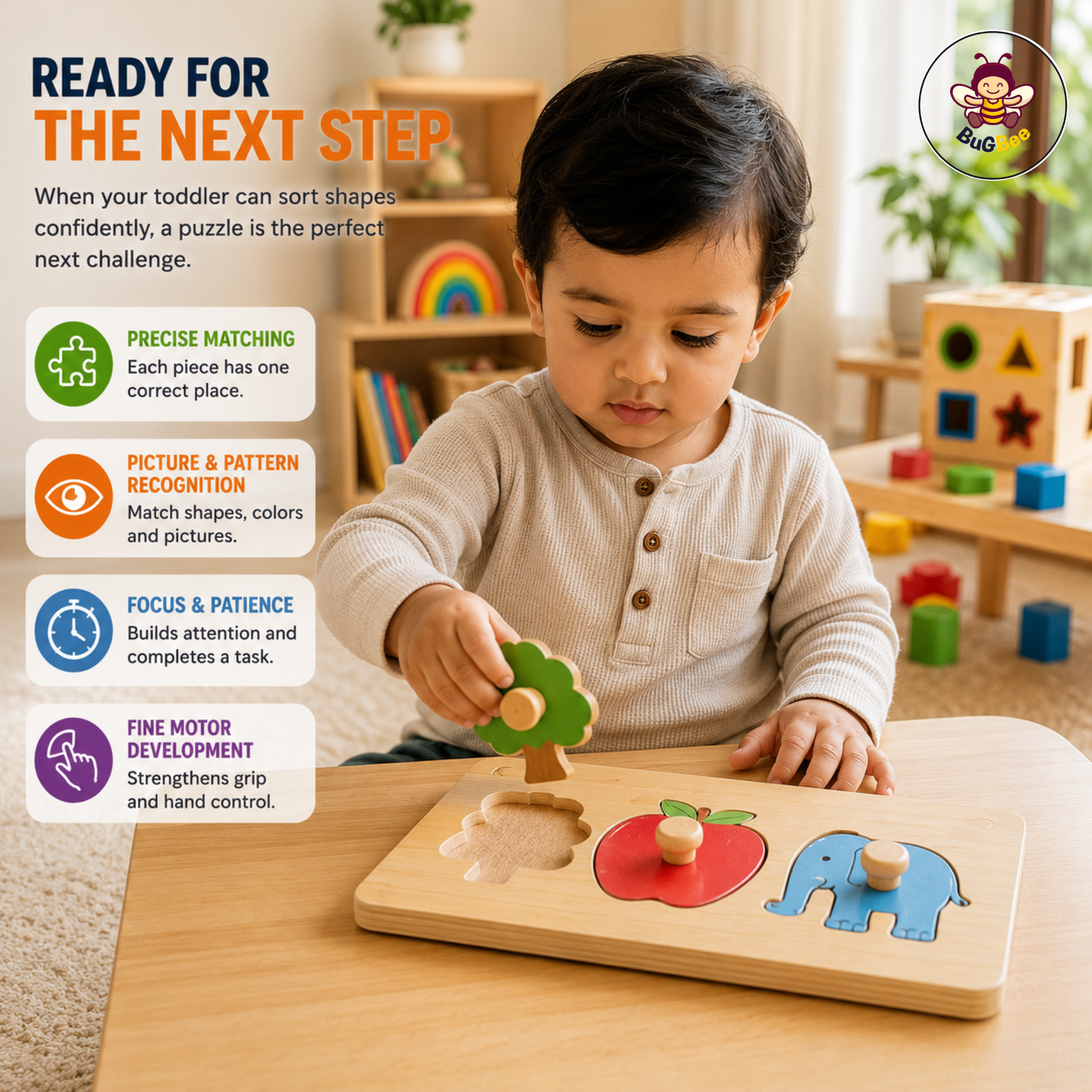
A puzzle, even a very simple two or three piece wooden knob puzzle, asks for something more exact. Each piece has exactly one correct spot, and the picture, colour or outline on the piece has to be matched to the cut-out shape underneath. This needs more precise hand control, a longer attention span, and the ability to compare two images and decide whether they match — a cognitive step that is genuinely harder than "does this shape fit through any of these five holes." There is no "close enough" with a puzzle piece, which is exactly why it tends to come after the shape sorter stage rather than before it.
Types of shape sorters, and why the type matters
Not all shape sorters ask the same thing of a child, and choosing the wrong type for your child's stage causes many of the "my toddler isn't interested" moments parents describe.
- Single-shape drop boxes — usually a ball or a simple round peg dropped through one hole. The easiest starting point, good for children under 14 months who are still learning cause and effect.
- Small multi-shape sorters (3 to 5 shapes) — the most common "first proper" sorter, typically suited to 14 to 20 months.
- Large multi-shape sorters (8 to 12 shapes) — better for a child who already sorts confidently, roughly 20 months and older, since more shapes means more searching and comparing.
- Geometric or nesting sorters — combine sorting with stacking, and work well as a slightly more advanced option once basic shapes are mastered.
Types of puzzles, and where each one fits
- Knob or peg puzzles — each piece has a small handle, which removes the need for a pincer grip to lift the piece out. This is almost always the right starting type, typically from 18 months.
- Frame puzzles — flat pieces without knobs, sitting inside a fixed frame. These need a slightly steadier pincer grip and are usually introduced from around 2 to 2.5 years.
- Floor puzzles — large, chunky interlocking pieces, good for a child who enjoys whole-body play and wants to build something bigger than a tabletop toy, typically from 2.5 years.
- Small jigsaw puzzles (6 to 12+ pieces) — the true next step after knob and frame puzzles, generally from 3 years onward, once a child can hold an image in mind while searching for a piece.
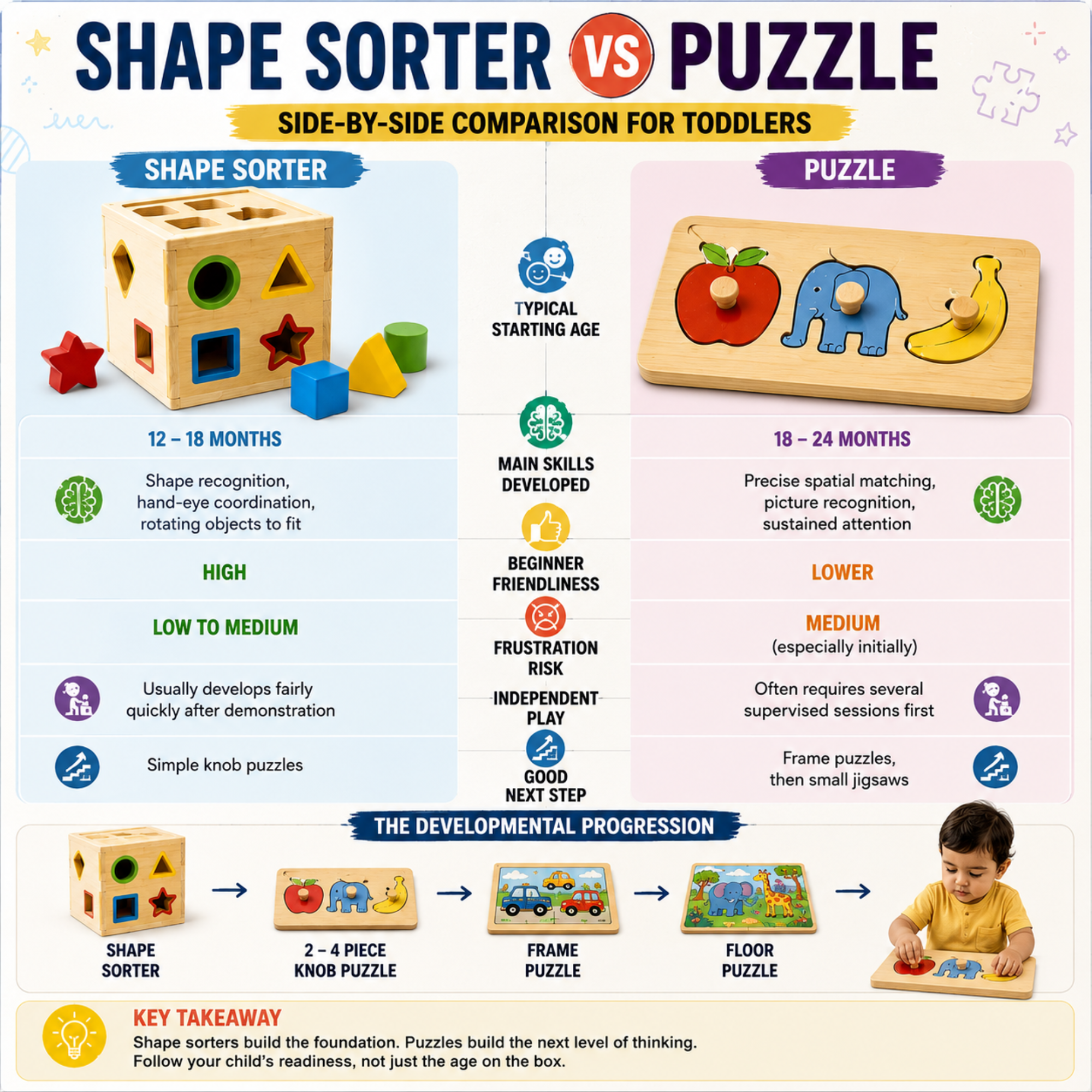
Shape sorter vs puzzle: side-by-side comparison
| Feature | Shape sorter | Puzzle |
|---|---|---|
| Typical starting age | 12–18 months | 18–24 months for first knob puzzles |
| Main skill practised | Shape recognition, hand-eye coordination, rotating an object to fit | Precise spatial matching, picture recognition, sustained attention |
| How forgiving for beginners | High — several holes, so trial and error works | Lower — one exact spot per piece |
| Typical frustration risk | Low to medium | Medium, especially in the first few sessions |
| Independent play after one demo | Usually yes, fairly quickly | Often needs a few supervised sessions first |
| Good next step from | Ring stackers, simple posting boxes | Shape sorters, large-piece stacking toys |
| Good next step to | Simple knob puzzles | Frame puzzles, then small jigsaws |
Age guide: when to introduce each toy
| Age | What to offer |
|---|---|
| 12–15 months | A shape sorter with 1–3 large, simple shapes such as a ball or a cube. |
| 15–20 months | A shape sorter with 4–6 shapes, or a first 2-piece knob puzzle if the sorter is already easy for your child. |
| 18–24 months | 2–4 piece knob puzzles with large, chunky pieces. |
| 2–3 years | 4–8 piece knob or frame puzzles; larger multi-shape sorters if still enjoyed. |
| 3–4 years | 6–12 piece jigsaw or floor puzzles with smaller, more detailed pieces. |
These are general starting points based on typical toy design, not fixed rules for every child. A child who has never tried either toy before may need to start a stage earlier than the age suggests, and that is completely normal.
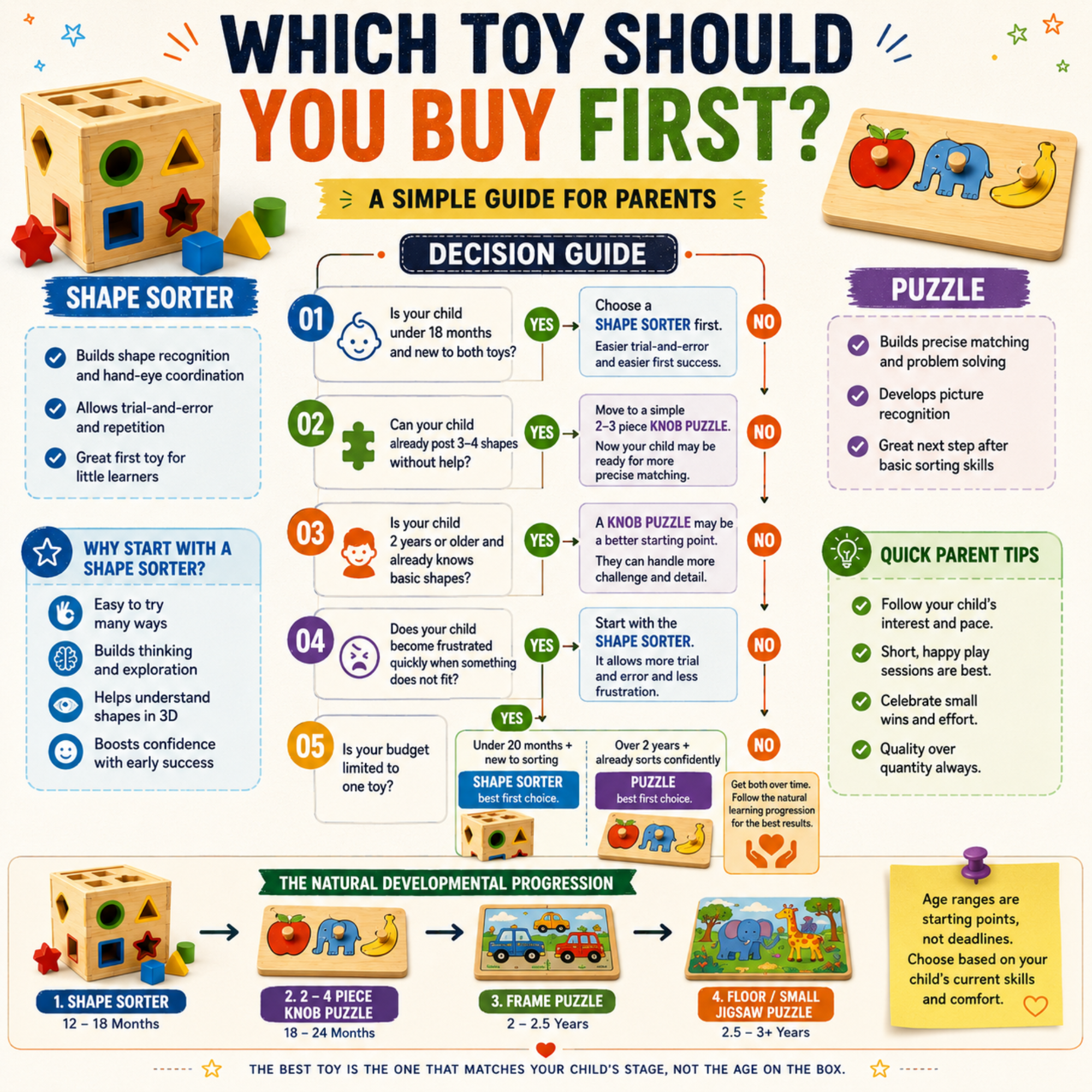
Decision guide: which one should you buy first?
- Is your child under 18 months and has never used a shape sorter or puzzle before? Start with a shape sorter. It gives an easier first success and builds confidence before precision is needed.
- Can your child already post 3–4 shapes into a sorter without help? Move on to a simple 2–3 piece knob puzzle.
- Is your child 2 years or older and already names basic shapes? You can start directly with a knob puzzle; a sorter may feel too easy and lose interest fast.
- Does your child get upset quickly when something does not fit? Choose the shape sorter first, since it leaves more room for trial and error without a hard stop.
- Do you only have budget for one toy right now? For a first-time toddler under 20 months, choose the shape sorter. For a toddler over 2 who already sorts shapes confidently, choose the puzzle.
What to look for when buying a shape sorter
- Large, chunky shapes that are easy to grip with a whole hand, not just fingertips.
- Holes that are slightly forgiving rather than razor-tight, so a near-correct rotation still succeeds.
- 3 to 5 shapes for a first sorter; save 8 to 12 shape versions for later.
- A sturdy base or box that does not tip over when a shape is pushed in with force.
- Smooth, splinter-free edges if choosing a wooden version, and a finish described clearly by the seller.
What to look for when buying a puzzle
- Knobs or pegs on every piece for a first puzzle, so lifting a piece out does not require a precise pincer grip.
- Only 2 to 4 pieces for a first attempt; more pieces can wait until the first puzzle is genuinely easy.
- Clear, high-contrast pictures under each piece, which make matching easier than pieces printed only with abstract shapes.
- A solid base board rather than loose card, so the puzzle does not slide while your child is working on it.
- Pieces large enough to be a genuine choking risk only if swallowed whole and inappropriate for the stated age — always check the manufacturer's age guidance directly.
Play-value scorecard
Scored 1 to 5 on how each toy typically performs in day-to-day home use. These reflect general patterns based on how the toys are designed, not a guarantee for any individual child.
| Category | Shape sorter | Puzzle |
|---|---|---|
| Fine motor practice | 4/5 — grip and rotation | 5/5 — precise pincer control |
| Early problem-solving | 3/5 — trial and error | 4/5 — matching and logic |
| Independent play in the first month | 5/5 — low frustration | 3/5 — often needs support early on |
| Long-term replay value | 3/5 — interest often drops once shapes are known | 4/5 — new puzzles keep extending the skill |
| Travel and storage | 3/5 — box shape is bulky | 4/5 — flat puzzles pack easily |
| Durability (wooden versions) | 5/5 | 5/5 |
Real situations parents describe, and what they usually mean
"My child dumps the shapes out but never posts them in"
This is common in the first few sessions and usually means the child is still exploring cause and effect rather than genuinely trying to sort. Demonstrate posting one shape slowly, then let your child dump and explore freely for a while longer before expecting sorting behaviour.
"My child forces the wrong puzzle piece into a space"
This usually signals that the puzzle has too many pieces for the current stage, or that the pictures are too similar to tell apart quickly. Step back to a 2-piece puzzle with clearly different, high-contrast pictures.
"My child solved the puzzle once and now ignores it"
Once a puzzle is fully memorised, position no longer needs to be worked out, and the challenge disappears. This is a sign to move up to a puzzle with more pieces, not a sign that puzzles in general have stopped working for your child.
Common mistakes parents make
Buying a puzzle before the pincer grip is ready
If your toddler still grabs objects with a full fist rather than fingertips, a knobless puzzle piece may be genuinely difficult to lift and turn. This is a physical development stage, not a sign of low interest or ability.
Choosing a sorter with too many shapes for a first try
A 12-shape sorter can overwhelm a child who has never posted a single shape before. Start smaller, with 3 to 5 shapes, and add more later once the basics are comfortable.
Assuming a toy has "failed" after one attempt
Some toddlers need several short sessions before a toy makes sense to them. One quiet or slightly frustrated attempt is not a final verdict on whether the toy suits your child.
Comparing your child to another child's toy stage
Children reach shape-matching and puzzle-solving skills at different ages, sometimes by several months either way. The age ranges in this guide are starting points, not deadlines or benchmarks.
Buying based only on the box picture
A colourful box does not tell you the piece size, the exact number of shapes, or how tightly the pieces fit. Check these details in the product description before buying, especially for a child who tends to get frustrated easily.
Sitting too close and correcting every move
Both toys work best when a child is allowed to try, get it wrong, and try again. Stepping in after every unsuccessful attempt removes the problem-solving step that makes these toys useful in the first place.
Budget and buying for Indian homes
For families choosing between the two on a limited budget, it usually makes more sense to buy in sequence rather than together. A shape sorter for a child under 18 months, followed by a knob puzzle a few months later, gives more useful play time for the same total spend than buying both on day one and having the puzzle sit untouched. If storage space is limited, a puzzle is generally easier to keep in a small home, since it stacks flat, while a shape sorter's box takes up more shelf or floor space. If the toy needs to travel — for a car journey, a flight, or a visit to grandparents — a small knob puzzle in a cloth pouch is usually more practical than a boxed sorter.
Safety notes
Both toys involve small parts, so supervise play for children under 3 years old, and check that individual pieces are appropriately sized for your child's age according to the manufacturer's guidance. Look for smooth edges, non-toxic finishes, and sturdy construction, particularly in wooden versions where a poorly finished edge can splinter over time. Store loose shapes and puzzle pieces where they are not left within reach of a younger sibling who may still be at the stage of putting small objects in their mouth. If any piece becomes cracked, chipped or loose, remove that toy from use until it can be checked or replaced.
When should you ask for help choosing?
Ask for help when you are deciding between two similar-looking toys online, buying for a child you do not know well, choosing a birthday or return gift, or trying to work out why a toy your child previously enjoyed has stopped being used. Share the child's age, what they currently enjoy playing with, whether they get frustrated easily, and your budget. This will get you a more useful recommendation than asking only for "the best toy for a toddler."
Not sure which one suits your child?
BuGBee Toys is an educational toy store in Rajajinagar, Bengaluru, offering wooden puzzles, shape sorters, peg boards, Montessori-inspired toys and other children's activity toys. Call or WhatsApp +91 9986003534 and share your child's age and current skills, and we can help you decide which one to start with. You're also welcome to browse the collection online or visit the verified Rajajinagar store to compare pieces in person before buying.
Frequently asked questions
Which is better for a 1-year-old, a shape sorter or a puzzle?
A shape sorter is usually the better choice at this age. It allows trial and error across several holes, which suits a child who is still developing precise hand control and patience for a single-outcome task.
At what age should I introduce a puzzle?
Most children are ready for a simple 2 to 3 piece knob puzzle between 18 and 24 months, though this depends on the individual child's grip and attention span rather than age alone.
My toddler throws the shape sorter pieces instead of posting them. What should I do?
This is common early on. Demonstrate one shape slowly, then let your child try without correcting every attempt. Shorter, more frequent sessions often work better than one long session.
Can a puzzle teach shapes if we already have a shape sorter?
Yes. A puzzle reinforces shape and picture matching in a different way, and adds a precision step that a sorter does not require, so the two toys build on each other rather than repeating the same skill.
Which is more durable, a wooden shape sorter or a wooden puzzle?
Both are typically similar in durability when well made. The main wear points are the finish on the edges and how well the pieces hold up to being dropped, chewed or left in direct sunlight.
Should I buy both together?
If your child is close to 18 months and budget allows, buying both is reasonable, since they build related but different skills. If budget is limited, use the decision guide above to choose one first and add the other later.
My child cries when a puzzle piece does not fit. What does that mean?
It often means the puzzle is a step ahead of where your child is right now, not that something is wrong. Step back to a shape sorter or a 2-piece puzzle and build up gradually from there.
Do shape sorters and puzzles actually help with school readiness?
They give practice in shape recognition, hand control and problem-solving, which are useful early skills. Neither toy on its own guarantees any specific academic outcome, and both work best as part of a variety of everyday play, not as a replacement for it.