


PARENT GUIDE · TOY ROTATION FOR TODDLERS
Toy Rotation for Toddlers: A Simple Planner to Stop the Clutter and Keep Play Interesting
A toy shelf that looks full often plays empty. When every toy is out all the time, a toddler tends to grab the same two or three favourites and ignore the rest, while the rest quietly become clutter you have to step around, dust, and eventually put away in a bigger box "for later." Toy rotation solves this, but most explanations of it stop at "just rotate your toys," without saying how often, how many, or what actually belongs in the box that's put away. This guide gives you an actual planner, not just the idea.
The short answer
Keep 8 to 12 toys out at a time, covering a mix of play types rather than duplicates of the same kind, and rotate a portion of them every 1 to 2 weeks. You don't need to buy more toys to make rotation work - most homes already own enough; they're just all out at once. The goal is not to hide toys from your child forever; it's to store some out of sight so that when they come back out, they feel new again.
Why toy rotation actually works
A toddler's attention is drawn to what's visible and reachable. When 30 toys are within reach, most compete for attention and lose, so a child settles into a narrow, familiar loop — often the same two or three items every day. When only 8 to 12 toys are visible, each one gets a genuine turn, and a toy that was ignored on a crowded shelf often becomes interesting again once it's the most novel option in a smaller set. This isn't about tricking your child; it's about reducing the number of choices so each one gets properly explored, which is closer to how attention actually works at this age.
Step 1: Sort your toys into play categories
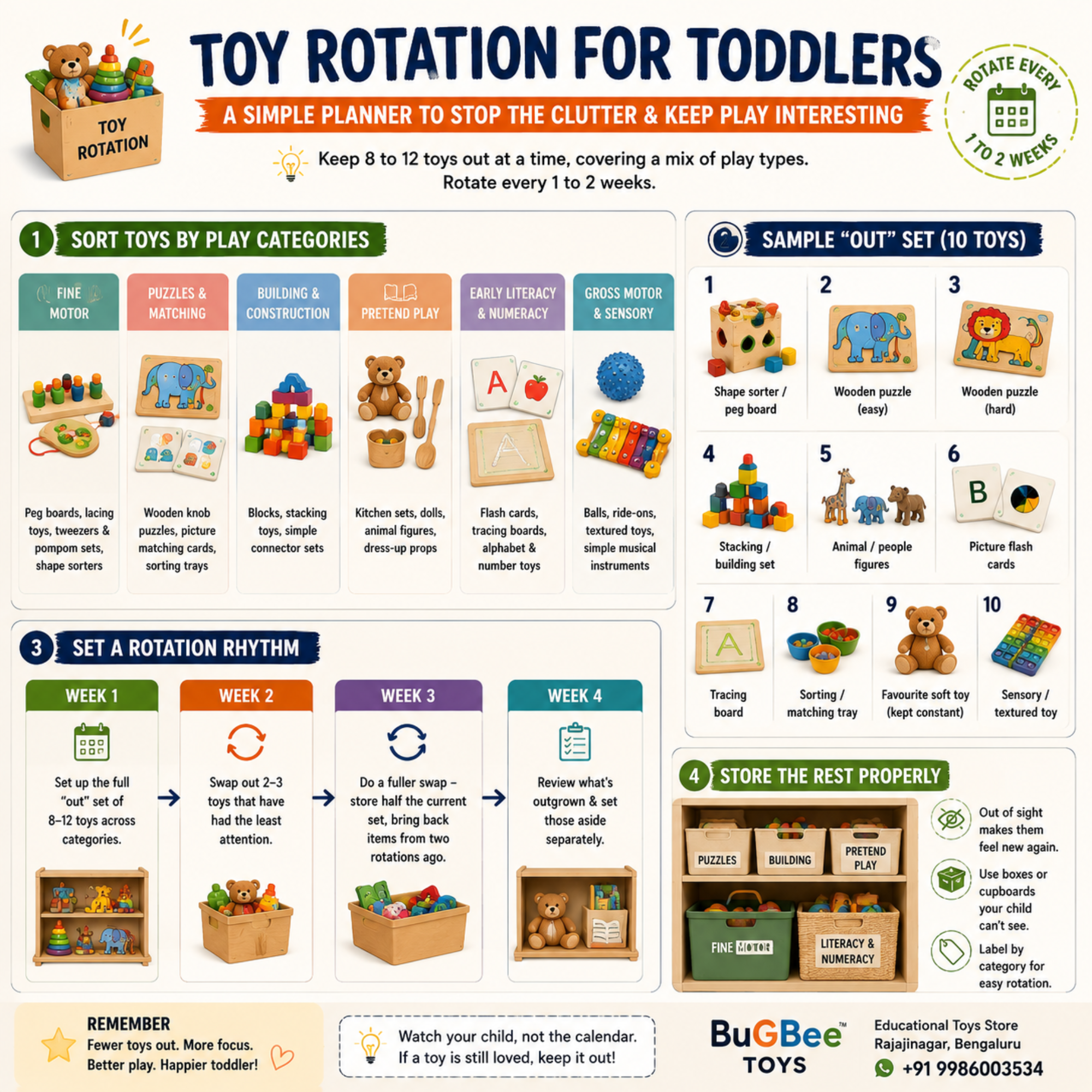
Before setting up a rotation, group what you already own. Most toddler toys fall into a handful of categories, and a good rotation set has one or two from each rather than five from one category and none from another.
| Category | Examples |
|---|---|
| Fine motor | Peg boards, lacing toys, tweezers-and-pompom sets, shape sorters |
| Puzzles and matching | Wooden knob puzzles, picture matching cards, sorting trays |
| Building and construction | Blocks, stacking toys, simple connector sets |
| Pretend play | Kitchen sets, dolls, animal figures, dress-up props |
| Early literacy and numeracy | Flash cards, tracing boards, alphabet and number toys |
| Gross motor and sensory | Balls, ride-ons, textured toys, simple musical instruments |
If your child's current shelf has six pretend-play toys and nothing from fine motor or puzzles, that imbalance is worth noticing before you rotate anything — it usually means one category is getting all the play time by default, not because your child prefers it, but because it's what's available.
Step 2: Build your "out" set
Aim for 8 to 12 toys visible and reachable at any time, pulling from at least four of the six categories above. Include one toy your child already loves — rotation works better when it's not a complete reset every time, since a familiar favourite gives your child an easy entry point before they explore the newer additions.
- 1 shape sorter or peg board (fine motor)
- 2 wooden knob puzzles, different difficulty (puzzles)
- 1 stacking or building set (construction)
- 1 set of animal or people figures (pretend play)
- 1 set of picture flash cards (early literacy)
- 1 tracing board (early literacy)
- 1 sorting or matching tray (matching)
- 1 favourite soft toy or comfort item (kept constant, not rotated)
- 1 sensory or textured toy (sensory)
Step 3: Set a rotation rhythm
There's no single correct schedule, but a rhythm that works for most Indian homes is a partial rotation every week and a fuller rotation every two to three weeks:
| Week | What to do |
|---|---|
| Week 1 | Set up the full "out" set of 8–12 toys across categories. |
| Week 2 | Swap out 2–3 toys that have had the least attention with 2–3 stored ones from the same categories. |
| Week 3 | Do a fuller swap — store half the current set, bring back items from two rotations ago. |
| Week 4 | Review what's genuinely outgrown (mastered, too easy, or too advanced) and set those aside separately from the active rotation pool. |
Watch your child rather than the calendar. If a toy is still getting daily attention, leave it out past its "turn." If something is ignored within the first two days of being reintroduced, it may be ready to leave the rotation pool altogether rather than come back a third time.
Step 4: Store the rest properly
Storage is where most rotation attempts quietly fail. If "stored" means shoved into a corner where your child can still see and reach it, the rotation effect disappears, because the toy was never really out of sight. Use a cupboard, a high shelf, or a box with a lid kept in another room. Label boxes by category rather than "misc," so that when you rotate, you can pull one puzzle and one pretend-play toy instead of digging through a mixed pile.
What to do about toys from grandparents and relatives
In many Indian households, toys arrive faster than they're used up — from grandparents, relatives, return gifts, and festival gifts. Rather than adding every new toy directly to the "out" shelf, treat it as an addition to the rotation pool first. Introduce it during the next scheduled swap instead of all at once, so it gets a genuine turn rather than temporarily displacing everything else and then being forgotten in the excitement of the next gift.
Common mistakes with toy rotation
Rotating everything at once
A complete reset every time removes the comfort of a familiar favourite and can make play feel unsettled rather than fresh. Partial rotation works better than a full swap.
Keeping too many toys out "just in case"
If the "out" set creeps up to 20 or more toys because nothing feels safe to store, the whole point of rotation — making each toy easier to notice — is lost.
Rotating on a fixed schedule regardless of interest
If a toy is still being used daily, don't remove it just because "it's been two weeks." Let genuine engagement override the calendar.
Storing toys somewhere your child can still see them
A glass cupboard or an open shelf in the same room doesn't create the "new again" effect. Store rotated toys somewhere genuinely out of daily sight.
Treating rotation as a one-time clean-up instead of an ongoing rhythm
A single big sort-and-store session helps once, but the benefit fades unless the swap keeps happening every one to three weeks.
When rotation isn't the answer
If your child avoids a toy every time it comes back into rotation, that's useful information rather than a rotation failure. It may mean the toy is currently too advanced, too simple, or simply not a fit for how your child likes to play. Set it aside separately from the active pool rather than cycling it through again and again out of habit.
A note on screen time
Toy rotation is sometimes suggested as a way to reduce screen time, and a well-stocked, genuinely varied "out" set can make independent play more appealing in the moment. It works best alongside other habits — a consistent play space, some unstructured time without adult direction, and realistic expectations for how long a toddler will play independently — rather than as a single fix on its own.
When should you ask for help choosing what to add?
If your rotation pool is missing a whole category — commonly fine motor or early literacy — and you're not sure what to add, share your child's age and what's currently in rotation. A useful recommendation fills the actual gap in your set rather than adding another toy similar to what you already have.
Filling a gap in your rotation?
BuGBee Toys is an educational toy store in Rajajinagar, Bengaluru, offering wooden puzzles, peg boards, flash cards, tracing boards, Montessori-inspired toys and other activity toys that work well as rotation pieces. Call or WhatsApp +91 9986003534 and tell us which categories your rotation is missing, or visit the store in Rajajinagar to browse in person.
Frequently asked questions
How many toys should a toddler have out at once?
Around 8 to 12 is a practical range for most toddlers, covering a mix of play types rather than many toys of the same kind.
How often should I rotate toys?
A partial swap every 1 to 2 weeks and a fuller swap every 2 to 3 weeks works for most families, adjusted based on how much attention each toy is still getting.
Does toy rotation actually reduce tantrums over toy clutter?
Many parents report calmer play sessions with fewer choices available, since a smaller, varied set is easier for a toddler to actually engage with than a large, undifferentiated pile. Results vary by child and household.
What should I do with toys my child has clearly outgrown?
Set them aside separately from the active rotation pool rather than continuing to cycle them through. They can be stored for a younger sibling, passed on, or donated depending on condition.
Is toy rotation the same as Montessori toy rotation?
The core idea is similar — fewer toys visible at once, chosen deliberately rather than left out by default. Montessori-specific rotation often also groups toys by a single skill focus per shelf, which you can apply to the category system in this guide if you want a stricter version.
Do I need to buy new toys to start rotating?
No. Most homes already have enough toys for a rotation system; the change is in how many are visible at once, not how many you own. New additions are useful mainly to fill a genuine gap in a play category.