
Wooden Educational Puzzles for Kids: A Simple Guide for Parents
Choosing a puzzle for a child can seem simple until you see how many options are available. There are wooden puzzles with animals, numbers, letters, shapes, vehicles and many other themes.
For parents, the important question is not simply which puzzle looks attractive? It is whether the puzzle is suitable for the child's age, easy enough to start with, and interesting enough to play with more than once.
Wooden educational puzzles can be a useful addition to a child's playtime because they give children something to pick up, examine, match and solve. They can also be played without a screen, making them an easy choice for home, preschool or travel.
If you are looking for wooden educational puzzles in Bangalore, this guide will help you understand what to look for before buying one.
What Are Wooden Educational Puzzles?
Wooden educational puzzles are puzzles made primarily from wood and designed around a learning activity.
Depending on the design, a puzzle may help a child practise:
-
Matching shapes
-
Recognising colours
-
Identifying animals
-
Learning numbers
-
Recognising letters
-
Understanding simple pictures
-
Improving hand-eye coordination
-
Solving simple problems
-
Using their hands and fingers carefully
A wooden puzzle does not have to teach a specific school subject.
For a young child, simply working out which piece fits into a particular space can be a useful activity.
The child looks at the piece, turns it around, compares its shape and tries again if it does not fit.
That process is part of the play.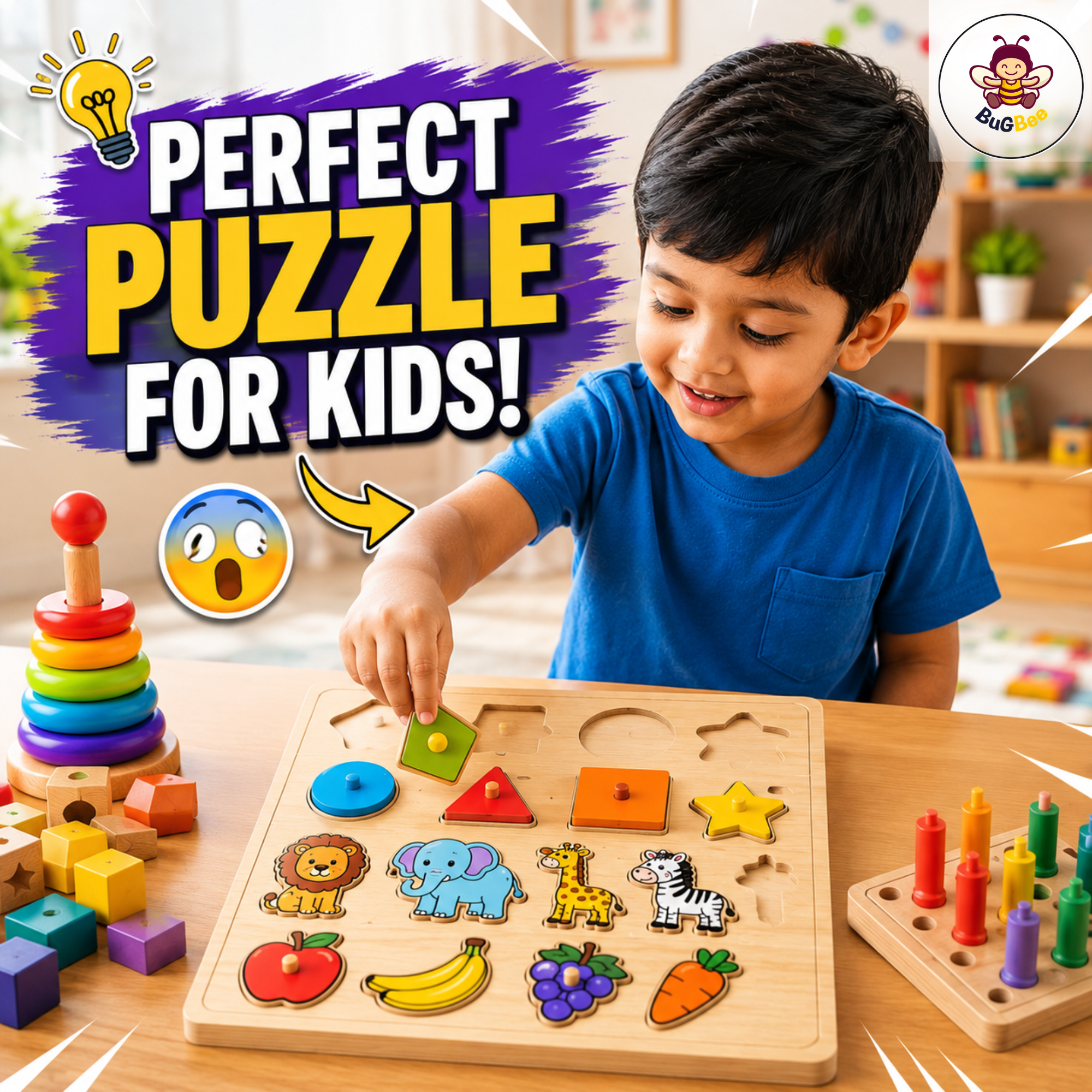
Why Do Parents Choose Wooden Puzzles?
Wooden puzzles are popular because they offer a straightforward way for children to play with their hands.
Unlike a screen-based activity, the child has to physically handle the puzzle pieces.
A child may:
-
Pick up a piece
-
Turn it around
-
Compare it with the board
-
Try a different position
-
Find a match
-
Complete the picture
The activity can also be repeated many times.
A three-year-old may use the same puzzle to practise matching today and return to it again later simply because they enjoy completing it.
The main benefit is not that the puzzle automatically "teaches" a skill. Rather, it gives children an opportunity to practise while playing.
Skills Children Can Practise With Wooden Puzzles
Different puzzles provide different types of play. Here are some common skills children may practise.
1. Fine Motor Skills
Picking up and placing puzzle pieces involves small movements of the hands and fingers.
Peg-style wooden puzzles can be particularly easy for young children to handle because the pieces are designed to be picked up and placed.
2. Hand-Eye Coordination
Children use their eyes to look at a piece and their hands to position it.
For example, when a child tries to place a wooden animal into the matching space, they are coordinating what they see with how they move their hand.
3. Problem-Solving
A puzzle gives children a small problem:
Where does this piece go?
They can look at the shape, picture or colour and make a choice.
If the piece does not fit, they can try another position.
Parents do not always need to give the answer immediately. Giving the child some time to work it out can make the activity more interesting.
4. Shape and Colour Recognition
Shape puzzles can introduce children to basic shapes such as circles, squares and triangles.
Colour puzzles can encourage children to compare different colours and find matching pieces.
Parents can make the activity conversational by asking:
"Which one is the same colour?"
"Can you find another circle?"
"What shape is this?"
5. Memory and Observation
Picture puzzles can encourage children to look carefully at details.
Animal puzzles, vehicle puzzles and everyday-object puzzles can also become opportunities for conversation and recall.
You can ask your child to remember where a particular piece belongs or describe what they see.
6. Early Maths and Language
Some wooden puzzles introduce numbers, counting or letters.
For example, while using a number puzzle, parents can count the pieces together.
With an alphabet puzzle, parents can name the letter and talk about words that begin with that sound.
The puzzle becomes a starting point for conversation rather than a formal lesson.
Types of Wooden Educational Puzzles for Kids
The best puzzle depends on the child's age and interests.
Wooden Shape Puzzles
These are suitable for introducing basic shapes and matching.
Children can learn to recognise differences between shapes while practising how to fit each piece into the correct space.
Wooden Animal Puzzles
Animal puzzles can be useful for children who enjoy animals.
Parents can talk about the animal's name, colour, sound or habitat while the child plays.
Wooden Number Puzzles
Number puzzles can introduce numbers in a hands-on way.
Parents can count the pieces with the child and connect the number to a quantity.
Wooden Alphabet Puzzles
Alphabet puzzles can help children become familiar with letters.
For younger children, the focus can simply be recognising and naming letters. Older preschoolers may also enjoy connecting letters with familiar words.
Wooden Vehicle Puzzles
Cars, buses, trains and other vehicles can make puzzles more interesting for children who already enjoy transport-related play.
Wooden Matching Puzzles
Matching puzzles ask children to find two related pictures, shapes or objects.
These can be useful for children who are beginning to compare and identify similarities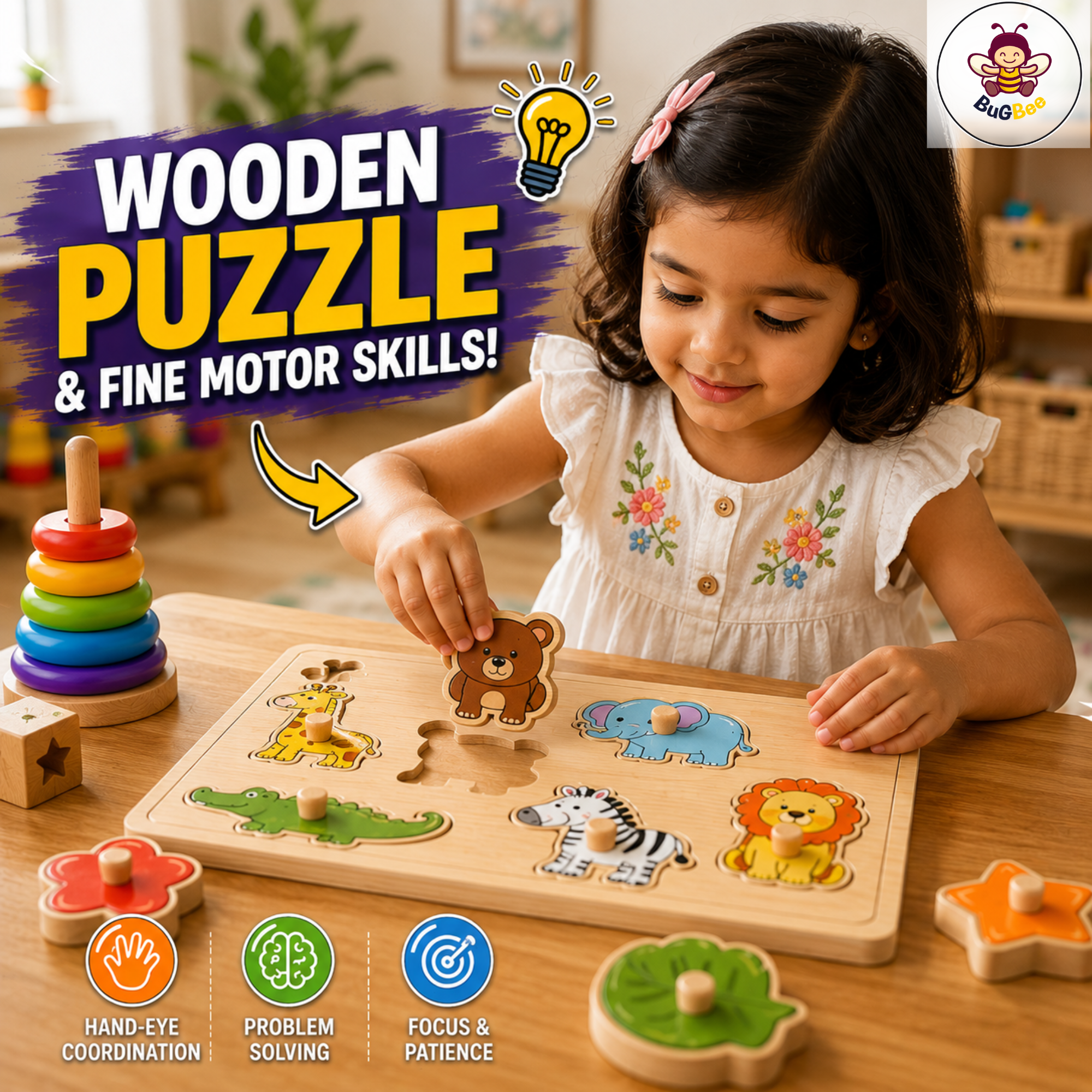 .
.
Wooden Puzzles for Different Ages
There is no single puzzle that is right for every child. Age recommendations are useful, but parents should also consider the child's current ability.
Wooden Puzzles for 2–3-Year-Olds
Look for:
-
Large pieces
-
Simple pictures
-
Easy-to-hold pieces
-
Shape matching
-
Basic colour matching
-
Familiar objects
Avoid choosing a puzzle that is too difficult.
At this stage, completing a simple puzzle can be enough.
Wooden Puzzles for 3–4-Year-Olds
Children can usually begin trying puzzles with more pieces or more detailed pictures, depending on their experience.
You can consider:
-
Animal puzzles
-
Number puzzles
-
Alphabet puzzles
-
Matching puzzles
-
Simple jigsaw-style wooden puzzles
-
Shape and colour puzzles
Let your child work at their own pace.
Wooden Puzzles for 4–6-Year-Olds
Older preschoolers may enjoy puzzles that require more observation and problem-solving.
Options can include:
-
More detailed wooden puzzles
-
Number and counting puzzles
-
Alphabet activities
-
Pattern puzzles
-
Matching challenges
-
Simple logic puzzles
If your child already enjoys puzzles, gradually increasing the difficulty can keep the activity interesting.
How to Choose the Right Wooden Educational Puzzle
Before buying a puzzle, consider these five points.
1. Check the Age Recommendation
The manufacturer's recommended age is a useful starting point.
A puzzle intended for an older child may be frustrating for a younger child.
2. Consider the Number and Size of Pieces
Younger children generally need larger, easier-to-handle pieces.
As children become more experienced, they can move towards puzzles with more pieces or smaller details, where appropriate.
3. Follow Your Child's Interests
A child who loves animals may spend more time with an animal puzzle than an alphabet puzzle.
A child who enjoys vehicles may be more interested in cars and trains.
Choosing according to interest can make it easier for a child to engage with the activity.
4. Look at the Learning Activity
Ask what the child actually does with the puzzle.
Does it involve:
-
Matching?
-
Sorting?
-
Counting?
-
Recognising shapes?
-
Identifying pictures?
-
Solving a problem?
The word "educational" on a package is less important than the actual activity.
5. Check Safety and Construction
Look for age-appropriate puzzles with pieces that are suitable for the child.
Parents should check the product instructions and age recommendation carefully, especially when buying for younger children.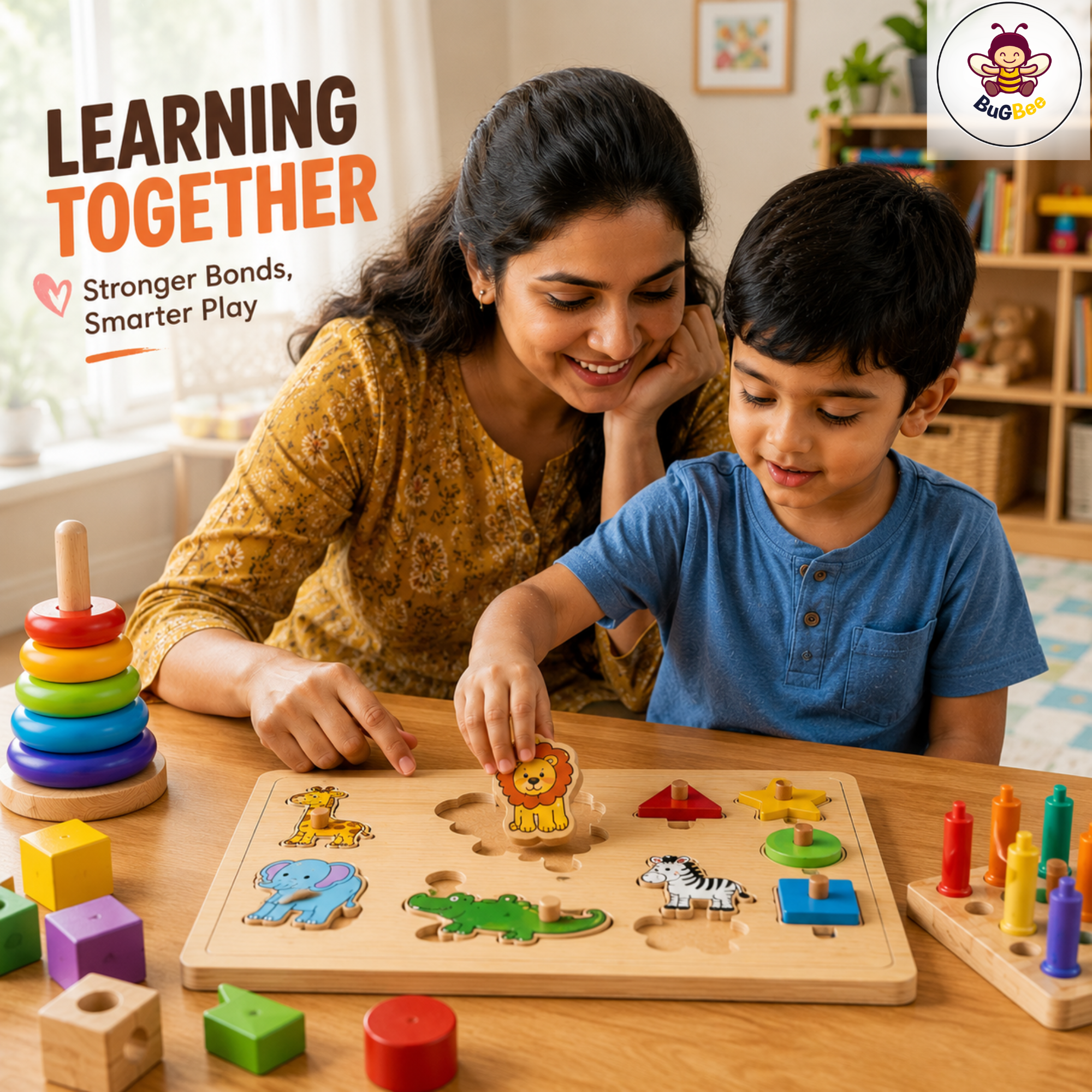
How Parents Can Make Puzzle Time More Interesting
You do not need to turn puzzle time into a lesson.
Simply talk about what your child is doing.
If they are using an animal puzzle, ask:
"What animal did you find?"
If they are completing a shape puzzle:
"Which shape could fit here?"
If they are working with numbers:
"How many pieces do we have?"
Give your child time to try before helping.
If they get stuck, offer a small clue instead of completing the puzzle for them.
For example:
"What happens if you turn the piece around?"
This allows the child to continue solving the problem themselves.
Wooden Puzzles vs Other Toys
Children do not need to choose between puzzles and other types of educational toys.
Different toys offer different types of play.
A puzzle focuses on matching and solving.
Building blocks encourage construction.
A peg board involves placing and arranging.
Flash cards can encourage recognition and conversation.
Tracing boards allow children to practise controlled movements.
Having a few different types of toys can give children more ways to play.
Where to Buy Wooden Educational Puzzles in Bangalore?
Parents searching for wooden educational puzzles in Bangalore can visit a local toy store to see the puzzles before buying them.
This can be especially helpful when you are unsure about the size of the pieces, the difficulty level or whether the puzzle is suitable for your child.
At BuGBee Toys, parents can explore wooden puzzles and other educational toys for babies, toddlers and preschoolers.
The range can include options such as:
-
Wooden puzzles
-
Shape puzzles
-
Matching games
-
Peg boards
-
Montessori-style toys
-
Flash cards
-
Tracing boards
-
Building toys
-
Activity toys
-
Educational games
If you are choosing a puzzle for a preschooler, it can help to start with what your child already enjoys.
Visit BuGBee Toys in Bangalore
If you are looking for wooden educational puzzles for kids in Bangalore, you can visit BuGBee Toys at:
1st Floor, 205/A, 55th Cross Road,
Opposite ABC Park, 4th Block, Rajajinagar,
Bengaluru, Karnataka – 560010
Visiting a physical toy store gives parents an opportunity to look at different puzzle types and compare them based on age, size, theme and difficulty.
You can also explore other educational toys while choosing a puzzle that fits your child's interests.
Frequently Asked Questions
Are wooden puzzles good for toddlers?
Yes, age-appropriate wooden puzzles can give toddlers opportunities to practise matching, placing, handling objects and simple problem-solving.
What type of puzzle is best for a 3-year-old?
Start with simple puzzles containing appropriately sized pieces and familiar pictures or shapes. Always follow the manufacturer's age recommendation.
Do wooden puzzles help with learning?
They can provide opportunities to practise skills such as matching, observation, fine motor control, hand-eye coordination and problem-solving.
Are wooden puzzles better than plastic puzzles?
The material alone does not determine whether a puzzle is suitable. Parents should consider the design, safety, age recommendation, size of pieces and how the child will use it.
How many puzzles should a child have?
There is no required number. A few puzzles with different themes or difficulty levels can provide plenty of opportunities for repeated play.
Final Thoughts
A good wooden educational puzzle does not need to be complicated.
For a young child, finding the right piece, turning it around, matching a picture and completing the board can be an enjoyable activity.
When choosing a puzzle, focus on three things:
Age. Interest. Difficulty.
Choose something your child can handle, something they are interested in and something that gives them a small challenge.
If you are looking for wooden educational puzzles in Bangalore, visit BuGBee Toys in Rajajinagar and explore options based on your child's age and interests.
The right puzzle is not necessarily the one with the most pieces or the most features.
It is the one your child wants to pick up and try again.