
Brain Teasers for Kids
"Brain teaser" covers a surprisingly wide range of toys a tangram, a wooden burr puzzle, a sliding tile game, and a logic grid puzzle are all sold under the same label, but they ask for very different kinds of thinking and suit different ages. Buying the wrong type for your child's stage is one of the more common reasons a brain teaser ends up abandoned after one frustrating attempt. This guide breaks down the main types and matches each to an age and skill level.
The short answer
Brain teasers generally fall into a few types: shape-arrangement puzzles like tangrams, mechanical puzzles like burr or interlocking wood puzzles, sliding or sequencing puzzles, and logic grid puzzles that involve deduction. Younger children, around 4 to 5, do best with shape-arrangement puzzles with a visual answer key. Mechanical and sliding puzzles suit around 5 to 7. Logic grid puzzles usually work best from 6 or 7 upward, once a child can hold multiple clues in mind at once. Starting one level too advanced is the most common reason a brain teaser gets abandoned rather than solved.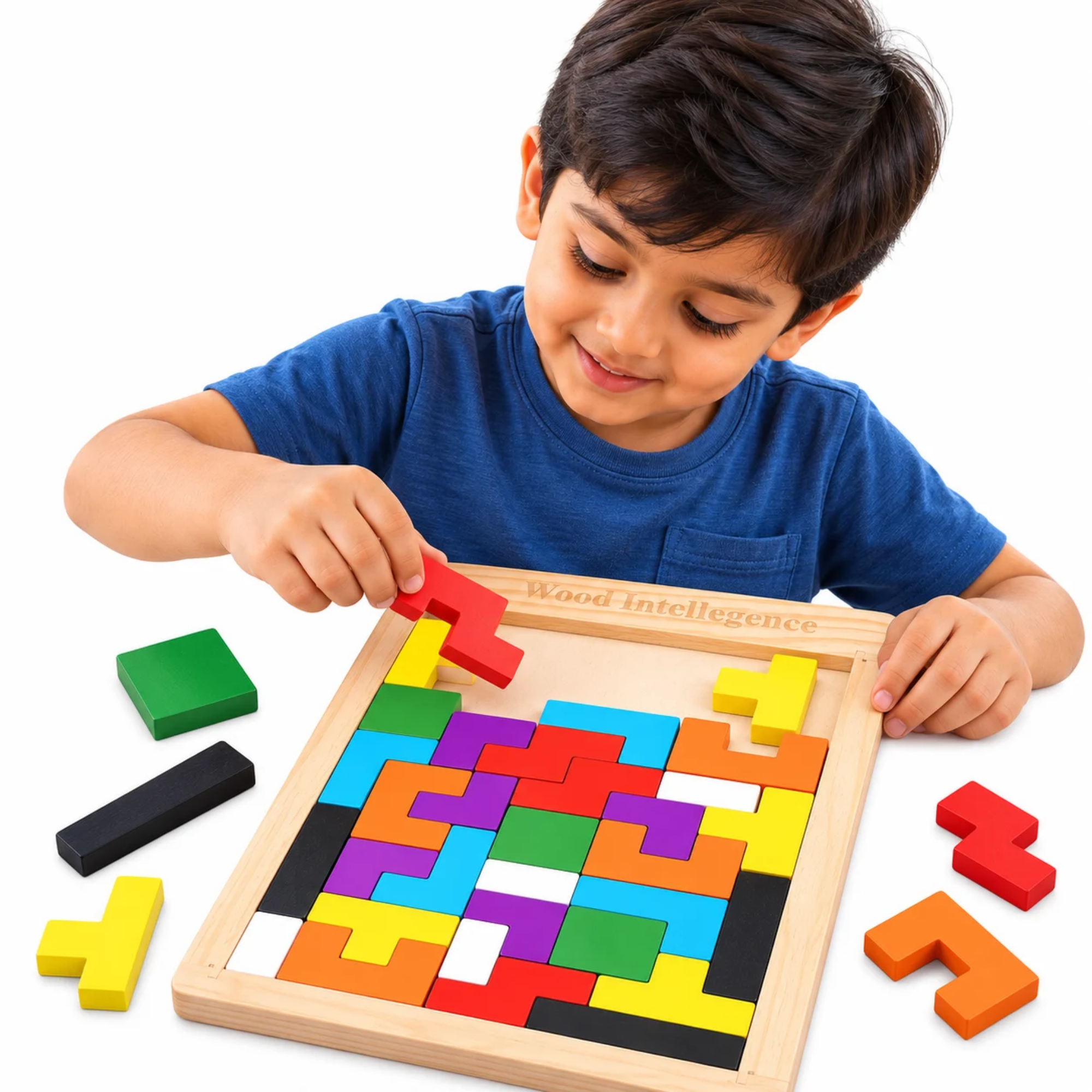
The main types of brain teaser
| Type | What it asks for | Typical starting age |
|---|---|---|
| Shape-arrangement (tangrams) | Arranging flat pieces to match a picture or silhouette | 4–5 years, with a visual answer card |
| Mechanical (burr, interlocking wood) | Working out how pieces fit or separate through trial and manipulation | 5–7 years, simpler versions first |
| Sliding or sequencing | Moving pieces in the correct order to reach a target arrangement | 5–7 years |
| Logic grid puzzles | Using multiple clues together to deduce an answer | 6–7 years and up |
How brain teasers connect to problem-solving
Each type of brain teaser leans on a different part of problem-solving. Tangrams build spatial reasoning most directly, since success means seeing how flat shapes relate to a whole picture. Mechanical puzzles lean heavily on trial-and-error persistence, since there's rarely an obvious first move. Logic grids build sequencing and multi-step planning, since an answer only emerges after working through several clues together. Our problem-solving skills guide covers these four underlying abilities in more depth if you want to match a brain teaser to the specific one your child needs practice with.
Signs a brain teaser is the right level
- ☐ Your child makes visible progress within the first few attempts, even without solving it fully.
- ☐ They return to it more than once without being asked.
- ☐ Frustration shows up occasionally but doesn't lead to giving up entirely.
- ☐ They can explain, even loosely, what they're trying next and why.
If a brain teaser fails most of these no progress at all, immediate abandonment, or repeated identical failed attempts with no adjustment it's usually a sign to step down to an easier type or a simpler version of the same type, rather than assuming the child isn't capable.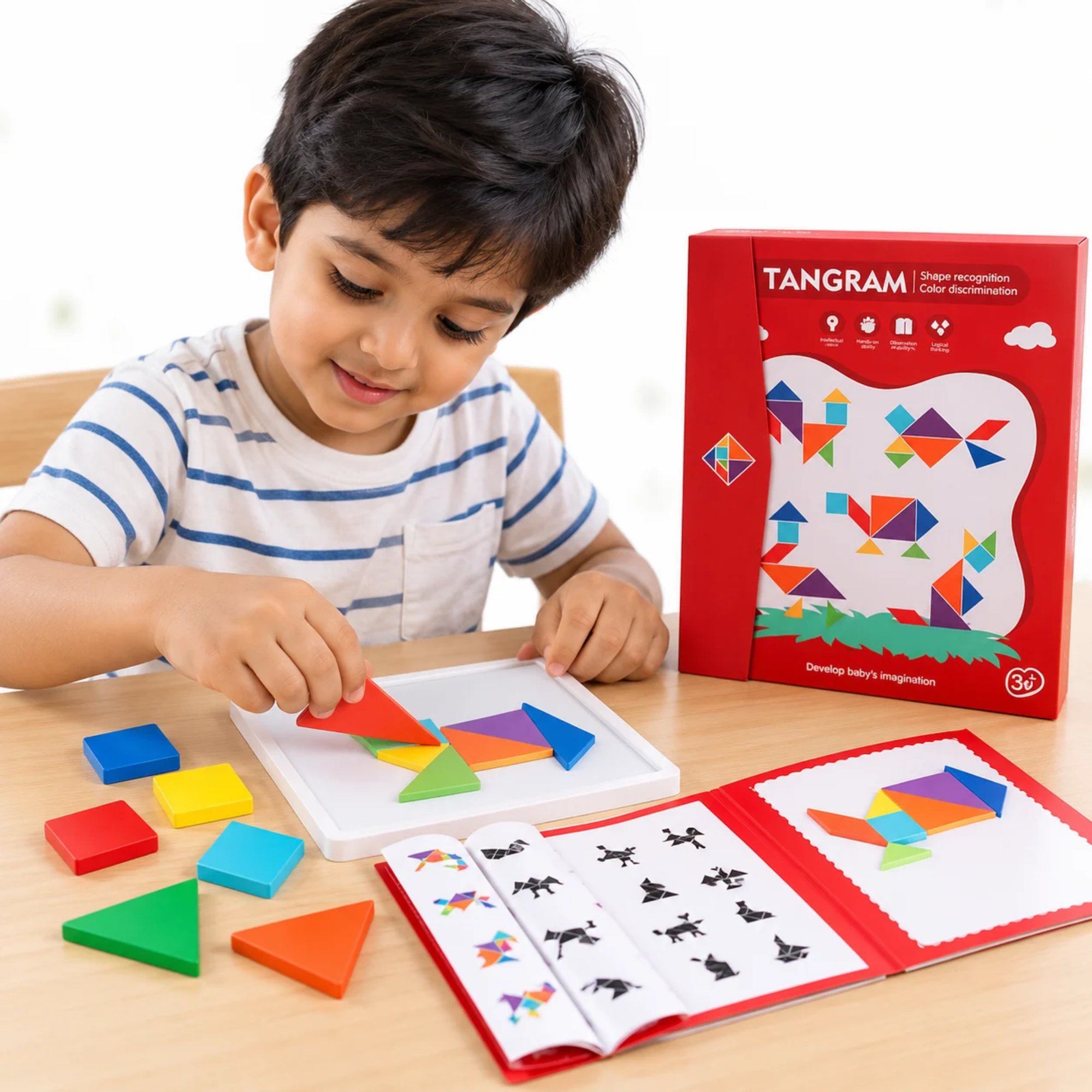
Brain teasers by age
| Age range | Good starting point | See our age guide |
|---|---|---|
| 4–5 years | Simple tangram sets with a visual answer card | Toys for preschoolers |
| 5–7 years | Beginner mechanical puzzles and sliding sequence puzzles | Toys for preschoolers |
| 6–7 years and up | Simple logic grid puzzles with 3–4 clues | Toys for preschoolers |
These are general starting points. A child new to brain teasers at any age usually benefits from starting at the easier end regardless of exact age, since the skill of approaching a brain teaser at all is itself something to build up.
Should you help, or let them struggle?
A brief pause before stepping in usually helps more than immediate assistance. Watching for a specific stuck point not just general difficulty lets you offer a targeted hint rather than solving the whole thing. Something like "what happens if you turn that piece around?" keeps the thinking with the child, rather than "no, it goes here," which removes it entirely.
Common mistakes when buying brain teasers
Starting with a type that has no visual answer key
For a first brain teaser, a tangram or puzzle with a picture to match gives a clear target. Open-ended mechanical puzzles with no visible goal can feel directionless for a beginner.
Buying based on how clever the puzzle looks, not the child's stage
An impressive-looking wooden burr puzzle is a poor first choice if your child has never tried a brain teaser before. Start simpler than seems necessary.
Solving it for the child at the first sign of struggle
The struggle itself is where the skill is built. A short pause before helping, rather than immediate intervention, gives more room for genuine problem-solving.
Assuming one brain teaser type suits every child equally
A child who enjoys tangrams may find logic grids tedious, and vice versa. Trying a small variety helps identify which type actually holds their interest.
Introducing too many pieces or clues at once
A logic grid with 8 clues is a big jump from one with 3. Increase complexity gradually rather than starting at the hardest available version.
Extending a brain teaser once it's solved
Many brain teasers can be reused with a self-imposed challenge once the first solution is found timing a second attempt, solving it a different way, or explaining the solution aloud to a sibling. Our guide on getting more out of one toy covers this kind of extension in more detail.
Fitting brain teasers into a rotation
A brain teaser that's been fully solved and memorised loses most of its challenge. Rotating it out for a while and reintroducing a harder version later works well within a broader toy rotation system.
Brain teasers while travelling
How BuGBee evaluates brain teasers
Brain teasers are assessed using the same criteria described in our Toy Lab methodology, including how a genuine frustration point is handled, not just how clever the puzzle looks on the shelf.
Buying brain teasers for a classroom or in bulk
If you're stocking a classroom or activity corner with brain teasers for a group, a small variety of types tends to work better than many copies of the same one, since different children respond to different types. See our bulk sourcing guide for other considerations when ordering in quantity.
When should you ask for help choosing?
Ask for help if your child gives up on brain teasers quickly, if you're not sure which type suits their interests, or if you want to check whether a specific puzzle is a fair challenge for their age. Share the exact age and how they typically respond to a difficult task.
Choosing a brain teaser for your child?
BuGBee Toys is an educational toy store in Rajajinagar, Bengaluru, offering brain teasers and other problem-solving activity toys across a range of ages. Call or WhatsApp +91 9986003534 and share your child's age and current puzzle experience, or visit the store in Rajajinagar to see options in person.
Frequently asked questions
What age are brain teasers appropriate for?
Simple shape-arrangement puzzles like tangrams can start around 4 to 5 years old with a visual answer key, with more complex mechanical and logic-based types typically suiting 6 years and up.
My child gives up on brain teasers immediately. What should I do?
Step down to an easier type, ideally one with a visual answer key, and keep sessions short. Building tolerance for the "not solved yet" feeling takes practice, especially for a first-time brain teaser user.
What's the difference between a tangram and a logic grid puzzle?
A tangram involves arranging flat shapes to match a picture, mostly building spatial reasoning. A logic grid puzzle involves working through multiple written or visual clues to deduce an answer, building sequencing and multi-step reasoning.
Should I give hints, or let my child struggle?
A brief pause before helping usually works best, followed by a targeted hint about the specific stuck point rather than the full solution.
Are brain teasers useful for a child who already enjoys puzzles?
Yes, they're a natural next step once basic jigsaw puzzles are comfortable, since they add a genuine logic or spatial reasoning challenge beyond simple picture matching.
How do I know which type of brain teaser my child will enjoy?
Trying a small variety of types is the most reliable way to find out, since interest varies more by individual preference than by age alone.