
Early Literacy Toys
Flash cards, alphabet peg boards, phonics toys and picture books are all sold under the same broad "early literacy" banner, but they build different pieces of the reading puzzle. A child who can recite the alphabet from a song isn't necessarily building the same skill as a child who can pick out which two pictures start with the same sound. This guide breaks pre-reading skill into its actual parts, and matches each one to a toy type that genuinely supports it.
The short answer
Early literacy is made up of several separate skills — vocabulary, letter recognition, sound awareness, print awareness, and early word recognition — and they usually develop in roughly that order, though with a lot of overlap. Flash cards and picture cards mostly build vocabulary. Alphabet peg boards and letter matching build letter recognition. Simple rhyming and sound games build phonological awareness, which research consistently links to later reading success more strongly than alphabet knowledge alone. Choosing based on which of these your child is actually working on gets better results than reaching for anything labelled "literacy."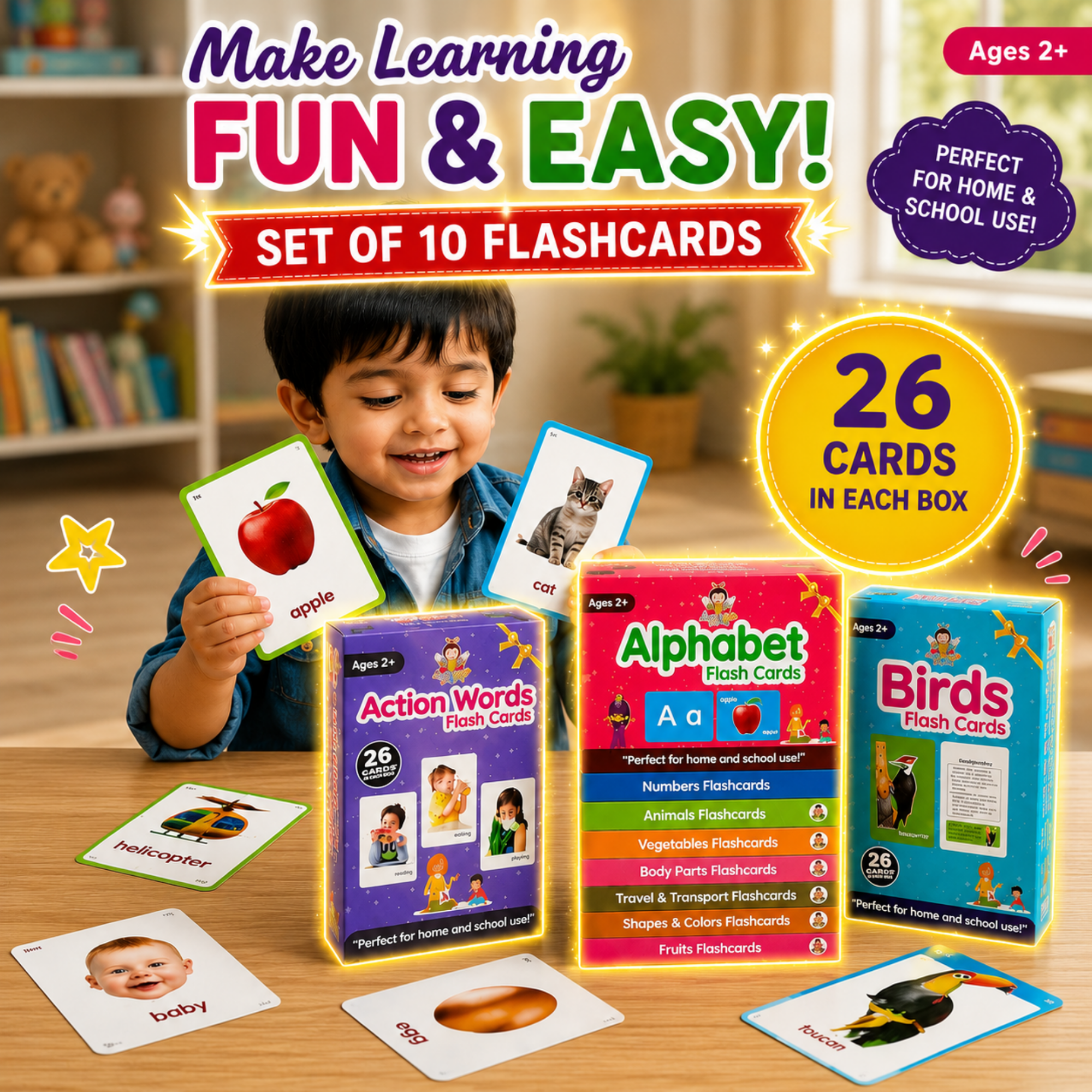
The five pieces of "early literacy"
| Skill | What it means | Toys that build it |
|---|---|---|
| Vocabulary | Knowing and using more words to describe things | Flash cards, picture matching cards, story props |
| Letter recognition | Identifying letters by sight, upper and lowercase | Alphabet peg boards, letter matching toys, tracing boards |
| Phonological awareness | Hearing and playing with the sounds inside words, like rhyme and syllables | Rhyming card games, sound-matching toys, simple clapping-syllable games |
| Print awareness | Understanding that print carries meaning and is read in a direction | Picture books, labelled object cards, simple word-picture pairs |
| Early word recognition | Recognising a small set of whole, familiar words by sight | Sight word matching sets, simple phonics-based games |
Phonological awareness is the one most parents haven't heard of, yet it's one of the strongest predictors of later reading ease — a child who can hear that "cat" and "hat" rhyme, or clap out the two syllables in "ta-ble," is building a skill that transfers directly into reading once letters are introduced.
How this maps to age
| Age range | Skill usually developing first | See our age guide |
|---|---|---|
| 1–2 years | Vocabulary, through naming and pointing | Toys for 1-year-olds |
| 2–3 years | Expanding vocabulary, early print awareness through books | Toys for 2-year-olds |
| 3–4 years | Letter recognition, early rhyme awareness | Toys for 3-year-olds |
| 4–6 years | Phonological awareness, early sight words | Toys for preschoolers |
A quick check: is a toy building literacy, or just occupying attention?
- ☐ Does it involve your child actually saying or repeating a word, sound or letter, not just watching or listening?
- ☐ Does it connect a word to a real object, picture or sound rather than an abstract symbol alone?
- ☐ Can it be used slightly differently as your child's vocabulary grows, rather than becoming instantly "finished"?
- ☐ Does a parent or caregiver's involvement add value, through conversation, rather than the toy working the same with or without them?
A toy that plays a pre-recorded word aloud when a button is pressed, for example, mostly fails the first check — it's the toy talking, not the child.
Getting more out of flash cards and letter toys you already own
Flash cards are often used only one way — show the card, say the word, move on — but they support several literacy sub-skills if used differently: sorting by first sound, finding rhyming pairs, or building a two-card story. Our guide on getting more out of one toy covers this kind of extended use in detail, and many of its "language" and "story" stage activities apply directly to flash cards and letter matching toys.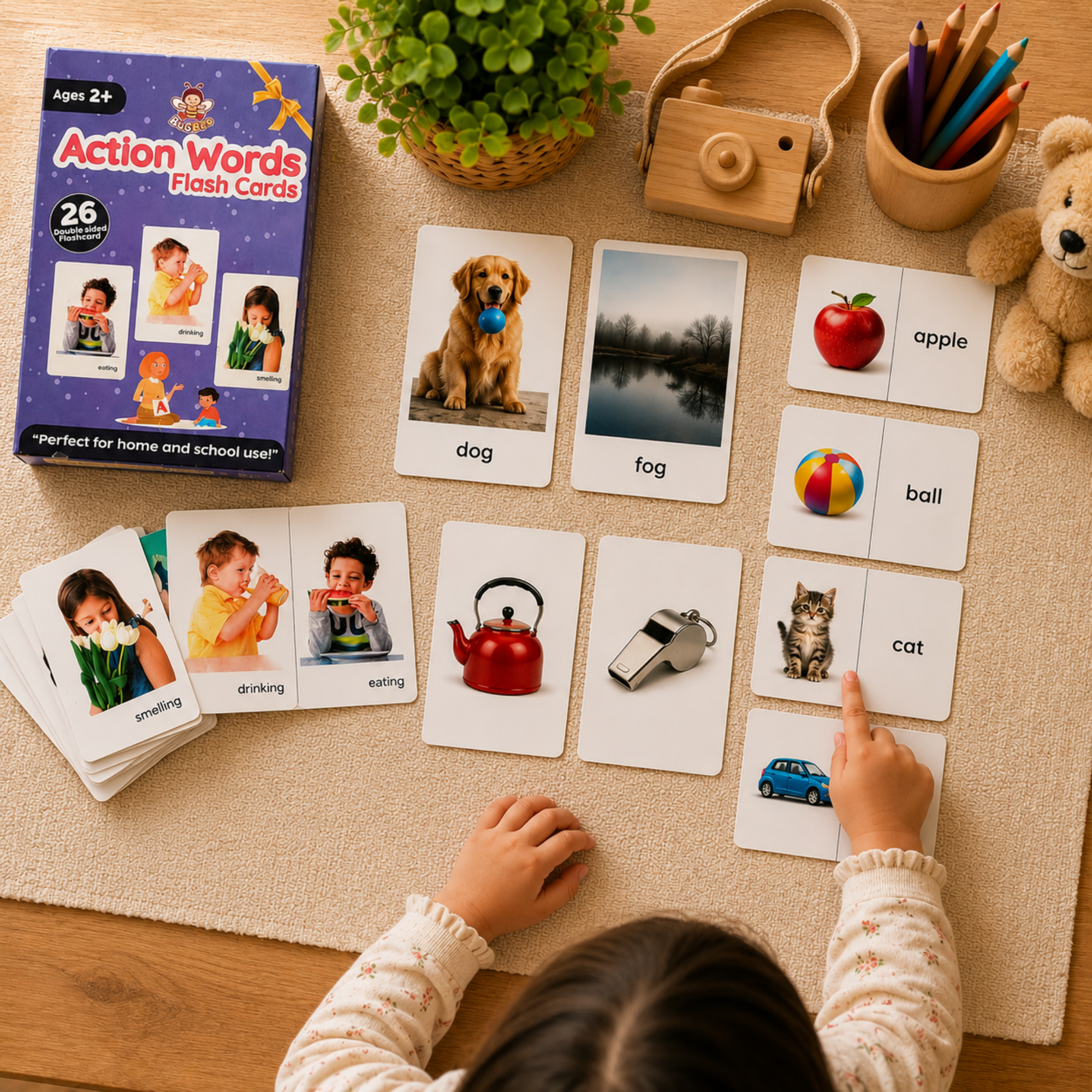
Common mistakes with early literacy toys
Jumping straight to letters before sound awareness
Phonological awareness — hearing sounds and rhymes — typically supports reading more than memorising the alphabet in isolation. Rhyming games and sound play are worth introducing alongside letters, not after them.
Treating flash cards as a test rather than a conversation
Quizzing a child repeatedly on the same cards can turn a useful tool into pressure. Naming, describing and discussing the picture builds more vocabulary than rapid drilling.
Choosing toys that do the talking instead of the child
Electronic toys that speak a word when pressed can be engaging, but they don't require the child to produce language themselves, which is where most of the actual learning happens.
Assuming reading readiness follows a fixed age
Children reach each of these five sub-skills at different points, sometimes well before or after typical ranges. Comparing timelines against another child rarely helps and can add unnecessary pressure.
Only using literacy toys at a desk or table
Vocabulary and sound play work just as well during a walk, a car ride, or while playing with an unrelated toy. Literacy toys don't need to be confined to a single formal setting.
Choosing between literacy and other skill toys for a specific age
If you're not sure whether literacy is the right focus right now versus fine motor or numeracy, our toy decision guide and fine motor skills guide can help you balance a well-rounded set rather than over-focusing on one area.
Keeping a literacy toy set rotating
Flash cards and letter toys work especially well in a rotation system, since a smaller, changing subset of cards keeps vocabulary work varied rather than repetitive. See our toy rotation planner for how to set this up.
Literacy play while travelling
Storing a growing card and book collection
Flash cards, letter toys and early readers can accumulate quickly. Our small apartment storage guide covers practical ways to keep a card collection organised without it becoming a loose, mixed pile.
How these recommendations are tested
The categories above follow the same evaluation approach used across every skill area at BuGBee, described in our Toy Lab methodology — assessed through real, repeated use rather than a product description alone.
Buying for a classroom or literacy corner
If you're setting up a preschool literacy corner or need multiple sets of the same flash cards or letter toys, consistency across units matters for shared classroom use. See our bulk sourcing guide for what to check before ordering in quantity.
When should you ask for help choosing?
Ask for help if you're unsure which literacy sub-skill to focus on next, if your child seems disinterested in flash cards specifically but not literacy generally, or if you want a mix of literacy and other skill toys. Share the exact age, current vocabulary level, and whether letters or sounds seem more interesting to your child right now.
Building an early literacy set?
BuGBee Toys is an educational toy store in Rajajinagar, Bengaluru, offering flash cards, alphabet peg boards, tracing boards and other pre-reading activity toys. Call or WhatsApp +91 9986003534 and share your child's age and current vocabulary level, or visit the store in Rajajinagar to see options in person. See our local guide to BuGBee Toys in Bangalore for address and visiting details.
Frequently asked questions
What toys help teach the alphabet?
Alphabet peg boards, letter matching toys and tracing boards all support letter recognition, ideally alongside sound-based games rather than the alphabet alone.
What is phonological awareness and why does it matter?
It's the ability to hear and play with the sounds inside words, like rhyme and syllables, separate from knowing letters by sight. It's one of the strongest predictors of how easily a child learns to read once phonics instruction begins.
Are flash cards actually useful, or just for show?
Used as a conversation starter — naming, describing, discussing — they build genuine vocabulary. Used only as rapid-fire drilling, they're less effective and can feel like pressure rather than play.
At what age should letter recognition start?
Many children begin recognising some letters around 3 to 4 years old, though this varies widely and depends more on exposure and interest than a fixed timeline.
Should I prioritise letters or sounds first?
Sound awareness — rhyming, syllables, first sounds — is worth introducing alongside letters rather than only after the alphabet is known, since it supports how those letters are eventually blended into words.
Do talking or electronic literacy toys help reading?
They can be engaging, but toys that require the child to say, repeat or respond generally build more active language skill than toys where the device does the talking.