
DECISION GUIDE · CHOOSING THE RIGHT EDUCATIONAL TOY
Which Educational Toy Is Right for My Child? A Simple Decision Guide
Every toy in a children's store claims to be educational. Puzzles, blocks, flash cards, kitchen sets, shape sorters, tracing boards — the label doesn't tell you which one actually fits your child, at their current stage, with the way they like to play. Most "best toys" lists sort by age alone, which is a start but not the full picture: two three-year-olds can need completely different toys depending on their attention span, their favourite type of play, and what skill they're ready to build next.
This guide walks through four things worth checking before you buy, then gives you a simple way to match your answers to a toy category.
The short answer
The right toy for your child depends on four things: their current skill level (not just their age), their natural play style, the specific skill you want to support next, and practical limits like budget, space and how much supervision the toy will realistically get. Age tells you a starting range. The other three narrow that range down to an actual toy. Skipping straight to "what's a good toy for a 3-year-old" without the other three factors is exactly how a toy ends up unused within a week.
Factor 1: Age and current skill
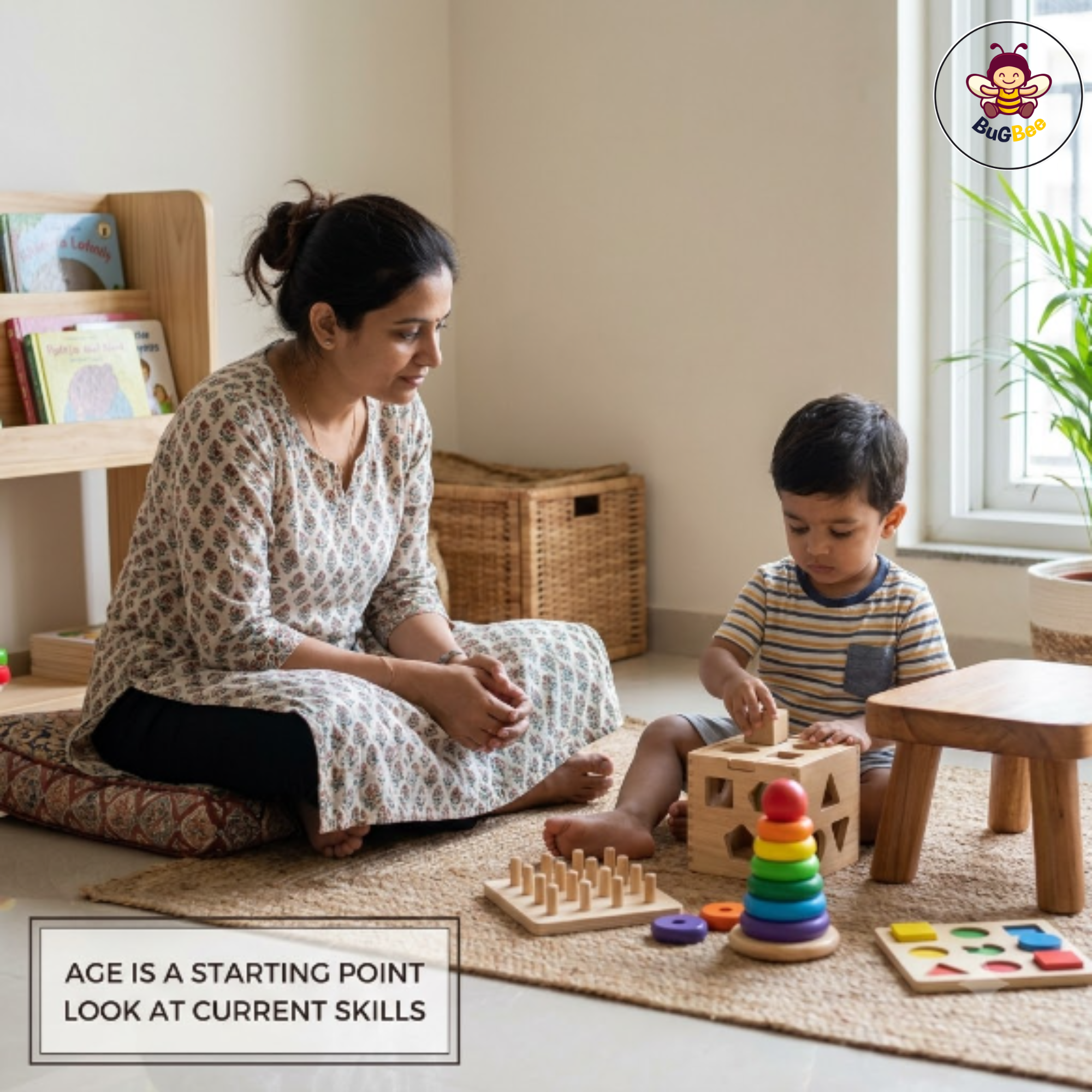
Age ranges on toy packaging are a reasonable starting point, but two children of the same age can be at very different stages for the specific skill a toy requires. A toy chosen by skill level rather than birthday tends to get used for longer and cause less frustration.
| Age range | What to check before buying |
|---|---|
| 12–18 months | Can they grip with a full hand? Are they interested in putting objects in and out of containers? |
| 18–24 months | Can they use a pincer grip (thumb and forefinger)? Do they point at and name familiar objects? |
| 2–3 years | Can they sit through a short activity without needing constant redirection? Are they starting to use 2–3 word phrases? |
| 3–4 years | Can they follow a two-step instruction? Are they interested in stories, sequences or "why" questions? |
| 4–6 years | Can they focus on one task for 10+ minutes? Are they starting to recognise letters, numbers or patterns on their own? |
Factor 2: Play style
Most children lean toward one or two natural ways of playing. A toy that matches this tends to be picked up on its own, without needing to be introduced every time.
| If your child usually… | Look for… |
|---|---|
| Puts things in and takes them out | Shape sorters, peg boards, posting toys |
| Lines up or groups objects | Sorting trays, matching cards, simple pattern toys |
| Draws or scribbles on anything nearby | Tracing boards, chunky crayons, pre-writing activities |
| Talks, tells stories or narrates play | Flash cards, story props, matching games |
| Builds and knocks things down | Blocks, stacking toys, simple construction sets |
| Gets upset when something is hard | Large-piece puzzles, beginner matching toys with a forgiving margin for error |
If your child clearly fits two rows, that's normal — it usually means either category is a reasonable next toy, and factor 3 below can help you pick between them.
Factor 3: What skill do you actually want to support?
"Educational" isn't one skill — it's a bundle of different ones, and being specific about which one you're targeting narrows the choice considerably.
| Goal | Toy types that support it |
|---|---|
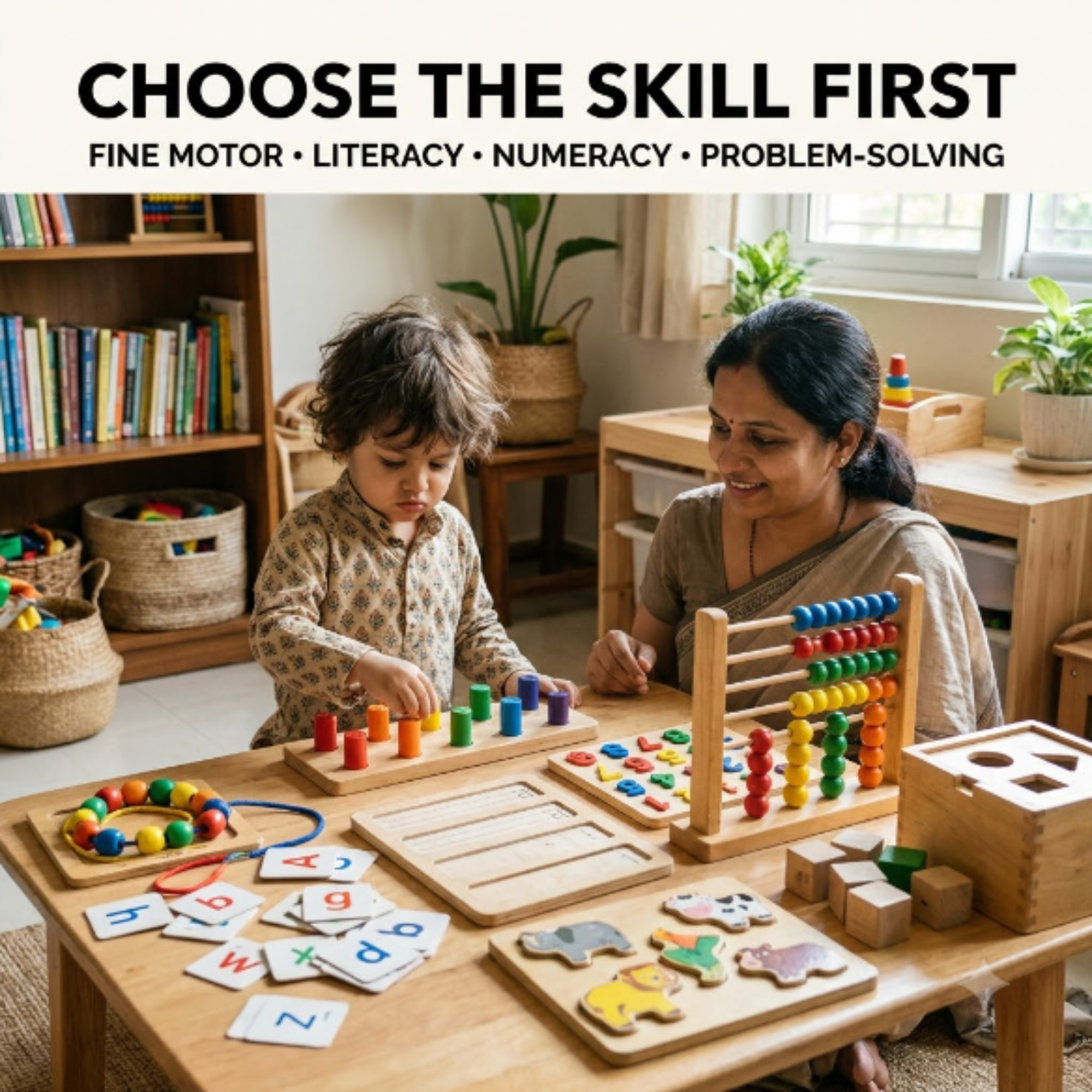
| Fine motor / hand control | Peg boards, lacing toys, tweezers-and-sorting sets, shape sorters |
| Early literacy | Flash cards, tracing boards, alphabet matching toys |
| Early numeracy | Counting toys, number peg boards, simple pattern sets |
| Problem-solving | Puzzles, brain teasers, simple building sets |
| Independent play | Toys that don't need an adult after one demonstration — shape sorters and open-ended blocks tend to work well here |
| Reducing screen time | Any hands-on toy your child can return to without prompting, ideally rotated so it stays interesting |
Factor 4: Practical constraints
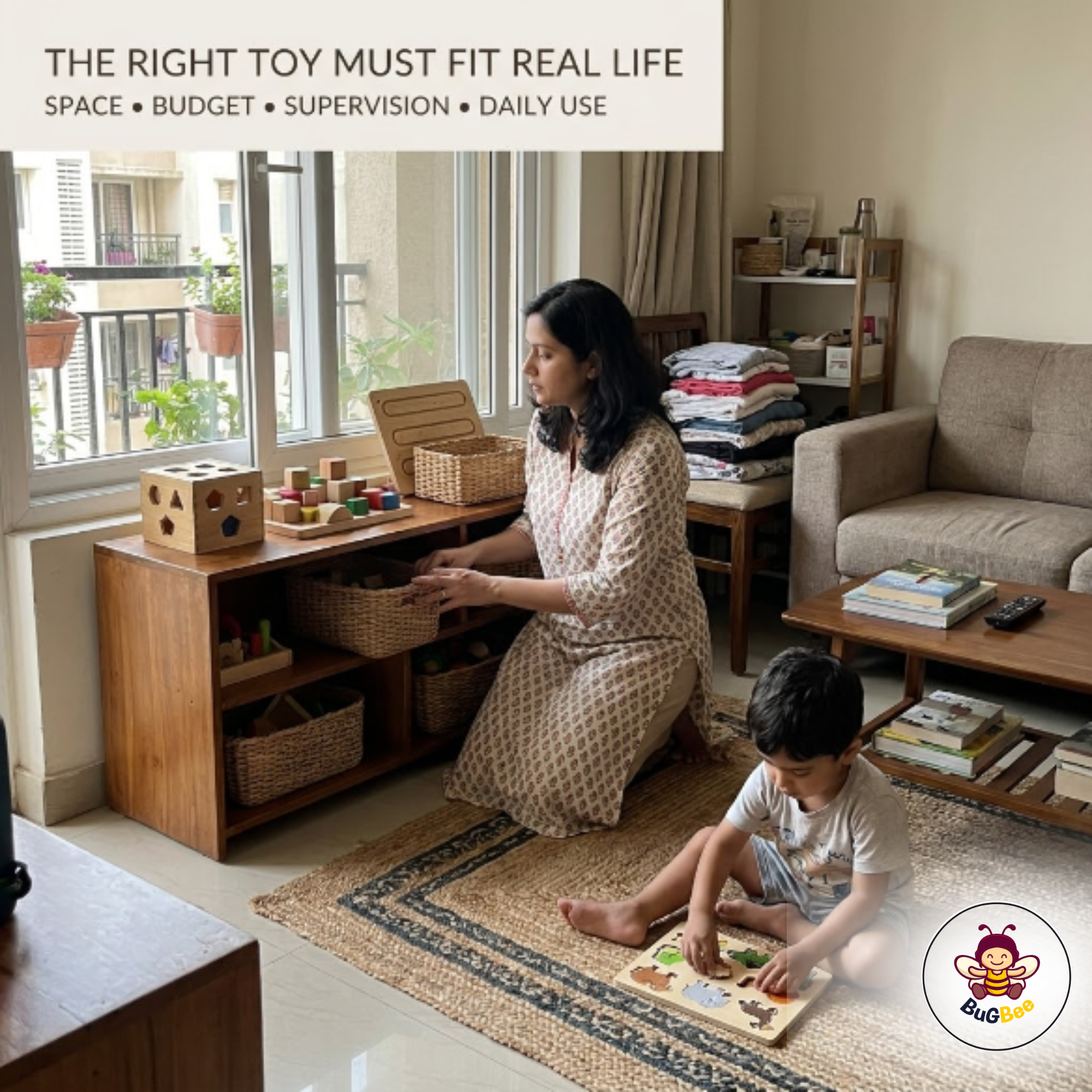
The "best" toy on paper still has to fit your actual home. A few honest questions before buying save more frustration than most feature comparisons do:
- Storage: Does this toy pack away in under a minute, or will it end up permanently out simply because tidying it is a hassle?
- Supervision: Can this be used with a short demonstration and then left alone, or does it need an adult present every time?
- Siblings: Will an older or younger sibling want the same toy at the same time, and is that a problem for this particular toy?
- Travel: Does this toy need to work outside the house — in a car, on a flight, at grandparents' — or is it strictly a home toy?
- Durability vs. cost: A toy that's used daily for a year is generally a better use of budget than several toys used briefly and abandoned, even if the per-toy price is higher.
The decision flow: putting it together
- Start with skill, not age. Use the age table above to check whether your child's current grip, attention span and language match the toy you're considering, not just their birthday.
- Match it to their play style. Pick the row from the play style table that sounds most like your child right now, this week — not how they played six months ago.
- Name the one skill you want this toy to support. If you can't name it in one sentence, the toy is probably being chosen by label rather than purpose.
- Run it past your practical constraints. If a toy fails two or more of the constraint checks above, it's worth reconsidering even if it fits perfectly on skill and style.
- If two categories still fit equally, choose the one that's easier for independent play. A toy your child can return to alone tends to get more total use than one that always needs a parent.
When you're choosing between two specific toys
If you've narrowed things down to two options rather than a whole category, a direct comparison is more useful than a general guide. For one of the most common early decisions — a shape sorter or a first puzzle — see our full shape sorter vs puzzle comparison, which breaks down age, frustration risk and replay value side by side.
Common mistakes when choosing a toy
Buying for the age on the box alone
Age labels are a starting point, not a guarantee of fit. Two children of the same age can be months apart in the specific skill a toy requires.
Choosing based on what looks impressive, not what matches play style
A large, elaborate toy set is often less used than a simple one that actually fits how your child naturally plays.
Not naming a specific learning goal
"Something educational" is too broad to act on. Naming the actual skill — fine motor, early literacy, independent play — makes the choice much easier.
Ignoring storage and supervision needs
A toy that's technically perfect but needs constant adult involvement or ten minutes to pack away often ends up unused, regardless of how good it is on paper.
Assuming one toy should cover every skill at once
It's usually better to choose one toy per goal — one for fine motor, one for early literacy — than to look for a single toy that claims to do everything, since those often do each individual thing shallowly.
Buying new instead of extending what you already own
Before buying a new toy for a skill your child hasn't mastered yet, it's worth checking whether a toy you already own could be used differently to build the same skill. Our guide on getting more play value from a peg board, shape sorter or puzzle has thirty ways to do exactly this.
If your child keeps losing interest quickly
Sometimes the issue isn't which toy category to choose, but why a reasonable-sounding toy still isn't holding attention. If that sounds familiar, our guide on why toddlers lose interest in toys covers the five most common reasons and a simple seven-day trial to test any toy properly before deciding it doesn't work.
Keeping the right toys in rotation
Once you've chosen well, the next challenge is usually keeping a small set of the right toys genuinely interesting over time rather than buying new ones every few weeks. Our toy rotation planner covers how many toys to keep out, how often to swap them, and how to store the rest — without needing to buy anything new.
Buying for a school, event or gift in bulk
When should you ask for help choosing?
Ask for help when you're choosing between two similar-looking toys, buying for a child you don't know well, selecting a birthday or return gift, or trying to reduce screen time. Share the child's age, current skill level, favourite way of playing, and your budget — this gets a far more useful answer than asking only for "the best educational toy."
Still not sure which toy fits your child?
BuGBee Toys is an educational toy store in Rajajinagar, Bengaluru, offering wooden puzzles, Montessori-inspired toys, flash cards, tracing boards, peg boards and other children's activity toys. Call or WhatsApp +91 9986003534 and share your child's age, current skills and play style, and we'll help you match it to the right toy. You're also welcome to browse the collection online or visit the store in Rajajinagar to see options in person.
Frequently asked questions
How do I know if a toy is actually educational, not just labelled that way?
Check whether it clearly supports one specific skill — fine motor, language, early numeracy, problem-solving — rather than just carrying the word "educational" on the box. If you can't name the skill in one sentence, look closer before buying.
Should I choose a toy based on age or based on skill?
Skill first, age as a starting range. Two children of the same age can need different toys depending on where they actually are with grip, attention span and language.
What if my child fits more than one play style?
That's common and not a problem. Either category is usually a reasonable next toy; use the practical constraints factor to decide between them.
Is it better to buy one expensive toy or several cheaper ones?
A single well-made toy that gets used daily for months is usually a better use of budget than several toys that are each used briefly and then abandoned, even though the upfront cost looks higher.
How do I choose a toy for a child I don't know well, like for a gift?
Ask the parent for the child's age, current favourite type of play, and anything they should avoid (allergies, sensory sensitivities, or toys they already own). A general "best toys" list is far less reliable than a few direct questions.
Can one toy support more than one skill at a time?
Yes, especially as your child grows into it — a peg board can support fine motor skills first and then early numeracy and language later. See our guide on getting more ways to play out of one toy for how this works in practice.
What should I do if a toy I chose carefully still isn't working?
Give it a proper trial period before deciding it's the wrong choice — sometimes a toy needs a few short sessions before it clicks. If it consistently doesn't land, it may be a stage mismatch rather than a bad toy; our guide on toddlers losing interest quickly covers how to tell the difference.
Visit Our Store