
Flashcards for Kids
Updated October 2026 · 16 min read · BugBee Toys, Rajajinagar · Bengaluru
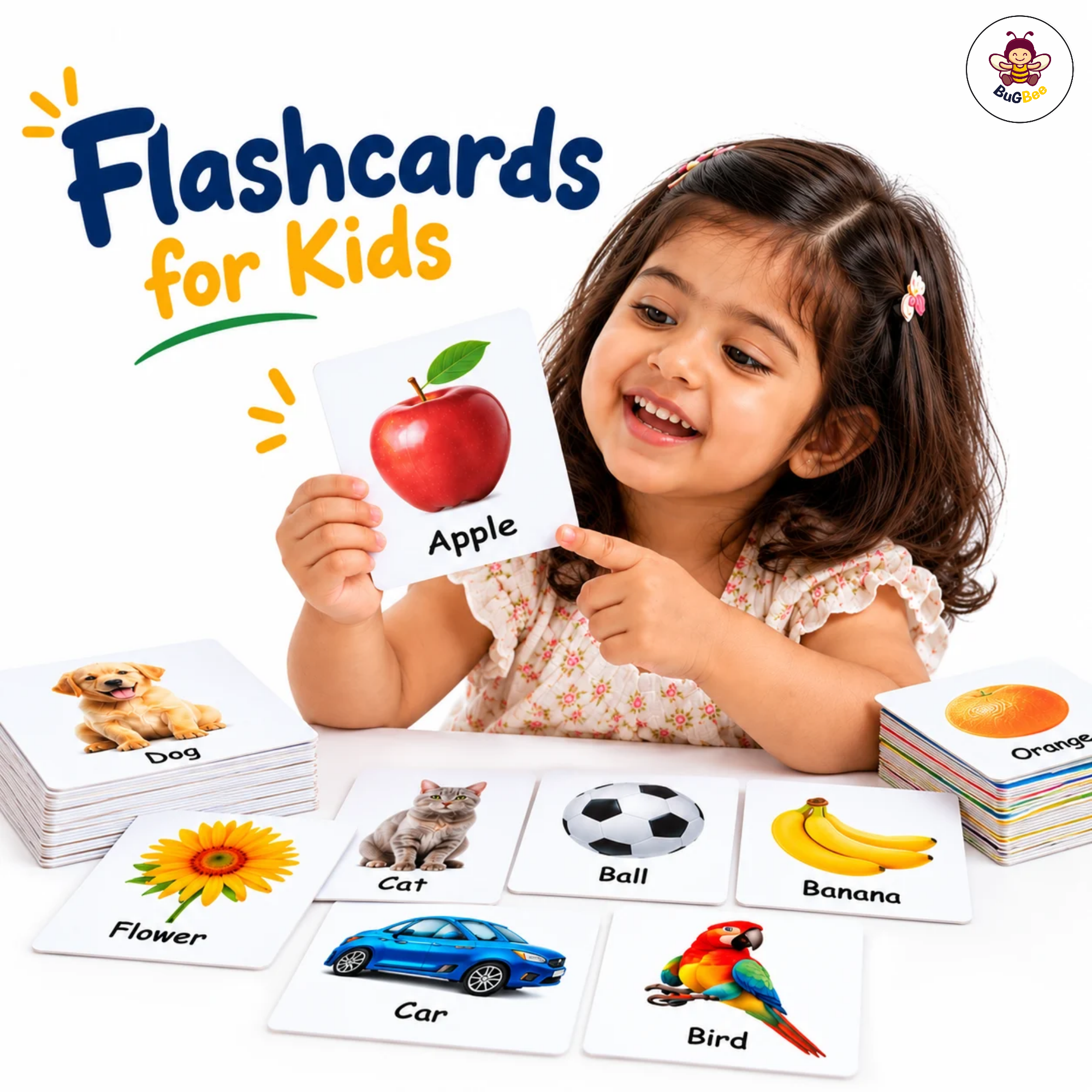
Flash cards work when they are used for two minutes a day and put away before the child gets bored. That is the whole method. This guide to flash cards for kids covers every family by age, from alphabet and animal cards to action words and numbers, and it is honest about the one thing flashcards for kids cannot do: teach a child to read on their own.
Quick Answers: Find Your Set in 15 Seconds
Most parents arrive knowing what their child needs and not what it is called. Find the row that sounds like you.
| What you need | Which set | Age |
|---|---|---|
| Something for a baby who stares at everything | High contrast black and white cards | 0 to 6 months |
| First words and naming | Animals, fruits and vegetables | 1 to 3 years |
| Letters and reading readiness | A to Z alphabet cards | 2 to 5 years |
| Counting and number recognition | Numbers 1 to 100 | 2 to 6 years |
| Words for actions, not things | Action verb set | 2 to 5 years |
| Teaching body awareness | Body parts set | 1.5 to 4 years |
| Vocabulary for a specific lesson | Birds, transport, colours and shapes | 2 to 6 years |
| A bundle that covers several | Three set and five set combos | 1 to 6 years |
What Educational Flash Cards Actually Do
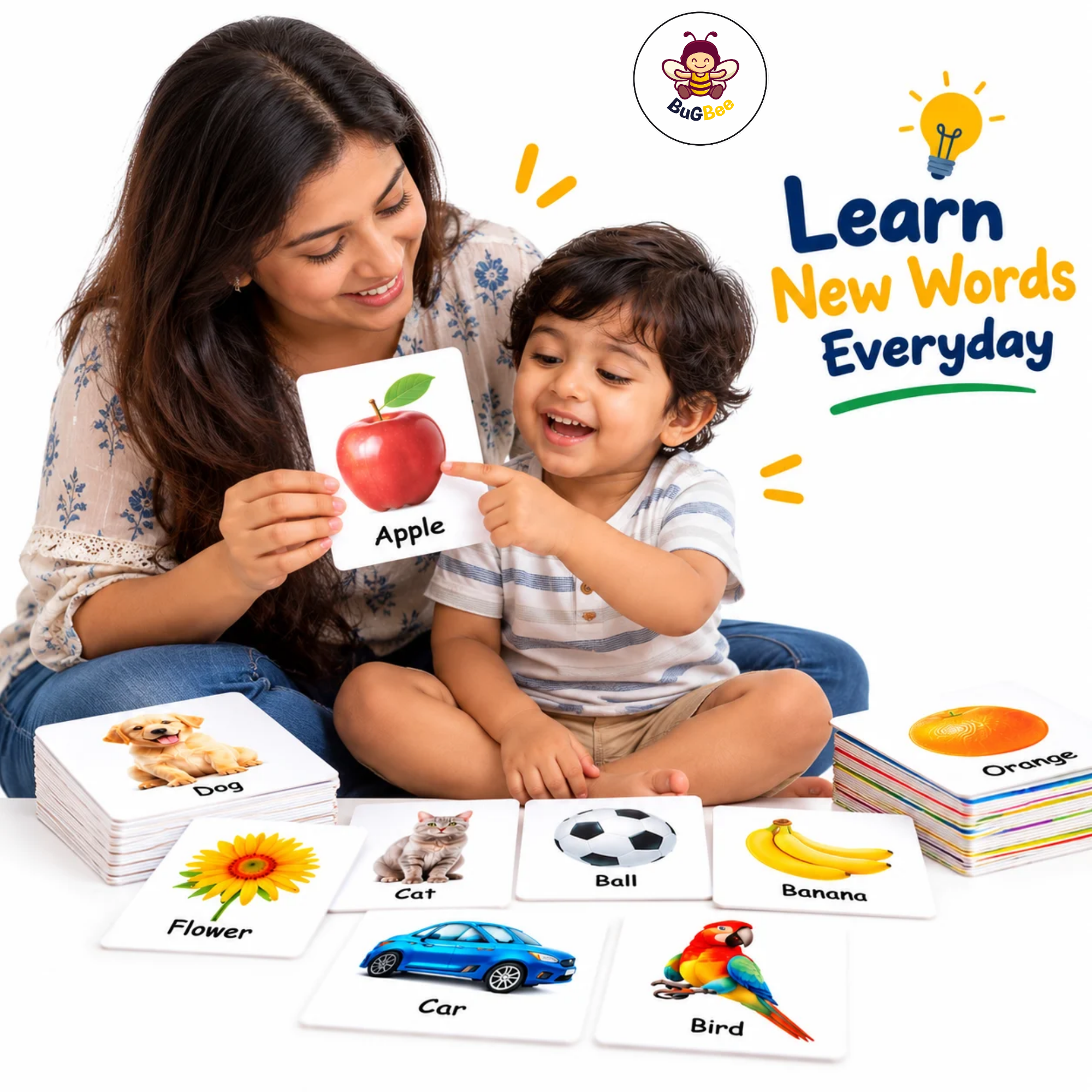
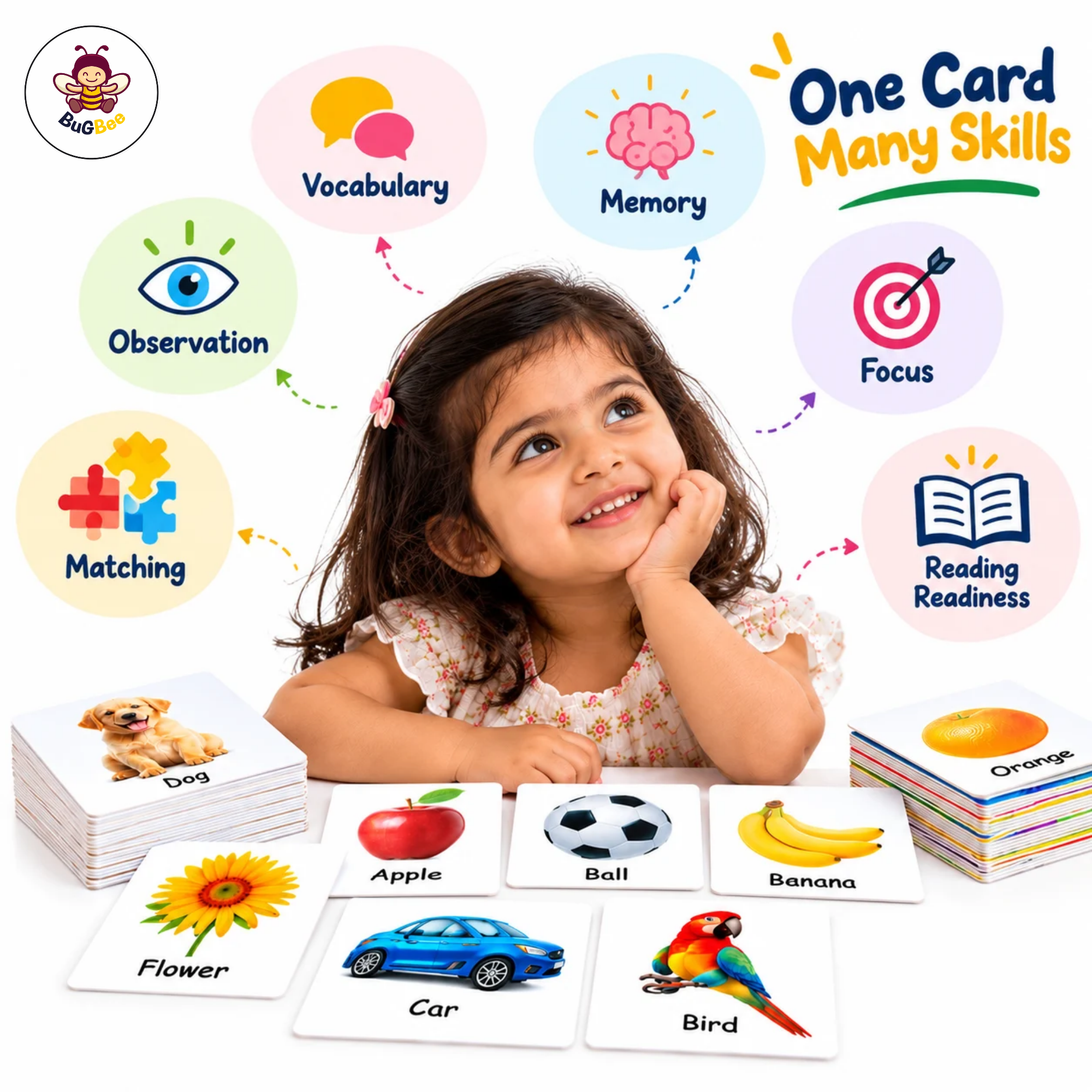
A flash card is a picture and a word, held up for a second, in a hand that is not holding a phone. That is the entire technology. That is also the whole of what educational flashcards are, and it is worth stripping the name back to the object, because the name makes them sound considerably more scientific than they are. What makes it work is not the card. It is the fact that a person is sitting with the child, pointing at something, and saying its name.
This is why they get called visual education flashcards. The card carries the image and the adult carries the meaning, and the child links the two. A child who sees a picture of a cow and hears the word cow at the same moment is doing something a screen cannot replicate, because a screen does not wait for them to look.
Three things flash card learning genuinely builds: vocabulary, the visual skill of matching one picture to another, and the habit of sitting still with an adult for a short task. That habit matters more than most parents expect, because it is the same habit a classroom will ask for later.
The honest limit, which almost nobody writes down
No set of cards teaches a child to read. Reading needs letter sounds blended together, and that is a different job done a different way. Flash cards give a child a large store of words and pictures to work with, and they build letter recognition, which makes reading easier when it starts. They do not replace it. If any shop tells you their cards will teach a two year old to read, ask them how.
How to Use Them Without Turning It Into a Test
Parents who struggle with cards are almost always making the same three mistakes, and all three are easy to fix. What follows is the method we actually show people in the shop.
Two minutes, then stop
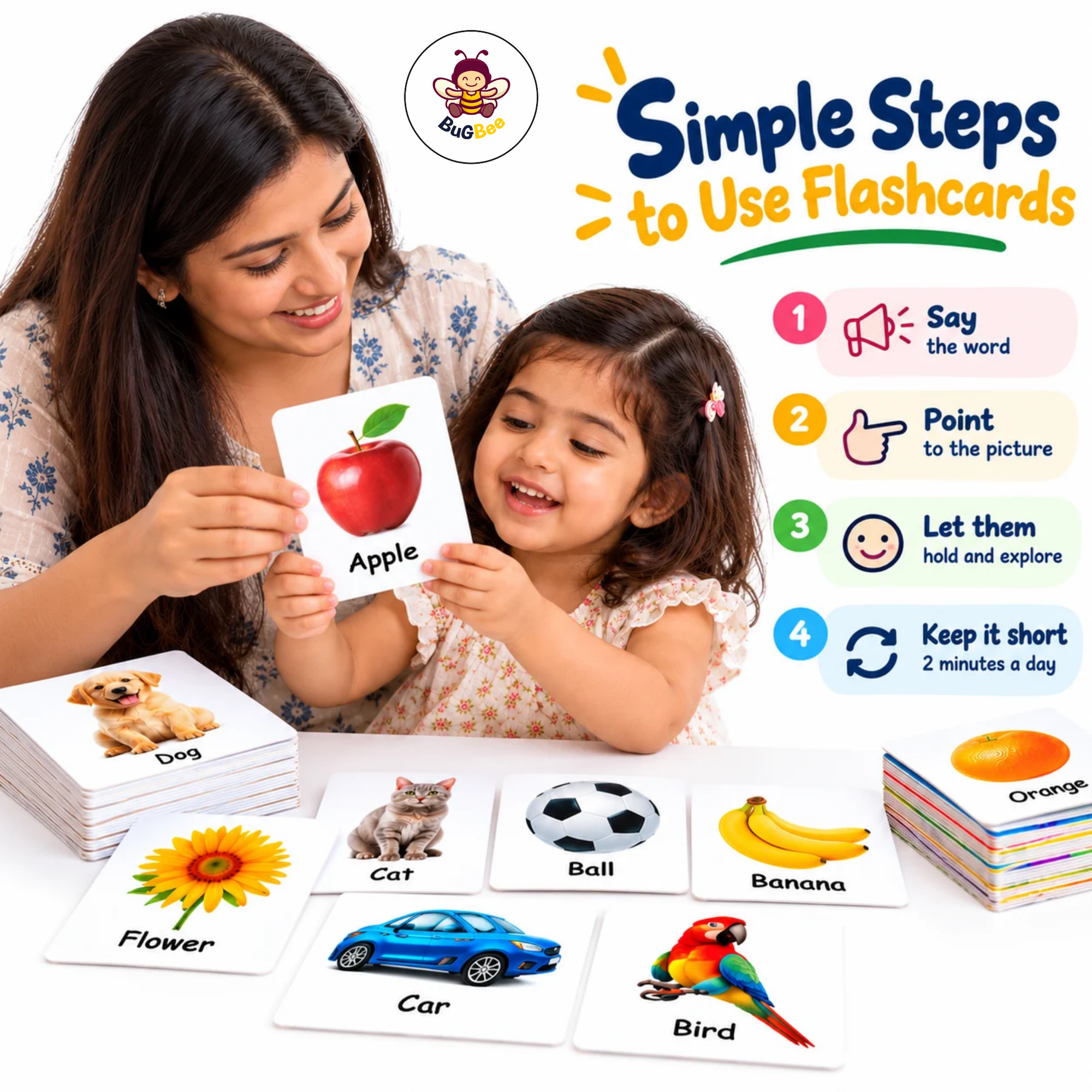
Not ten minutes. Two. A toddler's attention is shorter than the parents of a toddler always believe. Keep a few cards in your bag and do them at the bus stop. Two good minutes every day beats a twenty minute session every Sunday, and the child will ask for the cards rather than avoid them.
Never ask "what is this?"
That is a quiz, and a quiz has a right answer and therefore a wrong one. Say the name, point at the picture, hand the card over. If the child says it back, wonderful. If they turn the card around and look at the back, that is also fine and it is still learning. The moment a child feels tested, they stop.
Keep a small handful, not the whole box
Put six or eight cards in your hand and leave the rest in the box. A whole set spread on the floor is a mess to a small child and a task to clean up. Rotate the handful every week so the set stays new without ever feeling like a lesson plan.
Let them hold the cards
Handing the card over is what turns flash learning cards into a game rather than a presentation. The child gets to keep what they just learned, and they get to bend it, wave it and put it in a pile. Cards that get used get battered, and battered cards are what a well-loved set looks like.
Which Flashcards for Which Age
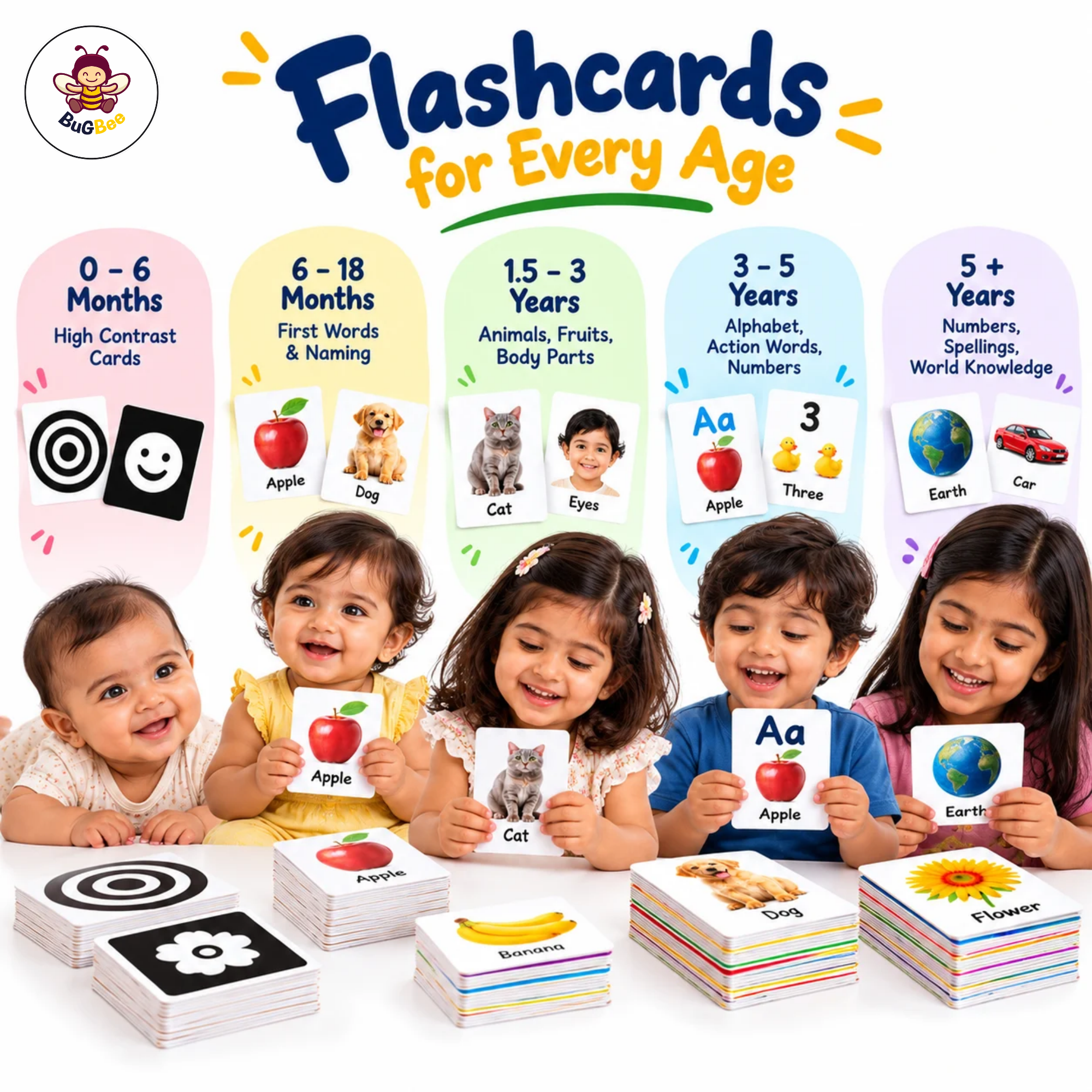
Age is the first question every parent asks us, and the answer changes faster than people expect in the first three years.
| Age | What to use | What they are doing |
|---|---|---|
| 0 to 6 months | High contrast black and white cards | Fixing on strong shapes. Baby led entirely, no schedule |
| 6 to 18 months | Single object pictures, one per card | Reaching, grabbing, turning the card over |
| 1.5 to 3 years | Animals, fruits and vegetables, body parts | Naming everything. This is peak card age |
| 3 to 5 years | Alphabet, action words, numbers | Matching, sorting, starting to link letter to sound |
| 5 years and up | Numbers, spelling, world knowledge | Cards become a game with rules rather than a naming exercise |
For the very youngest, meaning the high contrast flash cards for newborn stage, one thing at a time is the whole rule. Infant learning cards should show a single large shape, with nothing else competing for attention. A plain card does more work than a busy illustration with six objects on it, because a baby can only focus on one thing at a time anyway. That is the whole reason the high contrast newborn set looks so plain compared to the rest of our shelf.
Alphabet Cards: Letters, Sounds and First Words
Alphabet cards are the most useful set you can buy for a child between two and five, and also the easiest to buy badly. The difference is whether the card shows a letter on its own or a letter attached to a picture with a word.
Our a to z alphabet flash cards carry both cases, so a child meets the uppercase letter they see on signs and the lowercase letter they will meet in a book, on the same card. When you are looking at abc learning flash cards, check that. A set with only capital letters is comfortable, because capitals are easier to tell apart. But books are set in lowercase, so the jump happens later anyway. Better to meet both at once.
A good sequence for childrens alphabet cards is to start with the first letter of the child's own name, then the names of people at home, then the whole set. There is no reason to go in order, and the letters a two year old already cares about are the ones they will remember first. Say the letter, say its sound, name the picture, and hand it over.
A note on flashcards for letters
Some sets show the letter and a picture, and some show the letter and a word. The second kind is better for a child who already knows a few letters, because it points at the idea that letters make words. If your child is still learning that a letter is a thing with a name, start with the picture kind and move up when they are ready. Teachers use flashcards for teaching in the same order: recognise, then connect, then read.
Animal Cards: The Most Bought Set, and Why
If you buy one set, buy animals. Flashcards with animals do more work than any other family, because children have an instinctive interest in living things and because animals give you sounds, movements and categories all at once. Our animals flashcards set covers wild and domestic animals in one box, so the child meets the cow and the tiger side by side.
The interest in specific creatures is real, and it tells you what to do. A child who is obsessed with the cat flashcard will sit through the other twenty cards to get back to it. So do not fight it. Start with the one they love, work outward, and let the favourite card be the reward at the end of the handful. For a slightly different audience, the same logic explains why the animals of all kinds flashcards format, meaning a set that puts many species side by side, works better than a set organised by habitat.
Some sets print a letter on each animal, the abc animal flash cards and alphabet animal flash cards format, and they do double duty without asking anything extra of the child: they learn the animal and meet the letter that starts its name, in the same second. Two families are worth separating out. Flashcards wild animals are the ones children find most exciting, because a lion has nothing to do with their day to day life. Wild animal flashcards are also the easiest to sort, since a parent and child can split the pile into two on the floor: animal at home, animal not at home. It is a game, it takes thirty seconds to explain, and it teaches classification without any adult saying the word.
Our birds set covers the feathered side, which is a separate small joy because the child can then go outside and actually look for what they have been seeing on the cards. If you are hunting for a single owl flashcard or a deer flashcard, be aware that single animal cards are usually bought by teachers filling a lesson and rarely sold on their own in India. The practical answer is to buy a set that contains it, or to print the one card you need. We would rather tell you that than sell you a box for one picture.
One common misunderstanding worth clearing up. Cat flashcards and fish flashcards are searched for by parents whose child has a very specific interest, and by people looking for a pet themed party favour. If it is the second, a whole animal set often costs about the same as twenty single printed cards, and you get a better card at the end of it. Our transport set covers the vehicles side of the same idea, and the fruits and vegetables set covers food.
Body Parts Cards: The Set Nobody Expects to Buy
Body parts is the quiet overachiever of the whole category. Parents come in for animals and leave with both, because body parts flashcards answer a very specific problem: a two year old who has learned the word for every object in the house can now point at their own eye, nose and hand and say what they are. It is also the set we most often recommend as a second purchase, once animal flashcards for kids have been used properly for a few weeks.
Our body parts flash cards for toddlers pair each card with a clear picture, and they work as a two person game because the adult can point at the card and then at themselves. Flash cards of body parts are the only set where the child is also the answer. That is why it holds attention longer than the others at the same age.
It also does something nobody advertises. A child who knows the correct words for their own body can tell an adult what hurts, or where something happened. That is a small protective benefit, and it is the reason we recommend this set to parents who ask what to buy after animals.
Action Words, Spelling and Numbers
Once a child knows a hundred object names, the next thing they need is verbs, and this is where most home collections stop and most learning stalls.
Our action verb set shows a person doing something rather than an object sitting still. Action cards are harder for a child than object cards, and that is exactly why they are worth having. A picture of a cup is one thing. A picture of someone drinking from a cup introduces an idea, and ideas are what sentences are made of. Searching for flash cards for action words, or simply wanting flash cards action content for a four year old, usually means the child has moved past naming and is ready to describe. If you are weighing up action word flashcards against another object set, the verbs are harder on purpose, and that difficulty is the value.
Numbers are the other half of that step. Our counting set runs from 1 to 100 and is genuinely multiple toys in one box. A set of number cards at this size does the job of three separate purchases at other ages. A two year old uses the low cards to count objects. A four year old uses the higher cards for number recognition. If you are looking for flashcards for mathematics, be clear about what stage you mean: number recognition and counting are well covered by a card set, and everything past that, meaning addition and subtraction, is better done with counters and real objects than with a card that shows a sum.
For spelling, the honest answer is that flashcards for spelling work better as a game than as a drill. Lay five cards down, remove one, see if the child notices. Give them three letters and ask which one starts a word they know. The A to Z set is the foundation here, and the action set extends it because verbs are easier to spell than abstract nouns.
If your child is following a phonics programme at school
Many Bangalore preschools teach reading through a structured phonics scheme, and parents then look for matching material at home. To be straightforward about it: our cards are not the Jolly Phonics picture flash cards and we do not sell that programme. If your school is using flashcards jolly phonics in class, ask the teacher which sounds they have covered this term, and practise those sounds with your own set. What matters is the sound, not the branding on the box. Our letter cards support any scheme, because they show the letter, a picture and the word together.
Montessori Cards and the Visual Approach
Several of our sets are built the Montessori way, meaning one clear object per card on a plain background, no cartoon decoration, and real photographs or realistic drawings rather than smiling characters. This is not a marketing label. It is a teaching decision, and you can feel the difference the moment you hold two cards side by side.
A card where a cat looks like a cat teaches a child what a cat looks like. A card where a cat is a purple cartoon wearing a hat teaches them to recognise a drawing of a character. Both are fine as decoration. Only the first one is useful as a reference. If you are comparing montessori flash cards against the cheaper sets, that is the difference you are paying for, and it is the only one that matters.
Our 2 years set and our five card combination both carry this approach, and they are the two we most often recommend to parents who are setting up a first shelf at home rather than buying a single box.
Flashcards or Wooden Toys?
Parents ask us this constantly, usually while holding one of each, and it deserves a straight answer rather than a push towards whatever is more expensive.
Flash cards are portable, cheap, and excellent for vocabulary and naming. Our wooden toys in Bangalore guide covers the other side: solid wood toys are for grip, stacking, sorting and the physical problem solving that a card cannot offer, and they survive being thrown across a room. The two do different jobs.
A workable pairing is a card set for the ten minutes before dinner and a wooden peg board for the twenty minutes after. If you have to choose one for a child under two, choose the wooden toy, because at that age hands are doing more learning than eyes. If the child is three or older and talking constantly, the cards will be used more.
What we would not recommend is buying three card sets at once. Children work through one properly and ignore the rest. Buy the family that matches what your child is interested in this month, use it for six weeks, and then add the next one.
What to Check Before You Buy Any Set
Cheap card sets fail in predictable ways, and all of them are visible in the shop if you know what to look for.
| Check | Why it matters |
|---|---|
| Thickness of the card | Thin cards bend on the first afternoon and crease permanently. A card a toddler cannot crumple is the whole point |
| Rounded corners | Square corners on a card held by a small hand are an edge waiting to catch an eye |
| Print quality and colour | A faded print of a cat is not teaching what a cat looks like. Look for realistic images, not cartoons |
| Card size against the hand | For under-threes, a bigger card is easier to hold and harder to swallow. Small cards look neat and get ignored |
| Whether the spelling is Indian English | Colour, aeroplane, lorry. A card that teaches the American word for an object will be corrected at school |
| What is on the back | A blank back is fine. A back with the answer written on it turns the card into a test. Sometimes you want that, usually you do not |
Buying in Bulk for a Playschool
Playschools, activity centres and tuition classes buy card sets in bulk, and the questions are always the same three, so here they are.
| What you need | How it works |
|---|---|
| A few sets for one classroom | Retail price, no minimum, walk in and take them |
| A class set of one family | Carton pricing starts here. Ask us for the current minimum |
| Mixed cartons across families | Possible, and usually what a preschool actually wants |
| Term by term replacement | Tell us your term dates and we will hold stock |
One thing worth asking any supplier: whether the same set will still be available next term. Cards get lost and damaged in a classroom, and a replacement that looks different from the rest causes more trouble than it solves. We hold the same core families year round.
Where to See Them in Bengaluru
Card thickness is the one thing a photograph cannot show you, so it is worth holding a set before you buy it. We keep every family on the shelf at our Rajajinagar shop, and you can compare them side by side in about four minutes. If you have been looking for a flashcards shop rather than a marketplace listing, that is the difference: you can open a box and feel the card before you pay for it.
| Address | 1st Floor, 205/A, 55th Cross, Opposite ABC Park, 4th Block, Rajajinagar, Bengaluru, Karnataka 560010 |
| Phone / WhatsApp | 99860 03534 |
| Opening hours | Monday to Sunday, 10:00am to 8:00pm |
| Delivery | Across Bengaluru, and online across India |
Frequently Asked Questions
Straight answers, including the ones where the answer is no.
What age should I start flash cards with my baby?
Around four to six months, and only for a few seconds at a time. Before that a baby's eyes are still developing and the strong black and white shapes are the only ones they fix on reliably. There is no benefit in starting earlier and no harm in starting later. If your child looks away, the session is over.
How many cards should we do in a day?
Six to eight, twice a day, is plenty for a two year old. The number that matters is not how many cards but how many days in a row you manage it. A child who sees eight cards every evening for a month will know them. A child who sees sixty cards once will not.
Do flash cards actually work, or are they just a habit?
They work for what they are good at, which is vocabulary, naming and picture recognition. They do not teach reading, writing or maths on their own. Treat them as one tool among several, alongside wooden toys, books and ordinary conversation, and they earn their place. Expect them to do everything and you will be disappointed by week three.
Which set should I buy first?
Animals, almost always. It holds attention longest, it has the widest age range, and it gives you sounds and categories to talk about. If your child is already talking in short sentences, go for the action verb set instead, because they have moved past naming things.
Are flash cards safe for a baby who puts everything in their mouth?
Supervise, always. A thick card with rounded corners is much safer than a thin one, but it is still paper and it will soften and come apart if it is chewed. For a child in the mouthing stage, keep cards for supervised sessions and hand over a wooden or cloth object for independent play. Our cards are not designed as teething objects and we would not want you to treat them as one.
My child has no interest. What am I doing wrong?
Probably nothing. Either the set does not match what they are interested in this month, or the session is running longer than two minutes, or it has started to feel like a test. Put the cards away for ten days and come back with one card, not eight. It almost always works.
Should I use Indian English spellings?
Yes, and check before you buy. Colour, aeroplane, lorry and maths are what your child will meet at school here. A set printed for the American market will teach them a word they will be corrected on. It sounds like a small thing until a five year old is confidently wrong about a spelling.
Can I make my own instead of buying?
Yes, and for a single specific card it is often the sensible answer. Print on thick paper, back it with card, and round the corners with scissors. What you cannot easily match at home is the print quality and the card weight, which is why a printed set at home tends to last a fortnight with a two year old. For one card, print it. For a set you plan to use daily, buy one.
My child is 5 and still likes cards. Is that too old?
No. The cards change job rather than stop. At five they become a game with rules: turn them all face down and match pairs, or take a card and act it out for the others to guess. Action word sets are the best family for that, because the child is performing rather than reciting.
Do you have cards in Kannada, Tamil or Hindi?
Our card sets are in English. For regional scripts we stock wooden alphabet boards and puzzle boards instead, and they are a better format for Indian scripts anyway, because a child can feel the shape of the letter rather than just look at it. Ask us in the shop and we will show you both.
Can I buy a single card, like a cat or an owl?
We sell sets rather than single cards, because printing one card costs nearly as much as printing a box. If you need one specific animal, buy the family that contains it, or print the single card at home on thick paper. Both are reasonable, and we will tell you which is cheaper for your situation.
How do I clean them?
A dry cloth for everyday, and a barely damp cloth with mild soap for anything sticky. Never soak a card and never rub it hard, because the print sits on the surface and will lift. Dry them flat rather than propped up, or the card will dry with a curve in it that never comes out.
Can I buy in bulk for a preschool?
Yes, by the carton, and mixed cartons are fine. Send us the number of classrooms, the age groups and your budget per classroom, and we will send a price the same day rather than a catalogue.
Tell Us the Age and We Will Tell You Which Set
Send us your child's age and what they are currently obsessed with, and we will tell you which two sets are worth owning. One WhatsApp message, no obligation, and we will happily tell you if the answer is one set rather than three.
Two minutes a day beats an hour on Sunday.
Every set in our shop costs less than a restaurant meal for two, and any one of them used properly for a month will teach your child more than three sets left in the box. Start with one, use it daily, and let them ask for more.
More from BugBee Toys
- Wooden Toys in Bangalore: Where to Buy, What to Check and What They Cost
- Toy Shop in Bangalore: Visit Our Rajajinagar Store
- Wholesale Toy Shop in Bangalore: MOQ and Pricing
- ABC Order: Learning Alphabets with Educational Toys
- What Toy Age Labels Really Mean
- Toy Safety for Toddlers: A Parent's Checklist
- Best Learning Toys for Kids in Bangalore
- Shape Sorter vs Puzzle for Toddlers
- Peg Boards for Toddlers: What They Actually Teach
- Shop All Flash Cards
- Body Parts Flash Cards
- Action Verb Flash Cards