
Wooden Puzzles and Peg Boards for Kids
Updated October 2026 · 17 min read · BugBee Toys, Rajajinagar · Bengaluru
A wooden puzzle for kids costs ₹149 to ₹899, and the right one depends on one number: how many pieces your child can hold at once. This guide covers peg boards, alphabet and number puzzles, shape and animal puzzles, jigsaws and stacking games, what each one actually teaches, and the four things to check before you pay.
Quick Answers: Find Your Puzzle in 15 Seconds
Most parents arrive knowing what their child needs and not what the format is called. Find the row that sounds like you.
| What you need | Which format | Age |
|---|---|---|
| A first puzzle with no small parts | A small pegboard with five big knobs | 1 to 2 years |
| Something that teaches words | Fruits, vegetables or animals peg puzzle | 1.5 to 4 years |
| Letters, before school | Alphabet peg board or round abc puzzle | 2 to 5 years |
| Numbers and counting | Numbers and shapes wooden puzzle | 2 to 5 years |
| Shapes and colours | Shapes and numbers combination board | 2 to 4 years |
| Something genuinely tricky | Wooden jigsaw brain teaser, or the stacking tower | 4 to 8 years |
| A gift that looks impressive | 3D wooden capital alphabet and number set | 3 to 7 years |
| Everything in one box | The peg puzzle combo, shapes to numbers | 1 to 5 years |
What a Peg Board Actually Teaches
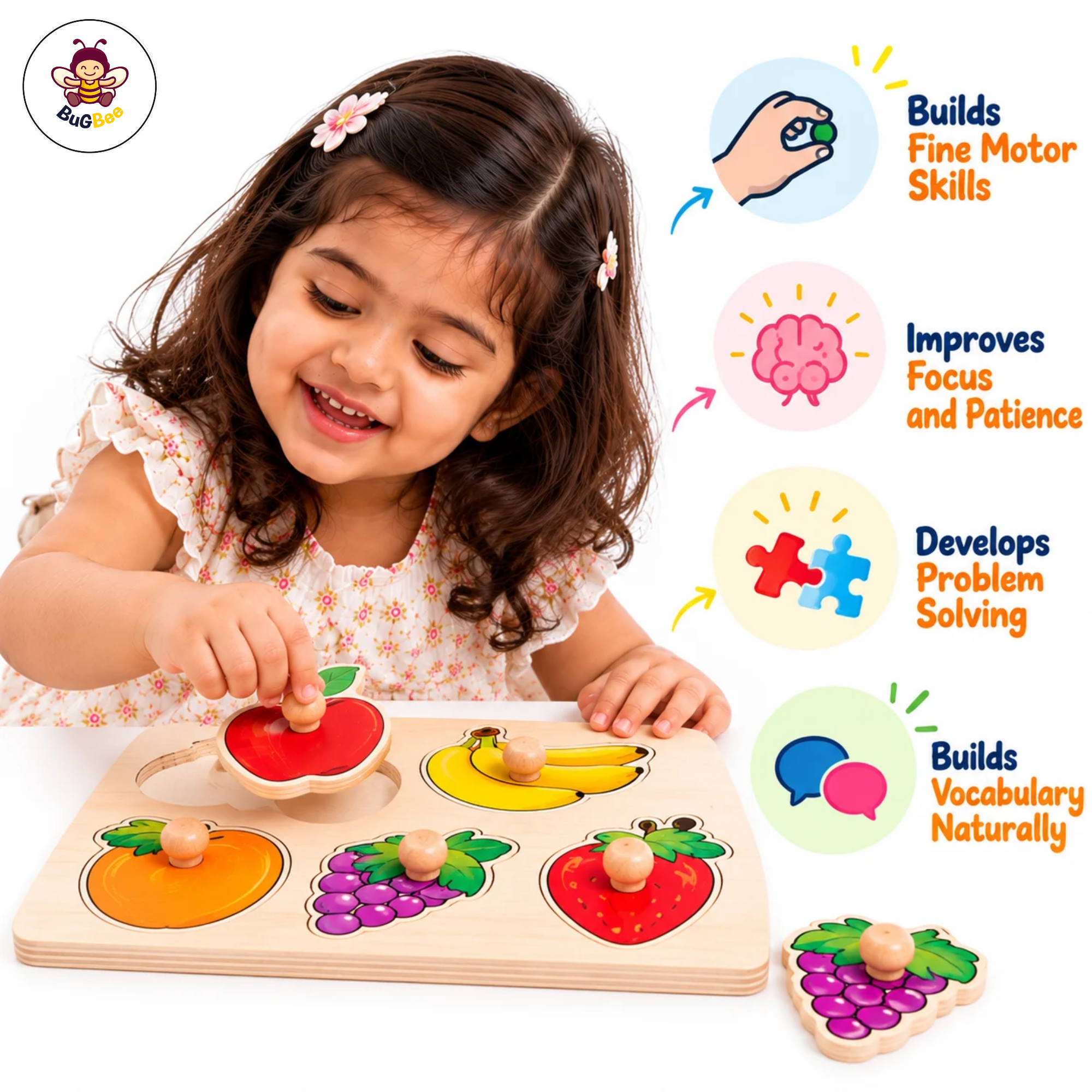
A peg board looks like the simplest thing in the shop. It is a flat wooden board with a picture cut into it, and each picture has a small knob on top so a hand can lift it out. And it quietly does more work than almost anything else on the shelf at that age.
Three things, in order. First, the grip. A puzzle peg is the exact size that forces a child to bring thumb and forefinger together rather than raking with the whole hand, and that pinch is the same grip they will need for a pencil in three years time. Second, matching: the piece only fits one hole, so the board corrects the child without an adult saying anything. Third, naming. Every piece is an object with a word, and a two year old lifting a banana out of a board and hearing the word banana is doing vocabulary work that looks like play.
There is a fourth thing that parents do not expect. Taking a board apart and putting it back requires patience, and patience is a skill a child has to practise somewhere. A peg board is one of the safest places to practise it, because getting it wrong costs nothing.
The one number that decides everything
Not the age on the box. The number of pieces your child can hold at once. A one year old can hold one and hand it back. A two year old can hold two and compare them. A three year old can hold five and start sorting. If a puzzle has more pieces than your child can hold, it will end up on the floor, and the child will not learn anything except that puzzles are frustrating.
Peg Board, Pegboard, Knob Puzzle, Jigsaw: The Names Explained
This is genuinely confusing and nobody explains it, so here it is in one place. Parents search all of these looking for the same object, and it is worth knowing what you are actually asking for before you walk into a shop.
| The name you hear | What it actually is |
|---|---|
| Peg board, pegboard | Both spellings mean the same object. A board with pegs or knobs. One word or two makes no difference to what you get |
| Knob puzzle, knobbed puzzle, pegged puzzle | The same thing again, named by nurseries and therapists. If a listing says knobbed puzzle, expect a thick board with big handles |
| Jigsaw | A picture cut into interlocking pieces, with no pegs and no board. Harder, for older children |
| Tangram | Seven flat geometric shapes rearranged to make pictures. Also called a wooden tangram puzzle. We do not stock these, see below |
| Peg board puzzle | Usually means a peg board with an educational theme, letters or numbers rather than a picture |
One warning on shopping. Searching for a pegboard board or typing pegs pegboard into a marketplace gets you a wall of near identical listings with the words jammed together by sellers, and the photographs tell you almost nothing about the wood. Whichever of those phrases you used to get here, what you are looking for is the same: a thick board, big knobs, and a print where you can tell what the animal is.
Which Puzzle for Which Age
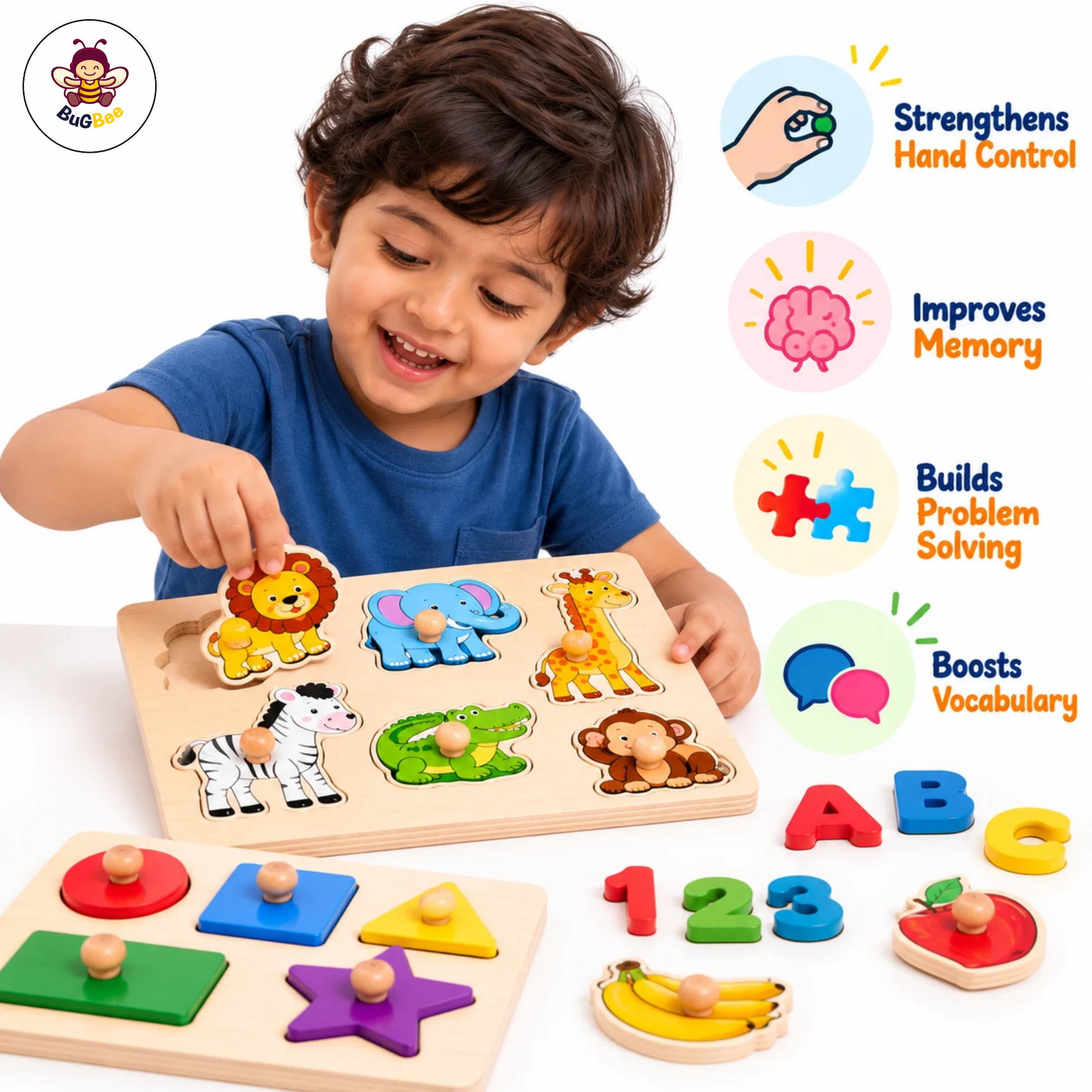
Age labels on a box are about safety. What follows is about what the child will actually enjoy, which is a different question.
| Age | Format | Pieces |
|---|---|---|
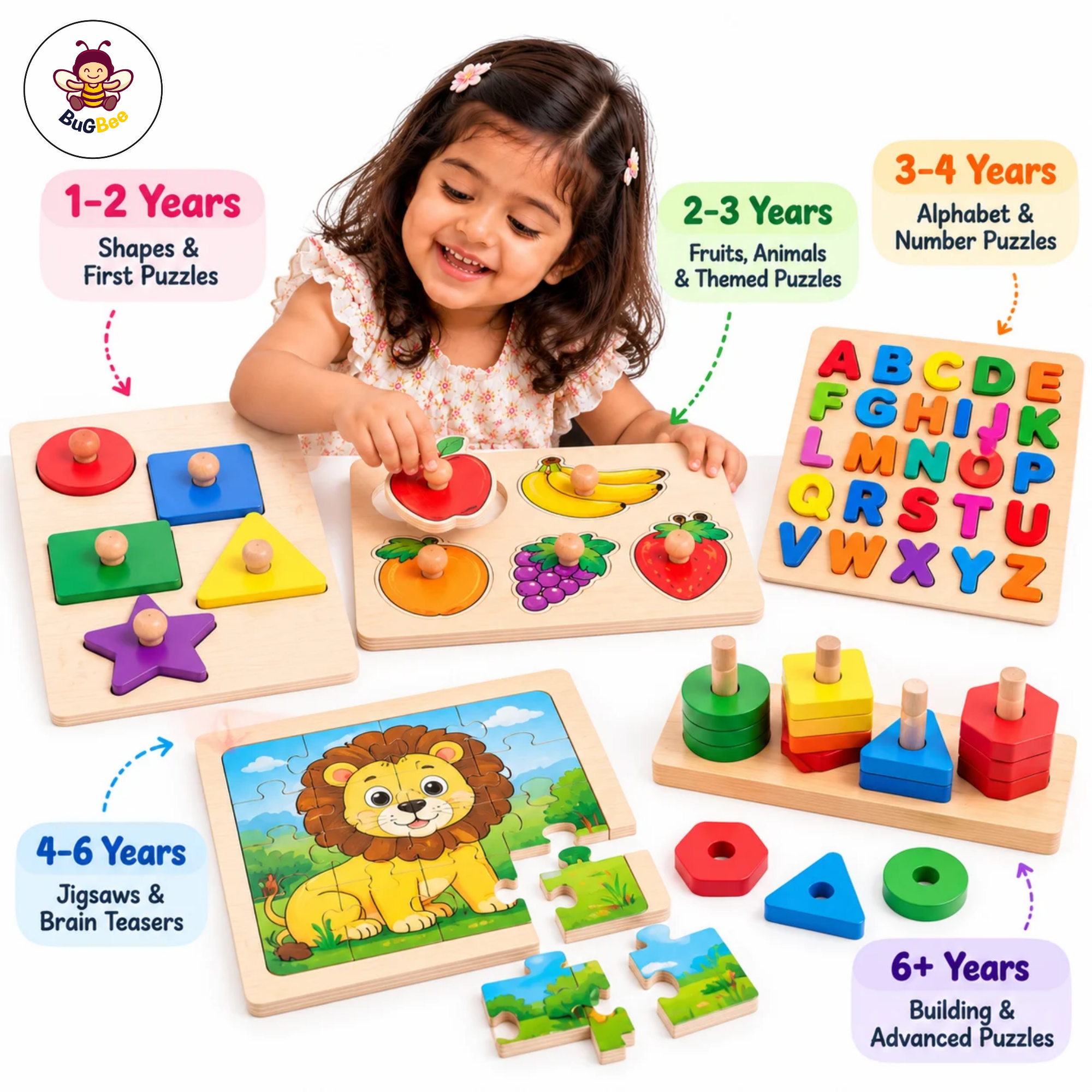
| 1 to 2 years | Single peg board, very thick pieces, no loose pegs | 3 to 5 big pieces |
| 2 to 3 years | Themed peg boards, fruits, vegetables, animals, body parts | 6 to 12 pieces |
| 3 to 4 years | Alphabet, number and shape boards, jumbo puzzles | 12 to 30 pieces |
| 4 to 6 years | 3D puzzles, jigsaws, brain teasers, stacking games | 30 pieces and up |
| 6 years and up | Strategy and construction puzzles, tic tac toe, blocks | 54 pieces and up |
For infant wooden puzzles, meaning the very first one, ignore the theme entirely. Buy the one with the biggest knobs and the fewest pieces. A board with three enormous shapes on it teaches more than a board with twenty tiny animals, because a one year old can actually complete it, and completing it is the whole point.
Peg Boards and Knob Puzzles
This is the family we sell most of, and it is where we would start any child under three. A childrens peg board is forgiving: the piece can only go one way, so the board does the correcting and the adult can stay quiet. That matters more than it sounds, because a child being corrected constantly stops enjoying the puzzle.
A childrens peg boards collection at home usually grows in a predictable order. First a small pegboard with five chunky pieces, usually shapes. Then a themed board, and the theme that works best at that age is food, because the child sees it every day. Then body parts, which is the quiet overachiever of the whole category. Our wooden educational peg puzzle combo covers shapes, body parts, fruits, vegetables, alphabets and numbers in one set, which is what most parents buy when they do not want to guess.
Our wooden peg board range is solid wood with rounded corners and non-toxic paint, and the pieces are thick enough that a two year old cannot bend one. The board pegs are big enough to grip but not big enough to feel babyish at three, which is a narrower window than it sounds.
One specific set is worth calling out separately: a peg board letter set. Ours uses pegs shaped like letters, and the physical act of lifting an A out of a hole and putting it back is surprisingly effective preparation for writing, because the child is learning the shape with their hand before they ever hold a pencil. We keep these in English and also in Hindi, Tamil and Kannada scripts, which almost nobody else in Bangalore does.
Two peg board searches that mean something else
If you arrived searching for peg board gaming, you are looking for something different: adult tabletop games, sometimes called pegboard games, which use pegs on a drilled board for strategy or solitaire. That is a separate product and we do not stock it. Puzzle peg is the other one. It is simply the knob you hold, not a separate item, so do not go looking for it as a product.
Alphabet, Number and Shape Puzzles
Alphabet puzzles
Once a child has the grip, the boards become teaching tools, and this is where a wooden alphabet puzzle earns its place. Our wooden abc puzzle comes as a round board where each letter sits in its own recess and can only go one way, and we also keep a set of flat abcd boards for children who are ready to line letters up rather than fit them into holes.
If you are weighing up an abc puzzle board against an abc puzzle wooden set, the difference is format rather than quality. The board format is easier because the recess guides the piece. The flat format is harder and travels better. For a first letter puzzle, take the board. For a child who already knows the alphabet and is starting to build words, take the flat one.
Number puzzles
A wooden number puzzle does something a flash card cannot, because counting is a physical act before it is an idea. When a child lifts the number three out of a board and puts it back, the shape of the numeral becomes a thing in their hand. Our numbers and shapes wooden puzzle pairs the two, and our 3D wooden capital alphabet and number set goes further by having the pieces stand upright, so a four year old can build a word with them rather than only match them.
Shape puzzles
Shape puzzles are the least glamorous and the most useful. A wooden shape puzzle teaches the difference between a circle and an oval, which sounds trivial until you watch a two year old try to push a circle into an oval hole and realise they are learning that shapes have rules. Our shapes and numbers combination board and our numbers and shapes wooden education set both do this, and they are the puzzles we most often see reused by a second child.
Animal Puzzles
Which animals to start with
If you buy one themed puzzle, buy animals. A wooden animal puzzle holds attention longer than any other theme, because children have a natural interest in living things, and because an animal gives you a sound, a movement and a category all at once.
Our animal wooden puzzles come as a jungle set, an ocean set, an insect set and a combined jungle and ocean board. If you are choosing between animal puzzle wooden sets, the useful question is whether the animals in the set live somewhere your child has actually been. A child who has seen a cow will remember the cow. That is why we also keep fruit and vegetable boards, since those are the objects a child meets at the table every day.
Two gaps we do not fill
Two gaps worth being honest about. Searching for a wooden bird puzzle will not find one here, because we stock bird learning cards rather than a wooden bird board, and the cards are genuinely better for bird identification because you can carry them outside. And if you are looking for a puzzle farm animals set, be aware that we do not have one. Our animal puzzles are jungle, ocean, insect and the everyday fruit and vegetable boards. A farm set is on our list, but we would rather tell you it is not here than sell you a jungle board twice.
3D, Jigsaw and Brain Teaser Puzzles
This is the family for children who have outgrown boards, and it is where a puzzle stops being a matching exercise and becomes a problem.
3d wooden puzzles are the gentlest step up. Our 3D wooden alphabet board has pieces that stand up in the board rather than lying flat, which adds a second dimension for a small hand to manage. When parents ask about 3d wooden toys generally, this is usually what they mean, and it is a good first taste of three dimensional building without the frustration of a full construction set.
Our wooden puzzles brain teasers set is a colourful jigsaw game that also stands in as wooden jigsaw puzzles for older children, and it is the one we recommend to parents of a five year old who finishes everything else too quickly. Jigsaws are worth understanding properly, because they are a different kind of task: there is no board and no guide, so the child has to hold the whole picture in their head while working on a small part of it. That is genuinely hard mental work and it is why jigsaw puzzles stay interesting for years.
We do not sell wooden jigsaw pieces separately, so if you have lost pieces from a set, the practical answer is to contact us with a photograph and we will tell you whether we can replace it. And a note on wooden brain puzzles: the name covers everything from simple jigsaws to proper mechanical puzzles, and the word brain does not tell you how hard a puzzle is. Look at the piece count and the picture, not the label.
Then there is the stacking game, which is the one adults quietly end up playing. Our wooden tetris puzzle is a 54 piece tower with dice, and it is the same format people know as wood tetris or a tumbling tower. It looks like a children's toy and it is genuinely a family game, which is the highest compliment you can pay a wooden toy.
Three products we do not stock, so you do not waste a trip
A wooden rubik's cube is a plastic puzzle with a mechanism inside. The wooden versions sold online are usually decorative rather than functional, because solid wood cannot twist the way a cube mechanism needs to. We do not stock one and we would not recommend a wooden version over the real thing.
A wooden tangram, or wooden tangram puzzle, is seven flat shapes that rearrange into pictures. It is a lovely puzzle and it is not on our shelf. If you specifically want one, buy from a seller who shows the actual shapes, because cheap tangram sets are often uneven, and uneven pieces will not make the pictures they are supposed to make.
A giraffe abc puzzle is a very specific product, usually a wooden board shaped like a giraffe with letters along its neck. We do not stock it. If you want a giraffe specifically, the closest thing we have is our jungle animals puzzle, which has the animals but not the letters.
Wooden Puzzles for Preschoolers, and What They Cost
Wooden puzzles for preschoolers are where the range widens and prices spread out, so it is worth knowing what you are actually paying for.
| Format | Our price band |
|---|---|
| Single theme board, 5 to 8 pieces | ₹149 to ₹299 |
| Alphabet or number board | ₹249 to ₹499 |
| 3D alphabet and number set | ₹449 to ₹699 |
| Multi theme peg puzzle combo | ₹599 to ₹899 |
| 54 piece stacking tower | ₹499 to ₹799 |
People search for a cheap pegboard, and it is worth being straight about what that word gets you. A pegboard price under about ₹120 in India almost always means three things: thinner board, smaller knobs, and a printed picture glued onto a board rather than painted wood. None of those is dangerous, but the first two make the puzzle harder for a small hand and the third means the picture peels within a year. If you want wooden puzzle toys that survive a second child, the floor is around ₹149, and below that you are buying a puzzle for a season rather than for years.
That said, wooden learning puzzles are not expensive the way people assume. A ₹149 board used every day for two years costs less per week than a packet of biscuits, and it will not end up in a landfill when it is done with. The honest advice is to buy one good board rather than three cheap ones, and to buy the next one only when the current one has stopped being interesting.
The One Safety Issue With Peg Puzzles
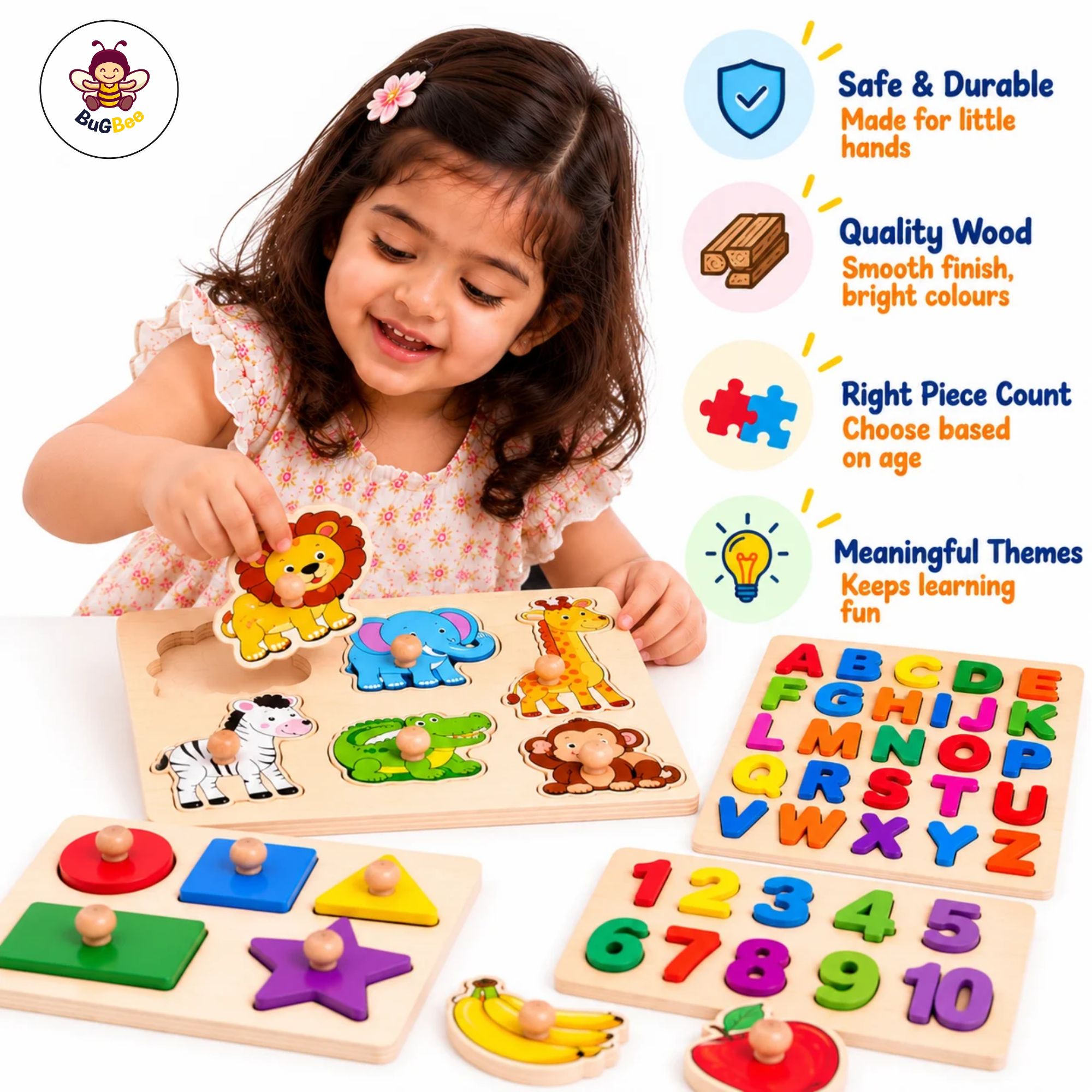
Peg puzzles have a specific risk that flat puzzles and jigsaws do not, and it deserves its own section rather than a footnote.
The peg itself can come off. On a well made board it will not, but on a cheap one it will, and a detached peg is a small wooden cylinder about the size and shape of a choking hazard. Before you hand a peg board to a child under three, take each piece and pull the peg hard, twisting slightly. If it moves at all, that board is not for a child who still puts things in their mouth.
The other three checks are quick. Run a bare finger around the cut edge of every hole, because that is where splinters live and a chipped edge can catch a finger. Check the paint has no chips at the corners, which is where a board takes its knocks. And confirm the board has a BIS mark and an age recommendation on the packaging, because in India toy safety marking is compulsory for good reason.
For cleaning, a barely damp cloth and mild soap, wiped dry straight away. Never soak a wooden puzzle and never put one in a dishwasher, because water swells the grain and lifts the print. If a piece has been chewed and the edge has gone rough, sand it lightly with fine paper and wipe it clean rather than throwing the set away. There is a longer version of this in our wooden toy cleaning guide.
Wooden or Cardboard
Cardboard jigsaws are cheaper, lighter and come in far more designs. Wood is heavier, more expensive and almost impossible for a small child to destroy. If your child is gentle and you want a new puzzle every month, cardboard makes sense and we would not argue with you. If your child is a two year old who bends things, wood is the cheaper purchase over three years.
There is also a sensory difference that is hard to describe and obvious in the hand. Wood is cool and a little heavy, and it makes a sound when pieces meet. For most children that makes a puzzle feel like an object rather than a picture. Our guide to wooden toys in Bangalore goes further into how to tell real wood from MDF before you buy, which matters because a lot of cheap wooden puzzles are MDF with a printed grain.
Puzzles and Early Literacy
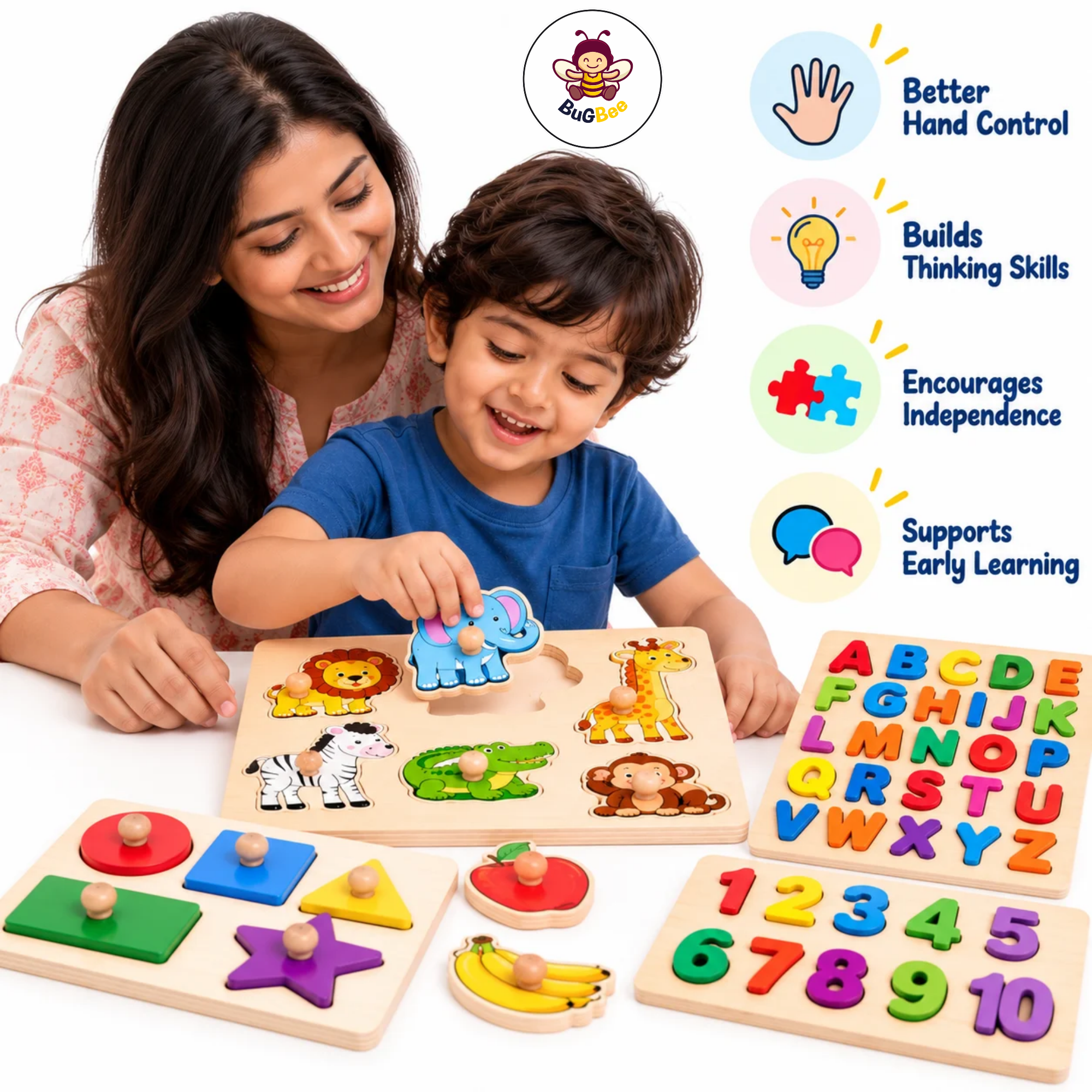
Two things happen before a child reads, and puzzles help with both. The first is shape recognition: a child who has handled a wooden D hundreds of times recognises it in a book faster than a child who has only seen it on a page. The second is the habit of looking closely at something and working out how its parts fit, which is exactly what reading is once you get past the first few months.
After the alphabet board, most parents add a set of letter or word cards, because cards and puzzles do different jobs. The board teaches the shape of a letter through the hand. Cards build the link between the letter, the word and the picture, and they can travel in a bag. Our parent's guide to flashcards for kids covers which set to buy and at what age, and if you are choosing between the two for a two year old, buy the puzzle first. Hands learn earlier than eyes.
Buying for a Playschool or in Bulk
Preschools, activity centres and tuition classes buy puzzle sets by the dozen, and the questions are always the same three.
| What you need | How it works |
|---|---|
| A few boards for one classroom | Retail price, no minimum |
| A class set of one theme | Carton pricing starts here. Ask us for the current minimum |
| Mixed cartons across themes | Possible, and usually what a preschool actually wants |
| Replacing lost pieces each term | Tell us the term dates and we will keep the same ranges in stock |
One thing worth asking any supplier: whether the same board will still be available next term. Puzzles lose pieces in a classroom, and a replacement that looks different from the rest causes more trouble than it solves. We hold the same core ranges year round, which is the boring answer and the useful one.
Where to See Them in Bengaluru
Board thickness and knob size are the two things a photograph cannot show you, and they are the two things that decide whether a puzzle works for your child. We keep every family on the shelf at our Rajajinagar shop so you can compare them side by side in about five minutes.
| Address | 1st Floor, 205/A, 55th Cross, Opposite ABC Park, 4th Block, Rajajinagar, Bengaluru, Karnataka 560010 |
| Phone / WhatsApp | 99860 03534 |
| Opening hours | Monday to Sunday, 10:00am to 8:00pm |
| Delivery | Across Bengaluru, and online across India |
Frequently Asked Questions
Straight answers, including the ones where the honest answer is no.
What is the difference between a peg board and a knob puzzle?
Nothing. They are two names for the same object, and so are pegged puzzle, knobbed puzzle and peg board puzzle. A peg board usually means the knob is a separate piece of wood fixed on top, while a knob puzzle sometimes means the knob is carved as part of the piece. In practice, if the piece has something to hold, it is the same thing.
At what age should a child start puzzles?
Around twelve months, with a board of three or four very large pieces and no loose small parts. Before that, a child will mostly chew the pieces, which is fine as long as the board is unpainted or uses safe paint and the pieces are too big to swallow. There is no advantage in starting earlier and nothing lost by starting later.
My child has no interest in puzzles. What am I doing wrong?
Usually nothing. It is almost always either too many pieces or the wrong theme. Take the board down to three pieces and put the rest away, and pick a theme your child already talks about. If the answer is animals and you bought shapes, that is the problem, not the child.
Are wooden puzzles worth the extra money over cardboard?
For under-fours, yes, because a cardboard puzzle will be bent within a fortnight and a wooden one will survive a second child. For a five year old doing a hundred piece jigsaw, cardboard is the sensible purchase and costs a fraction of the price. Match the material to how much the child will abuse it.
Do you have a wooden tangram puzzle?
No, we do not stock one. Tangram puzzles are seven flat shapes rearranged into pictures, and we have not found a supplier whose pieces are consistently even enough to make the pictures properly. If you want one, buy from a seller who shows the actual shapes in the photographs rather than an illustration. The closest thing we keep is our shape boards, which teach the same shape recognition without the arrangement puzzle.
Do you sell a wooden Rubik's cube?
No. A Rubik's cube needs an internal mechanism that solid wood cannot replicate well, so most wooden versions online are decorative rather than functional. If your child wants a cube, buy a proper one in plastic. If you want a wooden brain puzzle, our jigsaw brain teaser and our 54 piece stacking tower are both genuinely testing and both made of wood.
Can the pegs come off, and is that dangerous?
On a well made board, no. On a cheap one, they can. Before giving a peg puzzle to a child under three, pull each peg firmly and twist slightly. If it moves, the board is not safe for a child who still mouths objects. This is the one check we would do on every peg puzzle, ours included.
Which puzzle should I buy first?
A single peg board with five or six pieces in a theme your child already recognises, which for most families means fruit or animals. Then add an alphabet board around the third birthday and a jigsaw around the fifth. Buying three boards at once does not work, because children work through one properly and ignore the rest.
Do puzzles help with reading?
Indirectly and quite strongly. A child who has handled a wooden D hundreds of times recognises it in print faster, and puzzle solving builds the habit of looking closely at how parts relate to each other, which is what reading is. It does not teach reading on its own. For that you need letter sounds, which is a separate job.
How do I clean a wooden puzzle?
A barely damp cloth with a little mild soap, then dry it immediately. Never soak wood and never put it in a dishwasher. If a piece has been chewed and gone rough, sand the edge lightly with fine paper. There is a full method in our wooden toy cleaning guide.
Can I buy individual pieces to replace lost ones?
Sometimes, if the puzzle is a current range. Send us a photograph of the board on WhatsApp and we will check. If it is a discontinued set we will tell you honestly rather than leave you waiting, and we will suggest the closest thing we currently keep.
My three year old finishes peg boards in a minute. What comes next?
Move from pegs to flat pieces. A 3D wooden alphabet and number set makes them stand the pieces up rather than drop them into holes, and a jumbo puzzle with no pegs asks them to work out the picture instead of matching a shape. Both are the same skill one step harder. If they clear those quickly too, go to the 54 piece stacking tower, which is genuinely difficult and which most adults will also play.
Can I buy in bulk for a playschool?
Yes, by the carton, and mixed cartons across themes are fine. Send us the number of classrooms, the age groups, and your budget per classroom, and we will send a price the same day rather than a catalogue. Classroom sets are usually a mix of two themed boards and one alphabet board per age group, and we are happy to suggest that split.
Tell Us the Age and We Will Pick the Puzzle
Send us your child's age and what they currently like playing with, and we will tell you which one board to buy. One WhatsApp message, no obligation, and we will happily tell you if the answer is a cheaper puzzle than you were expecting.
Buy one board, not three.
A single ₹199 puzzle used every evening for a year teaches more than a shelf of sets left in their boxes. Start with the theme your child already talks about, and add the next one only when this one stops being interesting.
More from BugBee Toys
- Flashcards for Kids: Which Set, What Age and How to Use Them
- Wooden Toys in Bangalore: Where to Buy and What They Cost
- Shape Sorter or Puzzle for a Toddler
- ABC Order: Learning Alphabets with Toys
- Fine Motor Skills in Toddlers
- Toy Safety for Toddlers: A Parent's Checklist
- How to Clean and Care for Wooden Toys
- What Toy Age Labels Really Mean
- Shop Peg Boards
- Shop Jumbo Puzzles
- Wooden Puzzles and Brain Teasers
- Wooden Peg Puzzle Combo: Shapes, Body Parts, Fruits, Alphabets and Numbers