
Educational Toys for Kids by Age
Updated October 2026 · 18 min read · BugBee Toys, Rajajinagar · Bengaluru
A one year old needs a knob puzzle, a stacker, a ball and board books, and little else. Two year olds want to sort and name. Three year olds want to finish something. Four to six year olds want to build, follow rules and win. Here is the shelf for every band from 0 to 6.
What to Buy at Each Age, in One Screen
If you read nothing else, read this table. It is the whole article compressed, and it is the table we would hand you if you walked into the shop and asked the same question at the counter.
| Age | What they can do | What to buy first |
|---|---|---|
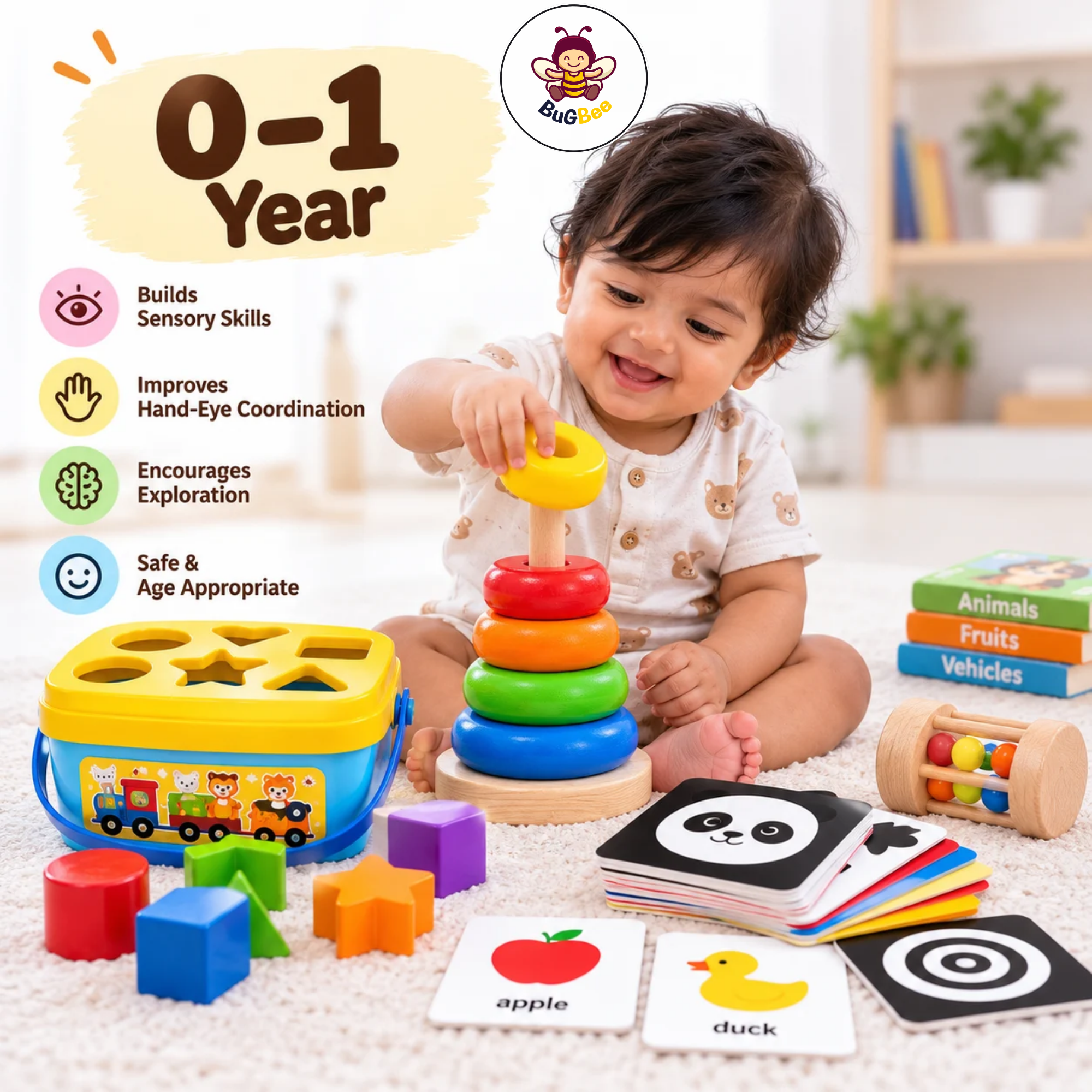
| 0 to 1 year | Reaching, gripping, mouthing, tracking a face or a shape across the room | High contrast cards, a soft rattle, one ring stacker. Nothing with small parts |
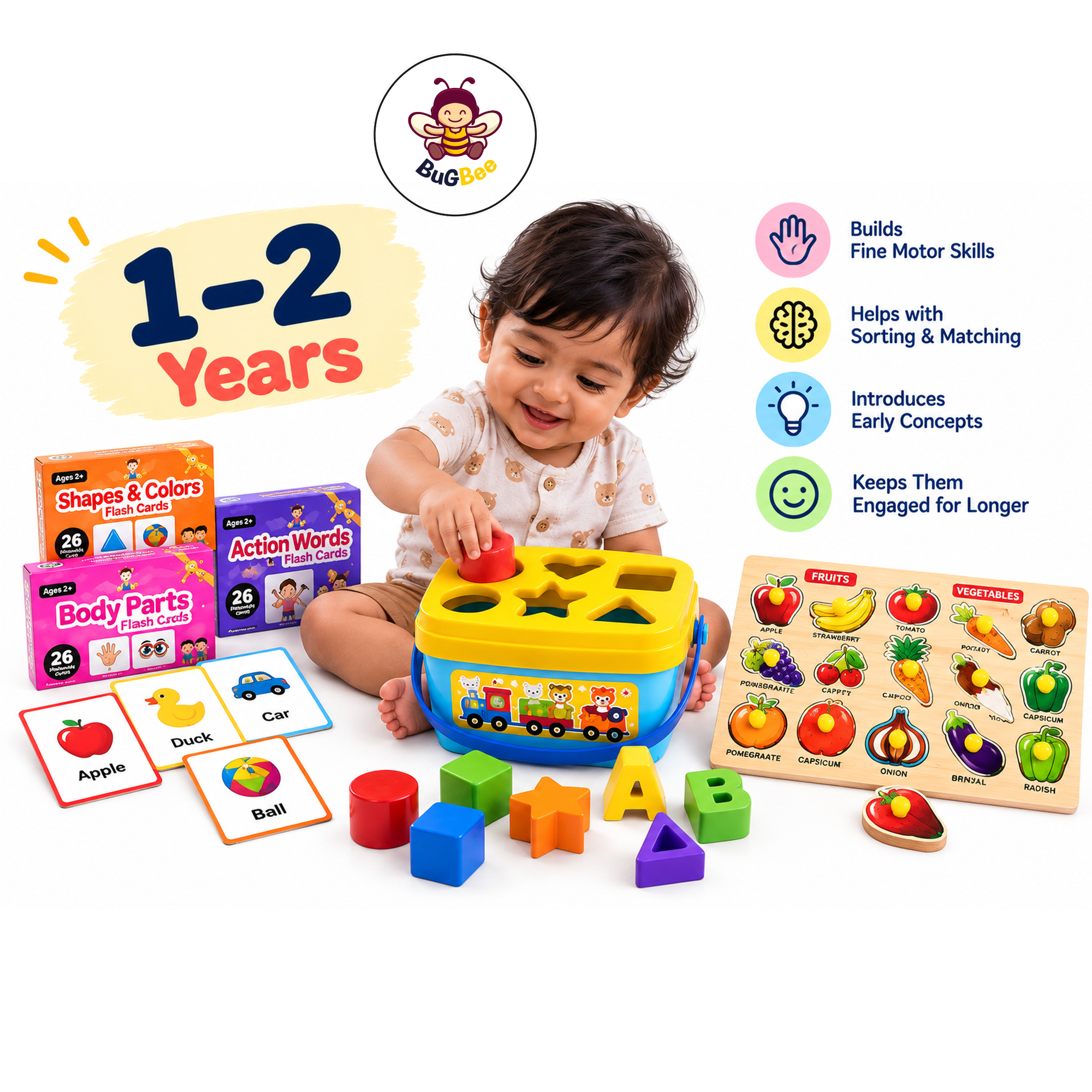
| 1 to 2 years | Lifting pieces out of a hole, stacking, pushing a shape in and turning it until it fits | A knob puzzle with three to five pieces, a first peg board, a five ring stacker |
| 2 to 3 years | Sorting by colour and shape, naming things, copying two step actions, pretend play | Themed peg boards, a six to twelve piece jumbo puzzle, a first doctor kit or kitchen set |
| 3 to 4 years | Following a sequence, holding a crayon properly, retelling a story, taking turns badly | Alphabet and number boards, a 24 to 30 piece jigsaw, a tracing board |
| 4 to 5 years | Planning something before doing it, counting with meaning, losing a game without leaving | Building blocks, a strategy game, counting cards, first non fiction cards |
| 5 to 6 years | Reading simple words, doing sums in their head, wanting to be good at things | Word and number games, a 54 piece tower or big jigsaw, map and body puzzles |
Two notes on that table. The ages are not promises. A child who walks early will usually sort early too, and a child who talks late is often ahead at puzzles. Compare your child with themselves last month, not with the child next door. And notice that nothing in the last two columns is expensive. The shelf that works at every one of these ages is made of ordinary wooden things, and it stays useful because the pieces can be used more than one way.
How to Read an Age Label
Every box in the shop carries a number, and almost every parent reads it as a difficulty rating. It is not one. That single misunderstanding causes more wrong purchases than price does.
The number is a safety claim, not a difficulty guide
When a toy says 3 years and up, it means it contains small parts that a child under three could choke on. It does not mean a clever two year old cannot manage it, and it does not mean a six year old will find it interesting. The label is a warning about parts, written for the youngest child who could reasonably be handed the box.
| The label says | What it actually means |
|---|---|
| 0 to 6 months | No loose parts at all. Designed to be looked at, held and mouthed |
| 6 to 12 months | Can be grasped and shaken. Still nothing that fits inside a toilet roll tube |
| 12 months and up | Pieces large enough that the whole piece cannot be swallowed. Knobs and big shapes |
| 3 years and up | Small parts are now present. This is the number to respect if there is a younger child at home |
| 6 years and up | Small parts plus parts that need force to click. A choking and pinching warning at once |
The practical rule that follows from this: if you have a two year old and a five year old in the same house, the label on the five year old's toy is the one that protects the two year old. Buy for the younger child and let the older one play up, and you will not spend the evening checking the floor. We go through this in far more detail in our guide to what toy age labels really mean.
Toys for 1 Year Olds
This is the age we sell the most of, and the one where parents arrive most confused, usually carrying a phone with a list of forty items on it. So let us start with the awkward part. If you have been searching for toys for 1 year old boy rather than just toys for a one year old, the honest answer is that the boy or girl part makes almost no difference at this age. What changes the choice is not gender. It is whether your child is still mouthing everything, and whether they can already get a piece out of a hole. Those two things decide the purchase.
A one year old is a scientist with no lab rules. Everything goes in the mouth, everything gets dropped to see what happens, and nothing gets played with the way the box suggests. So the best toys for 1 year old children are the ones that survive being tested: solid wood, rounded corners, no parts that can come loose, and paint in a colour that will not wear off in a month. Chunky pieces also matter for a quieter reason. A piece that a small hand can grip without an adult adjusting the grip is a piece the child will practise with on their own.
What a one year old can do
Watch one for ten minutes and you will see most of the following, and each one points at a specific kind of toy.
| What you will see | The toy that matches |
|---|---|
| Takes a lid off, puts things in a box, empties it again | A shape sorter with a removable lid, or any board with a lift out piece |
| Holds a piece in one hand and turns it until it fits | A knob puzzle. One piece, one hole, one correct answer |
| Drops things over the side of the cot, repeatedly, watching you fetch | A ball, and your patience. This is not naughtiness, it is an experiment |
| Points at things and waits for you to name them | High contrast cards and first picture cards. Naming is the whole game |
| Copies you clapping, waving, banging a spoon on a table | A xylophone or a drum. Something that makes a sound when hit, not when pushed |
| Puts one thing on top of another and knocks it down | A ring stacker with fat rings. Five rings is plenty |
Put those together and the first shelf for a one year old looks like this. A five ring stacker, which teaches order and size without needing language. A knob puzzle in a theme your child already points at, and at this age that is almost always food or animals. A set of high contrast cards if your child is on the younger side of the band, because black and white patterns are trackable before colour is interesting. A xylophone or a simple rattle. A ball. That is a complete shelf, and it is more than most children use.
If you want to see what we actually keep, our baby toys range is the entry shelf, and the first peg boards are on the peg boards page. The ring stacker we get asked for most is the rocking five ring stacker, because the base rocks and that small wobble is what makes a child try again instead of giving up.
Around fifteen months
Anyone searching for toys for 15 month old children has landed in the awkward middle of the band, and it is a real gap. At fifteen months most children have moved past rattles but cannot yet use a board with ten holes. What works is one step up from a stacker: a two piece inset puzzle, a posting box, and a first knob puzzle with exactly three pieces. If you skip this step and hand over a ten piece board because the box says 12 months and up, the child will tip the pieces onto the floor and walk away, and you will conclude that they do not like puzzles. They liked puzzles. The board was simply too hard.
Parents also type the age in a hurry, so toys for 1yr old and best toys for 1yr old land on the same page as the spelled out version, and so does 1yr old toys. All four phrasings are the same question, and the answer does not change with the spelling. What we would say to all of them: buy two things, not ten, and make one of them a board with fewer than five pieces.
One more search deserves a straight answer. Cool toys for 1 year olds is how a lot of parents and a lot of aunts and uncles phrase it, and the word cool is doing something specific here. At this age, cool almost always means it lights up and makes noise. That is what will get the biggest reaction on the first evening and the smallest amount of play in the second month, because the toy is doing the interesting part and the child is watching. The genuinely cool purchase at one year is the one where the child does the work. Hold a knob puzzle and a light up phone side by side and you will see it: the phone entertains for a week, the puzzle gets played with until the child is three.
What to skip at one
Four things, and none of them are bad products, which is exactly why parents buy them. Skip a walker that moves on wheels, because it teaches a child to move before they can stop and it is the one item paediatricians across the world have been consistent about for years. Skip anything with a screen at this age, and skip the electronic learning pads that ask a one year old to press a letter and reward them with a beep. Skip alphabet boards too, not because they are unsafe, but because the useful year for those is three, and buying early means the box sits unopened until you have forgotten where you put it. And skip the giant sets. A hundred piece bargain bucket is a hundred pieces of tidying for a child who can currently use five.
Toys for 2 Year Olds
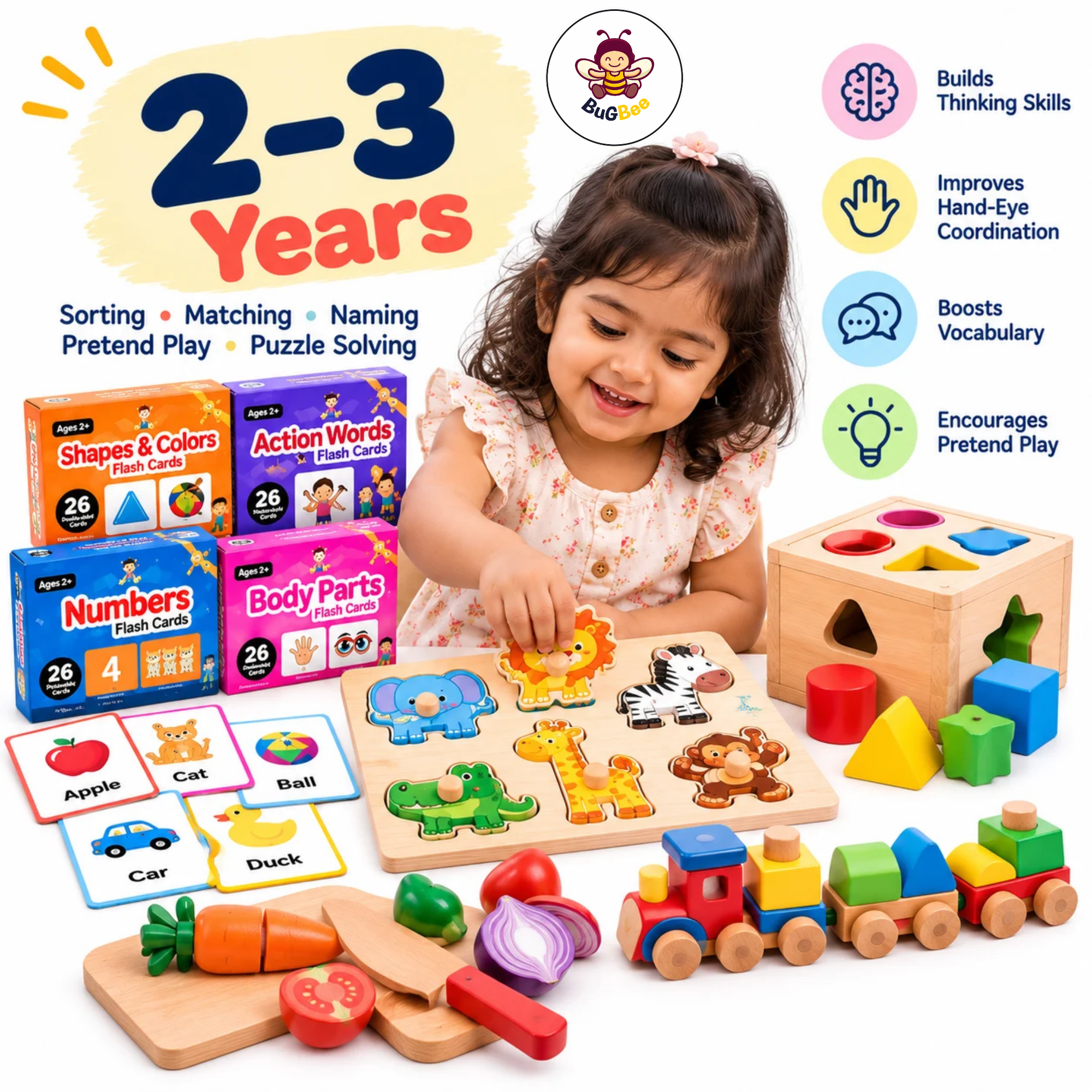
The difference between one and two is mostly a difference in intention. A one year old explores. A two year old has opinions, wants to do it themselves, and gets furious when you help. That is why the toys for 2 year olds shelf changes shape rather than just getting harder. Two is the year of sorting, naming and copying what adults do.
Themed peg boards become the centre of the shelf, because a two year old can now work through a board in a theme they already love, and can talk while doing it. Jumbo puzzles with six to twelve pieces come next, and the honest test is the picture: a two year old gets more from a puzzle with three big animals than thirty small ones. Pretend play arrives properly here, and this is where a doctor kit or a kitchen set earns its floor space, because it is the first toy that makes a child use words to run a scene.
Two things we say to almost every parent at this age. First, buy the mixed boards rather than five of the same kind, and the reason is variety of grip. Second, expect destruction, not care. At two, a puzzle gets finished once and then the pieces get used as food for a teddy. That is not misuse. That is the toy doing a second job. Our combined peg puzzle combo with shapes, body parts, fruits and vegetables exists for exactly that reason, and the jungle animals puzzle is the one we hand over when a parent says their child likes animals and nothing else.
If you are weighing up a board against a sorting tower, our comparison of a shape sorter against a puzzle settles it in two minutes. The short version: a sorter teaches shape alone, a puzzle teaches shape plus placement plus a finished result.
Toys for 3 Year Olds
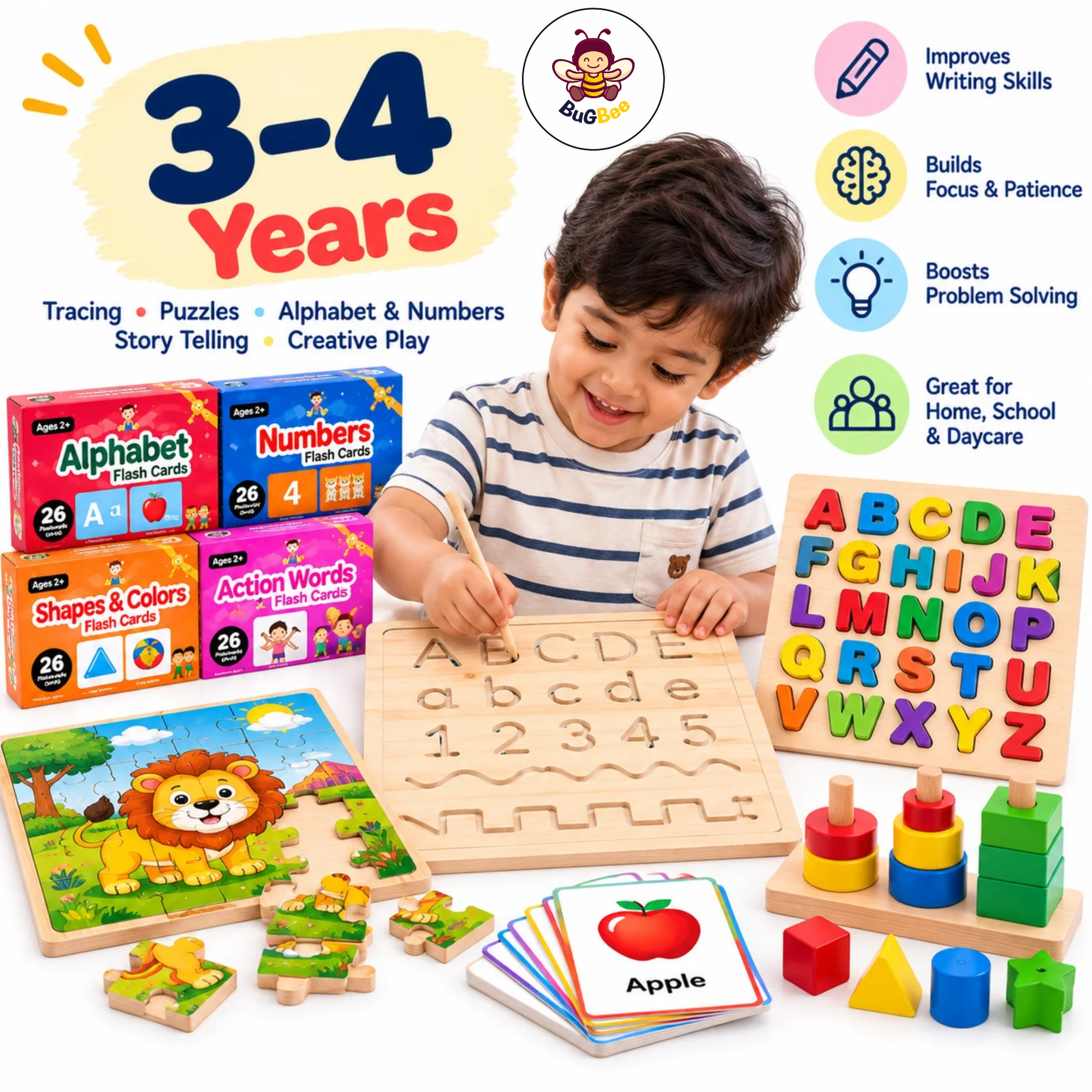
Three is the year the words alphabet and number start appearing on your search history, and the year parents start worrying about school. Here is the calm version. When we talk about educational toys for 3 year olds, we do not mean toys that teach reading. We mean toys where the child gets an answer back without an adult having to say correct or no. A recessed board does that. A jigsaw does that. A card set where the picture gives the answer does that. That feedback loop, and not the letters themselves, is what makes a toy educational.
So educational toys for three year olds in our shop means four families of things. Alphabet and number boards, which at this age are about matching a shape to a hole and hearing the sound said out loud, not about reading. Jigsaws of twenty four to thirty pieces, where the jump from twelve to thirty is the real milestone and usually happens in one afternoon. Tracing and writing preparation boards, which build the hand position before the letters matter. And pretend play that has a sequence in it, like a doctor kit, where the child has to do things in an order.
Learning toys for three year olds
The phrase learning toys for three year olds usually leads to a shelf of plastic tablets that beep. We would point you somewhere else. What a three year old learns from is repetition with a physical result, so the useful buys are the ones that can be done badly, then slightly better, then properly, with no adult narrating. Four examples from our shelf, and note how ordinary they are. The numbers and shapes wooden puzzle, where the numeral has to be dropped into its own recess. The ABC matching round puzzle, which is a circle rather than a rectangle and that small change makes it harder. The tracing and writing board, which is the only item on this list a four year old will still use daily. And the magnetic busy board, which is what we recommend for travel and for the restaurant hour, because there are no loose pieces to lose under a table.
Parents type this age in shorthand constantly, so 3yr old learning toys and great learning toys for 3 year olds land in the same place as the full phrase, and so does a search for the best educational toys for three year olds. The answer does not change: one board, one jigsaw, one tracing item, one pretence set. Four things that get used beat twelve that get stacked.
School readiness, honestly
The queries we see most from Bangalore parents at this age are about getting a three year old ready for preschool, and there is a lot of unnecessary anxiety in that phrase. Preschool teachers are not looking for a child who knows the alphabet. They are looking for a child who can sit for ten minutes, follow a two step instruction, ask for water, and manage their own shoes. Toys help with exactly two of those: sitting with something until it is finished, which is what a jigsaw teaches, and following a sequence, which is what a board or a simple game teaches. The rest is routine at home, and no toy on any shelf will substitute for it. Our flash cards guide covers the card side of this in detail if you want the reading preparation angle.
Toys for 4, 5 and 6 Year Olds
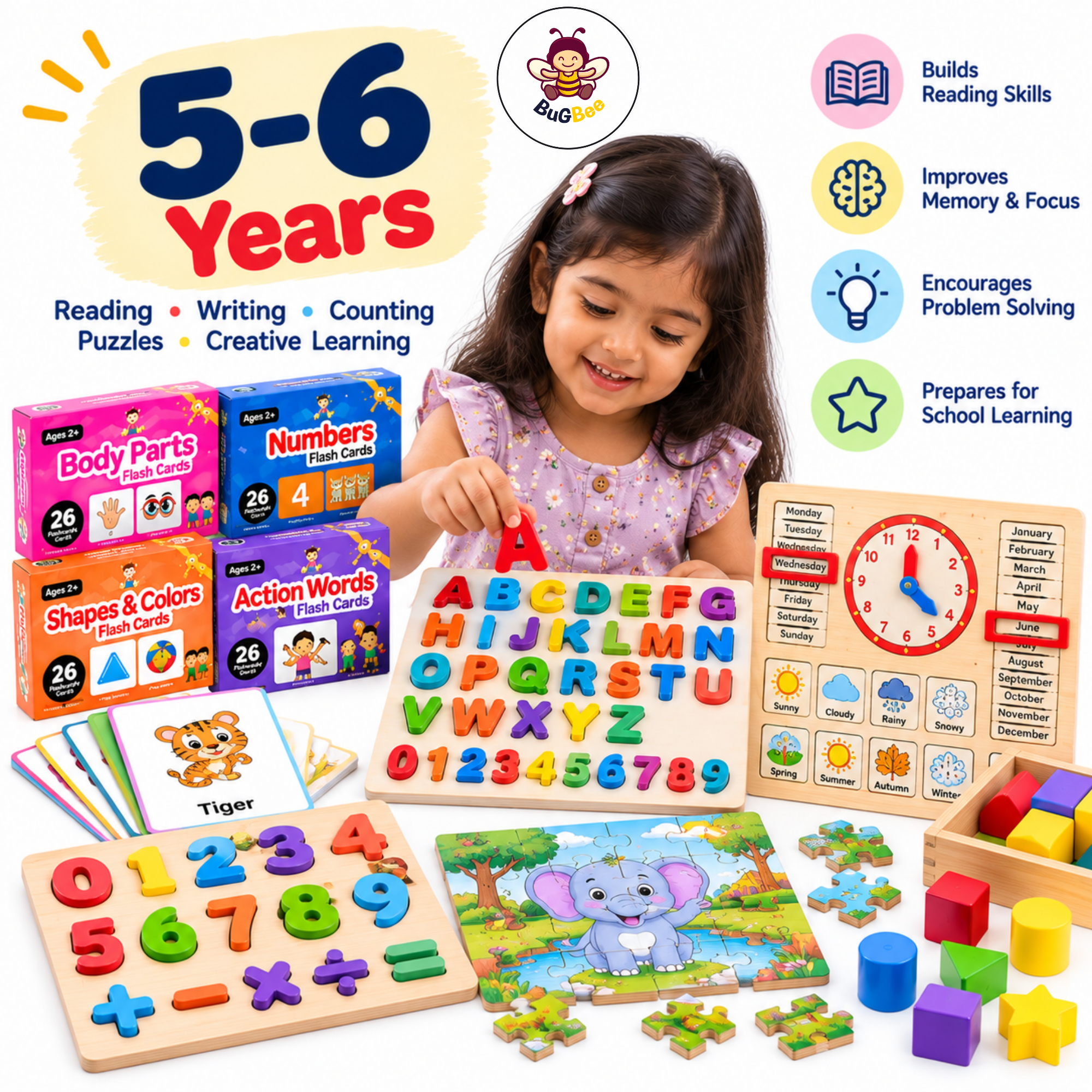
From four onwards the toys change from things you handle into things you plan with, and the parent's role changes from playing partner to opponent. That is not a small switch, and it is where a lot of families stop buying, usually because the child has discovered a screen. The response that works is not a ban. It is offering something where the child is trying to beat a real person who is sitting in front of them.
At four and five, building sets and construction blocks take over, and the useful ones are open ended rather than model specific, because a set that builds one spaceship gets built once. Strategy games arrive here, and this is the age where a child learns to lose without leaving the table, which is worth more than the game. Counting cards and first non fiction cards work well because this age loves collecting facts. Our interlocking star blocks and the wooden tic tac toe board cover both halves of that, and the STEM toys guide goes further into the building side.
At five and six, the shelf widens rather than gets harder. Word games and number games start working, because reading is now real enough to play with. Bigger jigsaws become genuinely absorbing, and the 54 piece tumbling tower is a family game at this age rather than a solo one. Puzzles about the world start landing properly too, because a five year old can hold a fact and a shape at the same time. The human body puzzle, the India map puzzle and the numbers 1 to 100 cards are the ones that get bought twice, because the first set goes to school.
Two player games, and why they matter
A game is the only toy on this list where the child has to wait for another person, and that waiting is the skill. Tic tac toe is the first one that works, because a three move game is short enough to sit through and simple enough that a five year old will beat a distracted adult. Expect losing to be a problem for the first month and a non event by the second. If your child cries at every loss, shorten the game rather than avoiding it.
One thing worth saying to parents of five and six year olds. This is the age where a child will tell you a toy is for babies, and they are sometimes right. Do not buy the next band up out of pride. Buy the item they will actually use, even if the box suggests it is for younger children. The most used thing in our shop among six year olds is a magnetic drawing board, which is on the shelf from age three.
How Many Toys a One Year Old Actually Needs
Fewer than you think, and this is the single most useful thing we tell parents. A one year old with six things they can reach plays longer than a one year old with forty things in a basket, because the forty thing version is really a search problem. They pick one up, put it down, and spend the rest of the time looking for the next one. The six thing version means the child has to go back to something, and going back is where practice happens.
So rotate rather than buy. Put half the shelf away in a cupboard, and swap it out when interest drops, which at one year is roughly every two or three weeks. The toy that was boring in September is a new toy in October, and this costs nothing. If you want the mechanism explained properly, our post on toy rotation for toddlers covers it, and one toy, thirty ways to play shows how much a single board can be stretched before you need another one.
There is a second reason to keep the shelf small, and it is not about money. Children who always have something new to reach for practise shallower. A child who has to make the same five things interesting develops the habit of inventing a use for something, and that habit is what people later call imagination. It starts with an empty shelf, not a full one.
Gifts and Toys Are Two Different Questions
This is the section we get asked about most at the counter, and it is why so many people search for gifts for 1 year old in the same week they search for toys. A toy is bought by a parent for daily use. A gift is bought by somebody who will not be there next week, usually for an occasion, often in a hurry, and always with the knowledge that the child already has plenty. Those are different jobs and they point at different items.
When people ask us for best gifts for 1 year old children, we start by asking who is giving it. A grandparent buying something memorable wants an object, not a consumable. A colleague invited to a birthday needs something that packs and travels. An older sibling wants something they can be seen helping with. That single question changes the answer more than the budget does, which is why great gifts for 1 year olds is not one list but three.
| Age | The safe gift | The gift that gets remembered |
|---|---|---|
| 1 year | A high contrast card set, because it is safe, useful and cheap to post | A five ring stacker or a first knob puzzle in the child's favourite theme |
| 2 years | A jumbo puzzle with six to twelve pieces | A themed peg board, chosen by asking the parent what the child points at |
| 3 years | An alphabet or number board, which every three year old can use | A tracing board, because it is still on the table a year later |
| 4 to 5 years | Counting or first facts cards | A building set or a two player game the child can beat an adult at |
| 6 years | A big jigsaw in a theme they collect | A map or body puzzle that makes them the expert at the table |
Then there is the birthday question, and 1 year old birthday gifts is one of the most searched phrasings we see from Bangalore families. A first birthday has one feature that no other birthday has: the child will not remember it and the parents will remember everything. So the gift that lands is the one the parents will be grateful for in three months, which almost always means something the child can use at home rather than something that needs a shelf. Practical, wooden, and one item rather than a hamper, is the reliable answer.
If the occasion is a party and you are buying for a whole set of children rather than one, that is a different job again, and our return gifts guide covers the quantities and the packing. If you are buying for a larger group and want it by the carton, the wholesale toys guide for Bangalore explains how the tiers work. Our best seller range is where most gift buyers end up when they have no idea what to choose.
Montessori at One, Without the Marketing
A lot of parents arrive looking for montessori toys for 1 year old children, and the honest thing to say is that Montessori is a way of setting up a room, not a range of products. Any wooden knob puzzle is a Montessori material in the sense that matters, and any plastic toy can be used in a Montessori way. What the method actually asks for at this age is simple, and none of it is expensive. Things at the child's height, so they can choose without asking. Real objects rather than pretend ones wherever it is safe. One activity out at a time. And an adult who does not take over.
If you want to buy against that thinking rather than the label, look for open ended items and for anything with a control of error, which means the toy itself shows the child when it is wrong. A recessed board does that. A stacker does that, because the rings will not sit in the wrong order. Our Montessori peg boards range is arranged by that idea, and the open ended vegetable knob puzzle is the clearest example on the shelf.
Two warnings. First, do not buy the whole method at once. Second, do not pay a premium for the word. The word itself is not protected, and there is no shortage of ordinary toys with the label on the box and nothing behind it. Judge the item: thickness, finish, and whether the child can use it without you. If a one year old can do it alone, it is the right buy, whatever is printed on the packaging.
Wooden, Plastic or Card
We sell wooden toys, so read this part knowing that, and we will try to be fair anyway. Wooden wins on three things: it survives a drop, it feels warm rather than disposable, and it holds its value on a second hand shelf. It loses on two: it costs more at the start, and a wooden piece dropped on a tile floor makes a noise that plastic does not. Plastic wins on price, weight and the fact that it can be washed. Card wins on nothing except being light to post, and card sets do get chewed at one year, which is a real cost.
| If this matters most | Buy this |
|---|---|
| It must last through two children | Wooden, solid rather than ply, with sealed edges |
| It must survive a bath or a hospital bag | Plastic, and this is a genuine reason to choose it |
| It must go in a bag and stay light | Card, in a box, and accept that it will not last forever |
| It must be quiet | Felt or fabric over wood. There is no trick that makes wood silent on tiles |
Whichever you choose, clean it properly, because at one year every toy spends time in a mouth. Our guide to cleaning and caring for wooden toys covers what to use and what to keep away from painted wood, and the wooden toys guide for Bangalore goes through types and what they cost if you want the long version.
Safety by Age
Safety is the only part of this article where the age genuinely changes the rule, so it is worth one short table. Toys sold in India are covered by a quality control order that makes certification mandatory for items within its scope, with standards covering mechanical hazards, flammability and the migration of certain elements. In plain language, the box should carry a certification mark, an age label, and the manufacturer's name and address.
| Age | The risk that matters |
|---|---|
| 0 to 1 year | Anything that fits entirely inside a toilet roll tube. Also cords, ribbons and long strings |
| 1 to 2 years | Parts that loosen over time. Check every knob and peg by pulling hard, once a month |
| 2 to 3 years | Painted surfaces and chipping. Flaking paint is the reason to prefer sealed, water based finishes |
| 3 years and up | Small parts arriving with older siblings. The younger child finds them, not the older one |
| All ages | Tipping. A shelf that a child can pull down on themselves is a bigger risk than any toy |
The three checks in the shop
Before you pay, do three things, and they take under a minute. Pull the knob or peg and see whether it holds. Run a finger along the edge of the board, and if it catches, put it back. Tip the board and look at the underside, because a board that is sealed underneath will not swell when it gets wiped. That is the whole test, and it tells you more than any claim on the packaging. Our toy safety checklist for toddlers turns this into a printable list you can carry to any shop, including ours.
What We Do Not Stock, Said Plainly
Age guides usually end with a recommendation for something the shop does not actually sell, and we would rather be straight with you. Our range runs from about six months to six or seven years, with two real gaps.
We do not keep baby gear, which means no walkers, no bouncers, no high chairs and no ride ons. If your one year old needs something to move around in, that is a different kind of shop and we will say so rather than sell you a puzzle instead. And our range thins out above six, so if you are looking for a seven or eight year old, ask us first rather than making the trip, because we may only have two or three things that would genuinely interest them.
Within our range, we are also honest about the age bands that sell least, because they are not the same as the bands that matter least. The 0 to 1 shelf is small and always will be, because there is a limit to what a baby can use. We would rather tell you that than pad the shelf with things nobody needs.
The one thing we will always do is tell you when a cheaper item will do the same job. A one year old does not need three boards. If you come in planning to buy a full set, expect us to talk you down to one, and expect us to be right.
Where to See the Whole Range in Bengaluru
Thickness, weight and finish are the three things a photograph cannot carry, and they are the three things that decide whether a one year old can use a board alone. So come and handle them. We keep every age band on the shelf, and you can compare a three piece board against a ten piece board in your own two hands before choosing.
| Address | 1st Floor, 205/A, 55th Cross, Opposite ABC Park, 4th Block, Rajajinagar, Bengaluru, Karnataka 560010 |
| Phone / WhatsApp | 99860 03534 |
| Opening hours | Monday to Sunday, 10:00am to 8:00pm |
| Delivery | Across Bengaluru, and online across India |
| If you are travelling | Message us the age before you come and we will keep two or three options aside for you to compare |
Frequently Asked Questions
Straight answers, including the ones where the honest answer is no.
What are the best educational toys for 1 year old children?
A five ring stacker, a knob puzzle with three to five pieces, a set of high contrast cards if your child is under eighteen months, a xylophone and a ball. That is a complete shelf. The test is not how clever the toy is, it is whether your child can use it without you adjusting their hand.
Do boys and girls need different toys at one year?
Not in any way that changes the purchase. At one year the variables that matter are whether your child is still mouthing everything and whether they can already lift a piece out of a hole. Choose on that, and choose a theme they already point at, whether that is animals, vehicles or food.
What is a good first birthday gift?
One useful item rather than a hamper. A ring stacker or a first knob puzzle is used daily for a year, and the parents will be grateful for it long after the party. A first birthday is remembered by the adults, so buy the thing the adults will still be happy about in three months.
How many toys should a one year old have?
Five or six within reach, and the rest in a cupboard. A child with six things plays longer than a child with forty, because forty is a search problem. Rotate the hidden half back in every two or three weeks and the shelf renews itself at no cost at all.
Should I buy an alphabet board for a one year old?
No, and we will talk you out of it if you ask. The useful year for an alphabet board is three, when the child can match a shape to a recess and start connecting a letter to a sound. Bought at one, a board with twenty six pieces is twenty six pieces of tidying.
My child is fifteen months old. Which size puzzle?
Two or three pieces, in a theme they already recognise, and preferably a two piece inset board before a full puzzle. Fifteen months is the middle of the band and it is the most common place to overshoot. If a board takes more than a minute to finish, it is too hard and it will be abandoned.
Are magnetic toys safe for a one year old?
Small loose magnets on their own are genuinely dangerous if swallowed, and that is why a magnetic board with beads sealed inside a case is the safe format. We sell that format. If a magnet can come out of the toy, it does not belong in a house with a one year old.
What should I buy a three year old for school preparation?
Preschool staff look for a child who can sit for ten minutes, follow a simple instruction and manage their own things. Toys help with the first two. A twenty four to thirty piece jigsaw teaches sitting until it is finished, and a board or a two player game teaches taking turns. The rest is routine at home.
Do you stock toys for children above six?
Our range thins out above six. We have a few bigger jigsaws, strategy games and puzzles that a seven year old will still enjoy, but we are not the right shop for older children. Message us the age and we will tell you honestly whether the trip is worth it.
Is a wooden toy worth the extra money for a one year old?
It survives a drop, it wipes clean, and it passes to a second child, which is where the extra money comes back. The honest downside is noise on tile floors and a higher entry price. Plastic is the better choice if the toy lives in a bathroom bag. Card is fine, and it will get chewed.
What does montessori mean on a toy label?
Nothing enforceable. Montessori is a way of arranging a room and of letting a child work without interruption, not a product standard, so no toy can really be certified as Montessori. What is useful is to look for open ended items that show the child when they have got it wrong, which a stacker and a recessed board both do.
Can I see and compare the age ranges in the shop?
Yes, and for a first toy we would prefer you did. Every age band is on the shelf in Rajajinagar and you can hold a two piece board and a thirty piece jigsaw next to each other. Tell us the age on WhatsApp before you come and we will keep two or three options out.
Do you sell in bulk for a playschool?
Yes, by the carton, and mixed cartons across age bands are fine. Send us the number of classrooms and the age group in each one. Classroom orders work best when they are quoted age band by age band rather than as one long list, because a two year old room and a four year old room should not get the same items.
Tell Us the Age and We Will Pick the Toy
Send us your child's age, what they currently play with, and what you already own. We will tell you which one thing to buy next. One WhatsApp message, no obligation, and we will happily tell you that the answer is nothing yet.
Buy one thing, not the whole shelf.
Whatever the age, the toy that gets used is the one the child can finish on their own. Start there, add the next one only when the first one stops being interesting, and you will spend less and get more play out of every rupee.
More from BugBee Toys
- Wooden Puzzles and Peg Boards for Kids: Types, Ages and What to Buy
- Flashcards for Kids: Which Set, What Age and How to Use Them
- Wooden Toys in Bangalore: Where to Buy and What They Cost
- Wholesale Toys in Bangalore: MOQ, Price Breaks and How to Order
- Return Gift Ideas for Birthday, Wedding and Naming Ceremony
- What Toy Age Labels Really Mean
- Toy Safety for Toddlers: A Parent's Checklist
- Toy Rotation for Toddlers
- One Toy, Thirty Ways to Play
- Toys for Independent Play
- How to Clean and Care for Wooden Toys
- Fine Motor Skills in Toddlers
- Shop Development Toys
- Shop Montessori Peg Boards
- Visit the BugBee Toy Shop in Rajajinagar
- Contact Us for Orders or Shipping